Rethinking Africa is a forward looking blog dedicated to the exchange of innovative thinking on issues affecting the advancement of African peoples wherever they are. We provide rigorous and insightful analyses on the issues affecting Africans and their vision of the world.
Freedom is human right. This right is inalienable. Freedom could, conceivably, mean different things to different people. In this epoch of febrile quest for freedom from the collapsing and collapsed “Berlin-states” of subjugation implanted in Africa, any African peoples who, for instance, wishes to chart a future based on the precepts of their forebears in the 12th century Contemporary Era (CE) or even way back, to, say, 8th century Before Contemporary Era (BCE), has the right to pursue this goal. Equally, any African peoples who believes that their aspirations lie in working through the immense challenges of the 21st century CE and projecting targets of creativity and transformations subsequently, must exercise this right. As everyone knows, the “Berlin-states”
that Europe created in Africa, in the aftermath of that infamous Berlin conference on
conquest (November 1884-February 1885), cannot
lead Africans to the reconstructive changes they deeply yearn for after the
tragic history of centuries of occupation. Such change was and never is the
mission of these states but instruments to expropriate
and despoilAfrica by the conquest.As in Berlin, thankfully, states are not a gift from the gods but relationships painstakingly formulated
and constructed by groups of human beings here on earth to pursue aspirations and
interests envisioned by these same human beings. Civilisation
To achieve the goal(s) of any of these stipulated paths does not therefore require anyone to embark on murdering someone else or have themselves murdered in the process. Since Nigeria’s launch of the Igbo genocide, 29 May 1966-12 January 1970, fifteen million Africans have been murdered in genocides and other wars in Africa.
For the future survival of the African humanity, let no more die for the path to their envisaged civilisation or, in other words, howsoever this civilisation a people chooses is construed. It, surely, can be attained and sustained without committing a crime, particularly genocide – heinous crime against humanity.
(Sonny Rollins Trio, “The freedom suite” [personnel: Rollins, tenor saxophone; Oscar Pettiford, bass; Max Roach, drums; recorded: Riverside Records, New York, US, 7 March 1958])
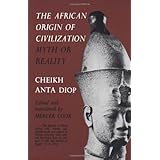
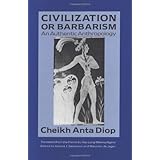
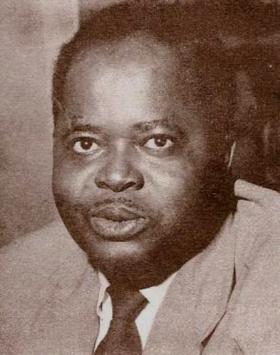
Mathematician, physicist, linguist, anthropologist, philosopher, historian and Egyptologist, demonstrates, most copiously in his near-40 years of research (beginning in the 1940s) and publication of papers and books, especially Nations Nègres et Culture, 1955 (English translation: African Origin of Civilization, 1974), L’unité culturelle de l’Afrique noire, 1959 (English: The Cultural Unity of Black Africa: The Domains of Matriarchy & Patriarchy in Classical Antiquity, 1989) and Civilisation ou barbarie, 1981 (English: Civilization or Barbarism, 1991), that Kemet, “ancient Egypt”, is an African civilisation and that African peoples are the indisputable heirs to its heritage
Cheikh Anta Diop, African Origin of Civilization (Chicago: Chicago Review, 1989), 336 pp, US$11.30/£10.73 pbk
Cheikh Anta Diop, Civilization or Barbarism (Chicago: Lawrence Hill, 1991), 464 pp, US$15.64/£15.49 pbk For an assessment of Cheikh Anta Diop’s salient contribution to the scholarship of the African World, see Herbert Ekwe-Ekwe, Readings from Reading: Essays on African Politics, Genocide, Literature (Dakar & Reading: African Renaissance, 2011), pp.7-11. Twitter @HerbertEkweEkwe
Celebrated
cultural and literary critic and executive editor of The Guardian, Lagos, Nigeria, beginning February 1983, when he
embarks on the radical transformation of
the standard and range of journalism not
seen in southwestcentral Africa in 50 years – since the African-centred revolution
of the 1930s in the profession spearheaded by Nnamdi Azikiwe, political
scientist, journalist and architect ofthe restoration-of-independence movement for the peoples in Nigeria and
south Cameroon from the British conquest and occupation
(27
December 1960, explodes bomb at Regganne, west Algeria)
In
flagrant disregard for the lives of African peoples and their environment, and
those of future generations, France carries out an atomic bomb “test” over the
Sahara Desert, the third in the year (earlier explosions had been conducted in
February and April) – exploded bomb has plutonium with yield of 10,000-14,000
TNT, equivalent to one-half power of atomic bomb the United States air force
dropped on Hiroshima, Japan, 6 August 1945
Physician and irrepressible advocate of harnessing Africa’s vast agricultural resource potential as launch base to embark on far-reaching societal transformation, head of pre-military junta 15 January 1966 east region Nigeria government, then home to Africa’s most resourceful and dynamic economy en route to emerging as a major manufacturing and industrial power, in its own right, but for the catastrophe of the Igbo genocide, 29 May 1966-12 January, when Nigeria and its allies, principally Britain, murder 3.1 million Igbo people in this foundational genocide of post-(European)conquest Africa Twitter @HerbertEkweEkwe
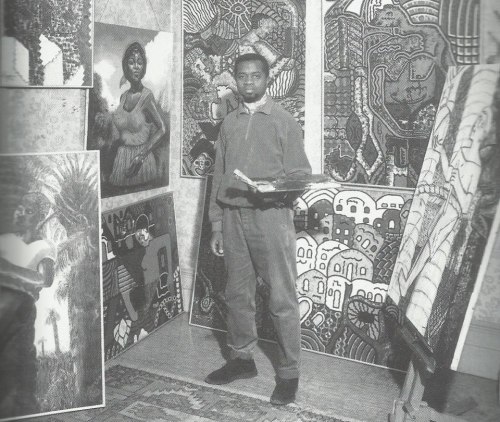
One of the African World’s multifaceted and most distinguished painters, his evocative, landmark Exodus (1970) captures the devastating aftermath of phase-I of the Igbo genocide, perpetrated by Nigeria, 29 May 1966-4 January 1967, as nearly 2 million Igbo who survive this initial slaughter in the north region and elsewhere in the country stream home before the subsequent phases (II & III: 5 January 1967-5 July 1967, 6 July 1967-12 January 1970 respectively) when the genocidists blockade and invade Igboland itself, Biafra, murdering a total of 3.1 million Igbo by 12 January 1970 Twitter @HerbertEkweEkwe
(Born 24
December 1944, Laurinburg, North Carolina, US)
Astoundingly
innovative trumpeter, fluguelhornist, clarinettist and composer, collaborates expansively in groundbreaking recordings with fellow leading innovative musicians
of the age including multiinstrumentalist Eric Dolphy, trumpeter Freddie
Hubbard, vibists Bobby Hutcherfield and Lionel Hampton, alto saxophonist
Jackie McLean, tenor saxophonists Joe Henderson, Dexter Gordon, Hank Mobley, Charlie Rouse and
Pharoah Sanders, pianists Andrew Hill, Mal Waldron and Horace Silver and
drummers Max Roach, Art Blakey and Louis
Hayes
(Mal
Waldron Quintet, “The seagulls of Kristiansund” [personnel: Waldron, piano;
Woody Shaw, trumpet; Charlie Rouse,
tenor saxophone; Reggie Workman, bass; Ed
Blackwell, drums; recorded: live, Village Vanguard, New York,
16 September 1986])
Herbert Ekwe-Ekwe is specialist on the state and on genocide & wars in Africa in the post-1966 epoch – beginning with the Igbo genocide, 29 May 1966-present day, the foundational and most gruesome genocide of post-(European)conquest Africa. 3.1 million Igbo or 25 per cent of this nation’s population were murdered by Nigeria and its allies, principally Britain. Africa and the rest of the world largely stood by and watched as the perpetrators enacted this horror most ruthlessly. The world could have stopped this genocide; the world should have stopped this genocide. This genocide inaugurated Africa’s current age of pestilence. During the period, 12 million additional Africans have been murdered in further genocide in Rwanda (1994), Zaïre/DRCongo (variously, since the late 1990s) and Darfur – west of the Sudan – (since 2004) and in other wars in Africa. African peoples have, presently, no other choice but exit/dismantle the extant genocide-state (the bane of their existence & progress) & construct own nation-centred states that serve their interests. He is author of several books & papers on the subject and his new book is entitled The longest genocide – since 29 May 1966 (2019).