Rethinking Africa is a forward looking blog dedicated to the exchange of innovative thinking on issues affecting the advancement of African peoples wherever they are. We provide rigorous and insightful analyses on the issues affecting Africans and their vision of the world.
AS I show in
the essay in the following link (http://re-thinkingafrica.blogspot.com/2015/05/blog-post_7.html), genocidist Nigeria, in 1999, declared 29
May of the year its “democracy day” as an additional tool in its murderous arsenal
to deny and erase 29 May 1966, day it and co-genocidist state Britain launched the Igbo genocide, from history
and public consciousness. Twenty-nine years earlier, 1970, soon after its end
of phases I-III of the genocide (12 January 1970), murdering 3.1 million Igbo people, the genocidists had abolished
the teaching of history in its schools as the key feature of this denialist project.
Failed mission Two reasons
account for the génocidaires’ abandonment of their 29 May so-called democracy
day on 6 June 2018:
1. The indefatigably resilient tenor of the politics of the
Biafra freedom movement with its heightened, pinpointed focus on the dates of
29May and 30 May (Heroes Day) on the Biafra calendar, particularly
in these last three years of the jihadist Muhammadu Buhari-led regime, has so
saturated the news cycle every month of May since that it makes nonsense of the
denialist theatrics of Nigeria’s 29 May “democracy day”.
2. The génocidaires high command is currently ravaged by a
grave crisis not seen in at least 30 years, exacerbated, pointedly, by the devastatingly
parallel murder campaigns by the jihadist terrorists Fulani militia and Boko Haram (2 of the 5 deadliest terrorist organisations in the world) in Nigeria’s
northcentral, northeast and the eastcentral Benue valley regions. These terrorists are allied more ideologically to the Fulani wing of the genocidist amalgam led by
Buhari. Olusegun Obasanjo, a Yoruba, but a very influential member of the high
command who crucially supported ex-US President Obama and ex-British Prime
Minister Cameron’s imposition of Buhari as head of regime in March 2015, has informed
Buhari that he won’t now endorse a “continuation” of the latter’s regime beyond
March 2019. It was Obasanjo, as head of regime, who had decreed 29 May as “democracy day” back in 1999. Buhari’s abrogation
of 19 years of regime status placed on this date is therefore an embittered response
to Obasanjo’s decision not to back his post-2019 leadership ambitions.
IN yet
another act in these génocidaires’ bizarre enchantment to the theatre of “democracy
day”-declarations, Buhari, just as Obasanjo, has himself decreed 12 June as the latest Nigeria’s “democracy day” – a desperate, cruedly opportunistic attempt by Buhari to appeal to the wider Yoruba population for support for 2019
as 12 June itself is a day of remembrance in Yoruba history.
(Jaki Byard Trio, “Trendsition
zildjian”[personnel: Byard,
piano; David
Izenzon, bass; Elvin
Jones, drums; recorded: Prestige, New York, US, 31 October 1967])
(Amber Rudd ... British home secretary whose department/ministry is responsible for the African peoples’ deportation)
Herbert Ekwe-Ekwe
MANY African
commentators in the diaspora and at home have joined other critics elsewhere in
the world to condemn the current British government’s outrageous expulsion of
some of its citizens of African descent to the Caribbean. The criticisms are rightly
commendable.
Yet silence…
IT IS however most noticeable that a number of these commentators have been
conspicuously silent when African peoples in African-run states are deported similarly
or subjected to even worse treatment by their hosts as the following examples highlight:
1. In Lagos,
west Nigeria, the regional regime has over the years deported scores of Igbo
people to Biafra. In 2015, the king or oba
of Lagos issued a royal edict to murder Igbo people if they did not vote for
the king’s own preferred candidate for a senior political regional office.
2. In South
Africa, thousands of African émigrés from southern, east and west Africa have
been expelled in recent years by the state. Hundreds of these immigrants have
been murdered in the country during the period and their homes and businesses destroyed
by organised groups often linked to state officials.
3. Since the March
2015 imposition of Muhammadu Buhari, the genocidist islamist jihadist, as head
of regime in Nigeria by ex-US President Obama and ex-British Prime Minister
Cameron, the Buhari regime’s military and its adjunct Fulani militia, one of
the world’s five deadliest terrorist organisations, have murdered 3000 Igbo people
across Biafra in what has been one of the bloodiest track of phase IV of the ongoing
Igbo genocide. These murders have continued unabated. Moral rectitude AFRICAN peoples’
lives matter. This must surely be the case wheresoever African peoples live: Biafra,
Sénégal, Tanzania, Botswana, United States
of America, South Africa, Barbados, Kenya, India, Côte d’Ivoire, Guyana, Canada, Britain, Surinam, St
Lucia, Jamaica, Trinidad & Tobago, Brazil, France, Ghana, Finland, Uganda… Few now doubt that African commentators and others in that prominent professional
grouping stand to forfeit any moral rectitude if they restrict their quest to
uphold African lives’ interests usually in geographical spaces marked outside
Africa but exercise a predictable stone-walled silence when these same
interests are assaulted, quite often more viciously, inside Africa.
(John Coltrane & Don Cherry, “Focus on sanity” [personnel: Coltrane, tenor saxophone; Cherry, pocket trumpet; Percy Heath, bass; Ed Blackwell, drums; recorded: Atlantic Studios, New York, US, 28 June/8 July 1960])
AS FAMILIES and friends and peoples heartily exchange the customary best wishes for the new
year, west Africa’s most notorious Murdering Inc., genocidist Nigeria, is
already putting final touches to the launch of its new year’s early bloodbath
episode. But this time round, the target isn’t across the predictable borders
of the contiguous state of Biafra to the south but further to its west – the
Gambia, 1500 miles away.
“Elections”
for head of regime were held in the Gambia last month (December 2016) in which
Yahya Jammeh, the incumbent, apparently lost and conceded to opponent Adama
Barrow initially but soon changed his mind because he had “since [found] irregularities
in the polling” exercise. Jammeh has instead “appealed” to the country’s high
court, which he invariably controls, to “rule” on the dispute.
Bellicosity
In the
meantime, a 4-person representative body of ECOWAS, west Africa region’s
economic organisation, of which the Gambia is a member, travelled to Banjul, the
Gambia, to begin some mediation in the crisis. The delegation met both Jammeh
and Barrow, separately, but was unsuccessful in resolving the contentious
issues at stake. An ECOWAS summit in Abuja, Nigeria, later followed on the
subject but its resulting communiqué, prompted largely by Nigeria and the
organisation’s secretariat, was outlandishly bellicose.
Instead of
continuing and even expanding the parameters of its representative’s mediation
visit to Banjul, just begun with the very brief, mostly formal procedural sessions
with the Gambian protagonists, the communiqué was surprisingly emphatic that it
would “take all necessary actions to enforce the
results of 1st December 2016 elections”. To underscore the gravity of this
increasing bellicosity, some media organisations in the region have in the last
few days been publishing images of “battle ready Nigeria” troops “awaiting
orders” for “possibly invading” the Gambia to “topple”/“force” Jammeh out of
office. Marcel de Souza of the ECOWAS secretariat indeed confirmed in a separate
press briefing (Premier Times, Lagos,
23 December 2016) that the Abuja summit had “authorised” an ECOWAS “standby
force” to invade the Gambia from staging bases in Sénégal (not explicitly
stated in the communiqué) if Jammeh did not “step down” by 19 January 2017, the
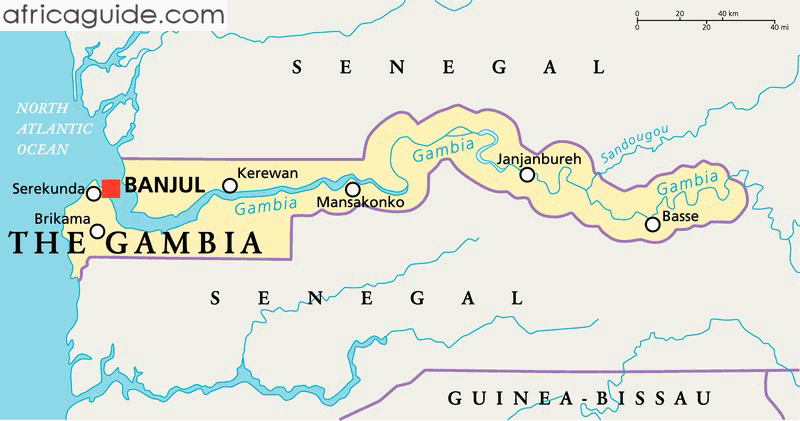
presumed end of “his mandate”. (Sénégal almost envelopes the Gambia land space completely,
as the map above indicates, thanks to those incredulously bizarre conquest
frontier lines darted out by the dual European occupying states France and
Britain in the region in the 19th century.)
Scant credible election
As most people know, what passes for election across
Africa is largely a farce. The murderous (European)conqueror “Berlin-state”
entrenched on the continent does not require an election to function and uphold
its definitive mission and as I have shown more expansively elsewhere (Herbert Ekwe-Ekwe, “Elections in Africa: the elector, the court, the outcome”, PENSAR-Revisita de Ciêcias Jurídicas,
http://www.unifor.br/images/pdfs/Pensar/v18n3_artigo6.pdf , accessed 20 March 2014), Europe’s
lead-occupation powers, particularly Britain and France, have ensured that
stipulated client-nations/nationalities (for instance islamist Hausa-Fulani in a
Nigeria, Arabised African islamists in the Sudan) in the contrived conquest
ensemble on the ground in Africa (Nigeria, Niger, Chad, the Congos, the
Guineas, the Sudan, whatever… ) run the “successor state” almost in perpetuity
– principally to oversee and safeguard extant European World strategic and
socioeconomic expropriated havens. It is in this context that Nigeria, the
archetype of the deathly ensemble in place created by none other than Britain,
the genocidist executioner of 3.1 million Igbo people in the most gruesome
genocide in Africa since Germany’s assault on the Herero and the Nama and the
Berg Damara peoples of southwest Africa in the early 1900s, is tellingly the
grave emergency to the peace and goodwill of contemporary west Africa; definitely
not a Yahya Jammeh.
APART FROM perhaps Sénégal and to a limited extent
Ghana, none other of the 16 countries of ECOWAS has had a credible election as
a “Berlin-state” of Africa. A credible election in a “Berlin-state” is intrinsically
a contradiction in terms. Just Botswana, Mauritius and South Africa,
paradoxically, given its very familiar history, would join Sénégal and Ghana in that league of rare exceptions
in Africa on this score (“Elections in Africa”).
It should be stressed, therefore, that the overwhelming
majority of the heads of regime gathered in the Abuja summit on the Gambia came
to power originally as military putschists or in rigged elections, often aided
by judiciaries they control (“Elections in Africa”). Nigeria regime’s Muhammadu Buhari, a trooper
actively involved in 50 years of the Igbo genocide, was imposed as chief of
state operations in March 2015 by the then British Prime Minister Cameron, born
five months after Buhari first got
involved in his murder of the Igbo in phase-I of the genocide, and US President
Obama, notably the first African-descent president in 233 years of the US republic.
Given particularly the monstrosity of the dehumanisation of African peoples in the United States throughout the course of this epoch, Barack
Obama’s support for the Igbo genocide in Africa, the land of his fathers, is an
incalculable tragedy, a catastrophic legacy. Since Buhari was installed in power, 2000 Igbo have been
murdered by his genocidist military and his two other adjunct forces, Boko
Haram and Fulani militia – two of the world’s five deadliest terrorist
organisations. Neither Obama’s White House nor his state department nor his
embassy in Nigeria has ever condemned any of these murders.
Hands off the Gambia!
Nigeria and ECOWAS must now abandon all plans
to invade the Gambia. They have demonstrated woefully that they are no worthy
arbiters in this dispute. The peoples in the Gambia must be allowed by essentially hostile neighbours,
and the rest of the world, to sort out the problems on the “elections” and
whatever else without threats and intimidations. There isn’t anything
sacrosanct about the 19 January 2017 “end of mandate” date in the Gambia for protagonists to
sit down and negotiate a way out of their differences. These negotiations
shouldn’t have deadlines. The Gambian parties must be encouraged to discuss and
discuss and discuss to resolve this crisis – however long it takes them.
Surely, the world can facilitate these
intra-Gambian talks. The lead arms supplying countries to Africa, especially Britain, the US, Russia, China, the Ukraine and Pakistan should immediately ban all arms
supplies to the Gambia and Nigeria as
well as to the rest of the 14 ECOWAS member states. These regimes and states,
with the obviously negligible manufacturing base of their own, rely heavily on
the world outside for the lethal range of armaments to murder peoples and
devastate communities within and without their frontiers. West Africa is arguably
the continent’s most troubled region and another front of confrontation, this
time in the Gambia, must be stopped.
(New York Art Quartet plays “Mohawk”, a composition by Charlie Parker [personnel: John Tchicai, alto saxophone; Roswell Rudd, trombone; Reggie Workman, bass; Milford Graves, drums; recorded: Nippon Phonogram, New York, US, 16 July 1965])
Herbert Ekwe-Ekwe is specialist on the state and on genocide & wars in Africa in the post-1966 epoch – beginning with the Igbo genocide, 29 May 1966-present day, the foundational and most gruesome genocide of post-(European)conquest Africa. 3.1 million Igbo or 25 per cent of this nation’s population were murdered by Nigeria and its allies, principally Britain. Africa and the rest of the world largely stood by and watched as the perpetrators enacted this horror most ruthlessly. The world could have stopped this genocide; the world should have stopped this genocide. This genocide inaugurated Africa’s current age of pestilence. During the period, 12 million additional Africans have been murdered in further genocide in Rwanda (1994), Zaïre/DRCongo (variously, since the late 1990s) and Darfur – west of the Sudan – (since 2004) and in other wars in Africa. African peoples have, presently, no other choice but exit/dismantle the extant genocide-state (the bane of their existence & progress) & construct own nation-centred states that serve their interests. He is author of several books & papers on the subject and his new book is entitled The longest genocide – since 29 May 1966 (2019).