Showing posts with label “Elections in Africa”. Show all posts

Saturday, 7 January 2017

No invasion of the Gambia!


Herbert Ekwe-Ekwe

AS FAMILIES and friends and peoples heartily exchange the customary best wishes for the new year, west Africa’s most notorious Murdering Inc., genocidist Nigeria, is already putting final touches to the launch of its new year’s early bloodbath episode. But this time round, the target isn’t across the predictable borders of the contiguous state of Biafra to the south but further to its west – the Gambia, 1500 miles away.

“Elections” for head of regime were held in the Gambia last month (December 2016) in which Yahya Jammeh, the incumbent, apparently lost and conceded to opponent Adama Barrow initially but soon changed his mind because he had “since [found] irregularities in the polling” exercise. Jammeh has instead “appealed” to the country’s high court, which he invariably controls, to “rule” on the dispute.

Bellicosity

In the meantime, a 4-person representative body of ECOWAS, west Africa region’s economic organisation, of which the Gambia is a member, travelled to Banjul, the Gambia, to begin some mediation in the crisis. The delegation met both Jammeh and Barrow, separately, but was unsuccessful in resolving the contentious issues at stake. An ECOWAS summit in Abuja, Nigeria, later followed on the subject but its resulting communiqué, prompted largely by Nigeria and the organisation’s secretariat, was outlandishly bellicose.

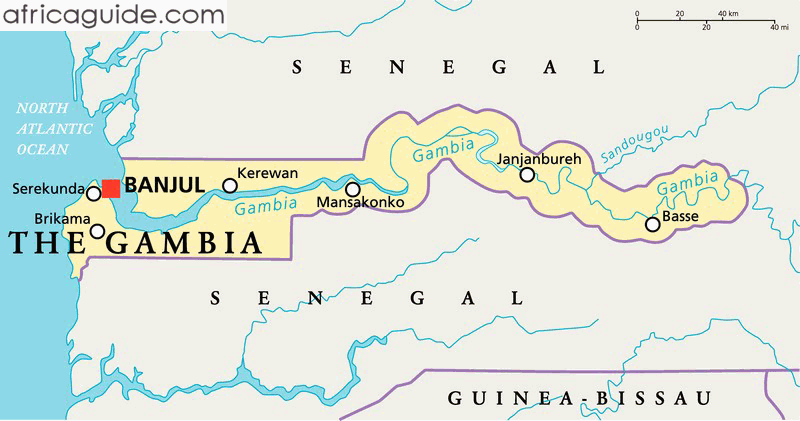
Instead of continuing and even expanding the parameters of its representative’s mediation visit to Banjul, just begun with the very brief, mostly formal procedural sessions with the Gambian protagonists, the communiqué was surprisingly emphatic that it would “take all necessary actions to enforce the results of 1st December 2016 elections”. To underscore the gravity of this increasing bellicosity, some media organisations in the region have in the last few days been publishing images of “battle ready Nigeria” troops “awaiting orders” for “possibly invading” the Gambia to “topple”/“force” Jammeh out of office. Marcel de Souza of the ECOWAS secretariat indeed confirmed in a separate press briefing (Premier Times, Lagos, 23 December 2016) that the Abuja summit had “authorised” an ECOWAS “standby force” to invade the Gambia from staging bases in Sénégal (not explicitly stated in the communiqué) if Jammeh did not “step down” by 19 January 2017, the presumed end of “his mandate”. (Sénégal almost envelopes the Gambia land space completely, as the map above indicates, thanks to those incredulously bizarre conquest frontier lines darted out by the dual European occupying states France and Britain in the region in the 19th century.)

Scant credible election

As most people know, what passes for election across Africa is largely a farce. The murderous (European)conqueror “Berlin-state” entrenched on the continent does not require an election to function and uphold its definitive mission and as I have shown more expansively elsewhere (Herbert Ekwe-Ekwe, “Elections in Africa: the elector, the court, the outcome”, PENSAR-Revisita de Ciêcias Jurídicas,
http://www.unifor.br/images/pdfs/Pensar/v18n3_artigo6.pdf , accessed 20 March 2014), Europe’s lead-occupation powers, particularly Britain and France, have ensured that stipulated client-nations/nationalities (for instance islamist Hausa-Fulani in a Nigeria, Arabised African islamists in the Sudan) in the contrived conquest ensemble on the ground in Africa (Nigeria, Niger, Chad, the Congos, the Guineas, the Sudan, whatever… ) run the “successor state” almost in perpetuity – principally to oversee and safeguard extant European World strategic and socioeconomic expropriated havens. It is in this context that Nigeria, the archetype of the deathly ensemble in place created by none other than Britain, the genocidist executioner of 3.1 million Igbo people in the most gruesome genocide in Africa since Germany’s assault on the Herero and the Nama and the Berg Damara peoples of southwest Africa in the early 1900s, is tellingly the grave emergency to the peace and goodwill of contemporary west Africa; definitely not a Yahya Jammeh.

APART FROM perhaps Sénégal and to a limited extent Ghana, none other of the 16 countries of ECOWAS has had a credible election as a “Berlin-state” of Africa. A credible election in a “Berlin-state” is intrinsically a contradiction in terms. Just Botswana, Mauritius and South Africa, paradoxically, given its very familiar history, would join Sénégal and Ghana in that league of rare exceptions in Africa on this score (“Elections in Africa”).

It should be stressed, therefore, that the overwhelming majority of the heads of regime gathered in the Abuja summit on the Gambia came to power originally as military putschists or in rigged elections, often aided by judiciaries they control (“Elections in Africa”). Nigeria regime’s Muhammadu Buhari, a trooper actively involved in 50 years of the Igbo genocide, was imposed as chief of state operations in March 2015 by the then British Prime Minister Cameron, born five months after Buhari first got involved in his murder of the Igbo in phase-I of the genocide, and US President Obama, notably the first African-descent president in 233 years of the US republic. Given particularly the monstrosity of the dehumanisation of African peoples in the United States throughout the course of this epoch, Barack Obama’s support for the Igbo genocide in Africa, the land of his fathers, is an incalculable tragedy, a catastrophic legacy. Since Buhari was installed in power, 2000 Igbo have been murdered by his genocidist military and his two other adjunct forces, Boko Haram and Fulani militia – two of the world’s five deadliest terrorist organisations. Neither Obama’s White House nor his state department nor his embassy in Nigeria has ever condemned any of these murders.

Hands off the Gambia!

Nigeria and ECOWAS must now abandon all plans to invade the Gambia. They have demonstrated woefully that they are no worthy arbiters in this dispute. The peoples in the Gambia must be allowed by essentially hostile neighbours, and the rest of the world, to sort out the problems on the “elections” and whatever else without threats and intimidations. There isn’t anything sacrosanct about the 19 January 2017 “end of mandate” date in the Gambia for protagonists to sit down and negotiate a way out of their differences. These negotiations shouldn’t have deadlines. The Gambian parties must be encouraged to discuss and discuss and discuss to resolve this crisis – however long it takes them.

Surely, the world can facilitate these intra-Gambian talks. The lead arms supplying countries to Africa, especially Britain, the US, Russia, China, the Ukraine and Pakistan should immediately ban all arms supplies to the Gambia and Nigeria as well as to the rest of the 14 ECOWAS member states. These regimes and states, with the obviously negligible manufacturing base of their own, rely heavily on the world outside for the lethal range of armaments to murder peoples and devastate communities within and without their frontiers. 

West Africa is arguably the continent’s most troubled region and another front of confrontation, this time in the Gambia, must be stopped.
(New York Art Quartet plays “Mohawk”, a composition by Charlie Parker [personnel:  John Tchicai, alto saxophone; Roswell Rudd, trombone; Reggie Workman, bass; Milford Graves, drums; recorded: Nippon Phonogram, New York, US, 16 July 1965]) 
Twitter@HerbertEkweEkwe


Monday, 30 June 2014

The antinomies of the “Berlin-state”

(Review essay of Chinua Achebe, A Man of the People [London: Heinemann, 1966], 167pp., £7.10, pb, £4.35, kindle ed/US$11.63, pb)

Arrow of God

This is the year of Arrow of God. 2014 is the 50th anniversary of the publication of Chinua Achebe’s tome. I have been rereading it lately to write a paper for a conference on this jubilee commemoration later on in the year. I decided, earlier on in the year, to first reread A Man of the People, Achebe’s fourth and later novel after Arrow of God, and then approach the latter – in other words, alternate the sequencing of the epochs of the groundings of the two texts by appearing to reread Arrow of God backwards! For now, I would like to keep the important discovery I think I may have encountered in this fascinating rereading format until my conference paper delivery. It will be published subsequently.

One by-product that has of course emerged in the exercise has been the opportunity to review A Man of the People even if this invariably anticipates its own jubilee two years away. Such a review has a pressing relevance for the present, though, as this year marks the centenary of the British conquest regime’s construction of the unmitigated catastrophe that goes by the name Nigeria, in these lands of southwestcentral Africa, to which A Man of the People interrogates most profoundly. The very gasping irony of this construction, as Osita Ebiem has shown in his recent excellent book, Nigeria, Biafra & Boko Haram (Page Publishing, 2014), is that the British were aware, right from the outset, of its cataclysmic outcome: Frederick Lugard, its chief conquest state operative at the time had indeed observed, “south and north [Nigeria] are like oil and water that do not mix” (Ebiem, 2014: 47) and Hugh Clifford, another conquest overseer, agreed, quite panoramically, in the context of both history and geography, “Nigeria is a collection of independent states, separated from one another by great distances, by differences of history and traditions and by racial, political, social and religious barriers” (Ebiem, 2014: 11). Despite the misgivings, the conquest regime “cobbled together” (12) these disparate peoples and worldviews for the express interests of British politicoeconomic and strategic expropriatory goals (12, 26-27).

(Oliver Nelson Quintet, “Six and Four” – personnel: Nelson, alto saxophone; Eric Dolphy, alto saxophone; Richard Wyands, piano; George Duvivier, bass; Roy Haynes, drums [recorded Van Gelder Studio, Englewood Cliffs, NJ, US, 1 March 1961])
Prophet?

A Man of the People (hereinafter, AMP) is published in early January 1966. This is a few days before the military coup d’état that overthrows the Abubakar Tafawa Balewa civilian government which the supposedly outgoing British occupation-governor had imposed on the country in 1959, following a fractious election that the British rigged in favour of its north regional sociopolitical clients. The latter would, in turn, safeguard those vast expropriatory interests of Britain’s in the country subsequently (Herbert Ekwe-Ekwe, “Elections in Africa – the voter, the court, the outcome”, 
http://rethinkingafrica.blogspot.co.uk/2014/03/elections-in-africa-voter-court-outcome.html, accessed 29 June 2014).

 A striking feature in the resolution of the grave crisis of this state that Achebe wrestles with in AMP is its degeneration into a military coup and rampaging violence (“But the Army obliged us by staging a coup at that point and locking up every member of the Government” – Achebe, A Man of the People, 1966: 165), an extraordinary predictive insight, if ever there was one, that confronts the reader, considering the gruesome trajectory of politics in Nigeria, in 1966, the year this same state launches the Igbo genocide, the foundational genocide of post(European)conquest Africa, in which 3.1 million Igbo are murdered. Indeed on the receipt of an advance copy of AMP, poet and playwright John Pepper Clarke-Bekederemo observes, “Chinua, I know you are a prophet. Everything in this book has happened except a military coup” (emphasis in the original). Ken Post, a British academic working in west Africa at the time, recalls: “Chinua Achebe proved to be a better prophet than any of the political scientists”. Once again, “Prophet”! Is Chinua Achebe, the Father of African Literature, also a prophet?

AMP focuses on two main protagonists: Nanga, or to refer to his official designation, Chief the Honourable M. A. Nanga, M.P., Minister of Culture, and Odili, the narrator. In case anyone is inclined to think that Nanga’s depiction is much of a parody, given the thrust of the novel, they need to be reassured that a Nanga actively walking the corridors of regime power in contemporary Nigeria, 50 years later, is more likely to wear the following even more bombastic tag: Chief (Prof) Dr Alhaji Sir (Gen, ret.) Mallam The Honourable M. A. Ph.D. Nanga, M.P., mni, Minister of Higher Priesthood & Culture, such is Achebe’s exceptional descriptive and imaginative insights so registered avidly throughout the novel. Nanga epitomises what public service entails for the typical politician in Nigeria, since 1960: corrupt and corrupting operative who fleeces the public treasury, “bloated by the flatulence of ill-gotten wealth, living in the big mansion built with public money” (Achebe, 1966: 85).

Odili, the school teacher, the reflective intellectual, and authorial voice, argues that the Chief (Prof) Dr Alhaji Sir (Gen, ret.) The Honourable Nangas of the times are so stubbornly confident that, “as long as [peoples in society] are swayed by their hearts and stomachs and not their heads the … Nangas of this world will continue to get away with anything” (73). The Nangas here, and in fact elsewhere, Odili continues, have “taken away enough for the owner to notice … It was not just a simple question of a [person’s] cup being full. A [person’s] cup might be full and none the wiser. But here the owner knew, and the owner … is the will of the people” (97). Besides the billions of US dollars which Britain and its allied interests have wrenched from its Nigeria creation over the years, what empirically constitutes that which has been “taken away enough for the owner to notice” by these fleecing brigands of African overseeing truckers between the 1960s and presently is US$700 billion.

Brigand & monster

Here, Franz Schurmann’s observation that these brigands are not “traditional but rather a phenomenon of modernity. They are fighting for power in a Western-type state” is hugely significant. What has been definitive in the past 48 years of this “fighting for power” in the restricted, calibrated spaces of just overseeing these African redoubts created by and for European World/overseas’ interests is that it is a fight to the death – genocides (Igbo, Tutsi, Darfuri, Blue Nile/South Kordofan/Nuba Mountains, Democratic Republic of the Congo), wars, immiseration, genocides, wars, immiseration... Between 29 May 1966 and today, 30 June 2014, the “Berlin-states” of Africa have been responsible for the murder of 15 million Africans. Its worst offender, its most notorious, its principal killer, remains Nigeria. This Nigeria. This haematophagous monster. This Nigeria, this killing machine which continues its murder of Africans most ruthlessly, most flagrantly, most unconscionably, even as these lines are written…

Africans now no longer need any reminders that the “Berlin-state” in their midst is not there for their interests, their wellbeing. Enough of this reminder! Enough! There couldn’t be any more eloquent interlocutors on this subject, in the case of Nigeria, for instance, than Messrs Lugard & Clifford, the very creators of this contraption, as was highlighted earlier. It is now an overriding imperative that each and every constituent people or nation in Africa embarks on the construction of a state that suits its wellbeing. This crisis, currently, is undoubtedly existential.

Freedom

Just as an empirical value has been offered to underscore the urgency of Odili’s philosophical musings on the pulverising economic legacy of the local overseer brigands of the still-occupied Africa, another empirical reference is available, thankfully, to address Odili’s own liberatory conclusion that “the owner knew”, “the will of the people”, at last, does know what is at stake in this human-made imbroglio. It also requires a human intervention to right this wrong of history. Osita Ebiem’s Nigeria, Biafra & Boko Haram, which I cited earlier, is at once positioned to operationalise Odili’s optimism with regards to the resolution of the case of Nigeria, at least, and, 100 years to the day, offers a historic reply to conquest operatives Lugard & Clifford:
No generation of human beings should live as if the world comes to an end after them ... [T]he people in this generation must work at freeing all the entrapped sovereign nations and their people from the traumatic union of one Nigeria … this generation cannot afford to depart this stage without dissolving the Nigerian union in the interest of the next ones. (added emphasis) (Ebiem: 184-185)
Twitter@HerbertEkweEkwe