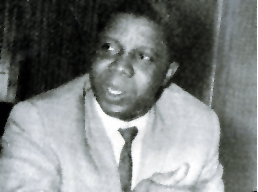
(Born 16 August 1930, Ojoto, Biafra)
Herbert Ekwe-Ekwe
TODAY, Friday 16 August 2019, is the 89th birthday of the great Christopher Ifekandu Okigbo.
Okigbo is Africa’s most celebrated and most influential poet. He occupied the poetry chair of the continent’s post- (European)conquest literary academy in the 1960s with Chinua Achebe the head of the novel institute and Wole Soyinka, head of drama.
Okigbo’s scholarship and influences are extensive and varied: Igbo history, mythology, art and philosophy, ancient world religious and spiritual heritage encompassing Nri, Kemet (“ancient Egypt”), Babylon, Judaism, Hinduism, Buddhism, Christianity, Greece and Roman as well as the poetry of Ovid, Virgil, Dante, Milton, Yeats, Mallarmé, Eliot, Pound, Hopkins.RIGHT from the outset, Okigbo’s perspicacious intellectual contribution in mapping out the tenets of Africa’s renaissance scholarship is his focus on both redeeming the European occupation’s assault on the spiritual embodiment of the African existence, in the wake of the conquest, and confronting a ruthless genocide state-in-the-making in Nigeria at the first half of the 1960s. Okigbo’s worldview does not tolerate any excuses for either the perpetration or perpetuation of any forms of tyranny and subjugation of peoples. Since then, Okigbo’s poetry has had a profound impact on the work of several poets of his generation as well as on the ever-expanding stretch of the continuing-Igbo genocide-generation of poets and writers in other genres.
Crucial site
FIFTY THREE years on, the state in contemporary Africa is essentially a genocide-state – exemplified, most catastrophically, by Nigeria, the Sudan and the so-called Democratic Republic of the Congo.Okigbo’s incisive scholarship (see, especially, Christopher Okigbo, Heavensgate, Silences, Limits, Distances, “Laments of the Masks”, “Laments of the Deer”, “Four Canzones” and Path of Thunder), to the poet’s eternal credit, anticipates the nature and characterisation of the multifocal crises of this development and rigorously interrogates their tragic consequences.For Okigbo, given the operationalising backdrop of the European conquest and occupation, the spiritual is a crucial site of the African resistance and campaign for the restoration of sovereignty. This is because the eventual goal of the occupation’s assault is aimed at burrowing a cataclastic fault-line in the soul of the people to pre-empt or complicate their determined process of recovery on the morrow of the triumph of freedom.EVIDENTLY, Okigbo responds to this emergency, in his poetry, by weaving a multilayered and panoramic landscape of often-complex fabric of overarching architecture of ideas that meditates on the variegated spiritual universe of the people.
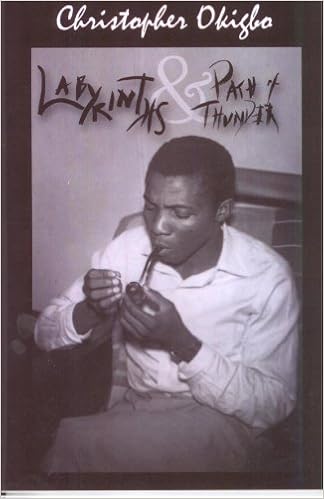
Genocide
In the 1960-1966 Nigeria historical context, particularly, Okigbo’s poetry of resistance pitches its tent squarely on behalf of those who would confront blatantly-rigged election results (1959/1960-1966) and imposed parties and leaderships (1959-1966), rigged census returns (1962, 1963), arbitrary arrests and detentions (1960-1966), rabid and rampant authoritarianism (1960-1966) and, most tragically of all, the Nigeria state & its British suzerain state-organised genocide against the Igbo people (beginning Sunday 29 May 1966). The poet himself was killed defending his beloved motherland. The dual-genocidists murdered 3.1 million Igbo people or one-quarter of the Igbo population during the 44 months of phases I-III of the genocide – 29 May 1966-12 January 1970. In phase-IV, which the genocidists launched on 13 January 1970 and continues unrelentingly to this day, they have murdered tens of thousands of additional Igbo. The latter include the 3000 Igbo murdered since November 2015 by the fiendish Muhammadu Buhari genocidist regime which was installed in power by ex-British Prime Minister David Cameron and Barack Hussein Obama, ex-US president, the first African-descent president in 233 years of the founding of the United States republic. Barack Hussein Obama’s unconscionable support for the Igbo genocide is the abominable legacy of his presidency.In the gripping lines of Okigbo’s last poem cycle, Path of Thunder, written before the 29 May 1966 outbreak of the Igbo genocide but published posthumously, he breathtakingly presages the contours of the cataclysmic consequences of Africa’s foundational genocide of the 20th century and his own likely death during the slaughter:
AND THE HORN may now paw the air howling goodbye …
For the Eagles are now in sight:
Shadows in the horizon –
THE ROBBERS are here in black sudden steps of showers, of
caterpillar –
THE EAGLES have come again,
The eagles rain down on us –
POLITICIANS are back in giant hidden steps of howitzers, of
detonators –
THE EAGLES descend on us,
Bayonets and cannons –
THE ROBBERS descend on us to strip us of our laughter, of our
thunder –
THE EAGLES have chosen their game …
…
POLITICIANS are here in this iron dance of mortars, of
generators –
THE EAGLES are suddenly there,
New stars of iron dawn;
So let the horn paw the air howling goodbye …
O mother mother Earth, unbind me; let this be
my last testament; let this be
The ram’s hidden wish to the sword the sword’s
secret prayer to the scabbard –
…
BEYOND the iron path careering along the same beaten track –
THE GLIMPSE of a dream lies smouldering in a cave,
together with the mortally wounded birds.
Earth, unbind me; let me be the prodigal; let this be
the ram’s ultimate prayer to the tether …
AN OLD STAR departs, leaves us here on the shore
Gazing heavenward for a new star approaching;
The new star appears, foreshadows its going
Before a going and coming that goes on forever… (Christopher Okigbo, Labyrinths with Path of Thunder, 2008: 71-72.)
Many a season
CHRISTOPHER IFEKANDU OKIGBO would be appalled by the devastation of Biafra, 53 years after the end of the phases I-III of the Igbo genocide, and 49 years after the launch of phase-IV of the genocide. The Fulani islamist/jihadist-led league of genocidist executioners on the ground in Nigeria and their centrally actuating constituent pan-African nations’ accomplices – Yoruba, Gwari, Jukun, Jawara, Kanuri, Tiv, Edo, Nupe, Hausa, Urhobo, Bachama – have indeed unleashed a half of century of unmitigated savagery on Igbo people, unprecedented in African history. Co-genocidist Britain, beginning with Prime Minister Harold Wilson on 29 May 1966, couldn’t have bargained for less in constructing such a ghoulish slaughtering coalition with its steadfast Nigerian allies.
Okigbo wouldn’t rest on his laurels, though, in response to challenge and overcome what is undoubtedly a clear, conscious, beastly-scripted and targetedly-driven juggernaut to destroy the Igbo, one of the world’s very talented peoples. Okigbo, who believes in the power of words, would head for his keyboard … and more…
HISTORY testifies that the quest for human freedom is not often an engagement pursued over just one season. For many, and the Igbo appear to be incorporated in this group, it is rather much more painfully drawn out; it could entail a cast of over several, long seasons. This trajectory, therefore, inevitably, encapsulates its vivid vicissitudes of pain, grief, opportunities, turmoil, setbacks, triumphs, turmoil, grief, opportunities, breakthrough. What is at stake here is for a more focused, more steadfast, and a more enduring understanding of the huge tasks ahead. Surely this is music in the ears of the resourceful and resilient Igbo people.
The Igbo will defeat this half a century of genocide. Unfailingly. The Igbo will rebuild their battered towns and villages and economy – which was Africa’s fastest growing powerhouse on the eve of the genocide. Unquestionably, the Igbo will restore their sovereignty.
AS THE Okigboan œuvre demonstrates, human freedom eventually prevails most luminously. Okaa Omee.
(Sam Rivers Quintet, “Mellifluous cacophony” [personnel: Rivers, tenor saxophone; Freddie Hubbard, trumpet; Herbie Hancock, piano; Ron Carter, bass; Joe Chambers, drums; recorded: Van Gelder Studio, Englewood Cliffs, NJ, US, 21 May 1965])
*****Herbert Ekwe-Ekwe’s latest books on the Igbo genocide and Biafra are The longest genocide – since 29 May 1966 (2019) and co-author, with Lakeson Okwuonicha, Why #DonaldTrump is #great for #Africa (2018)
Twitter @HerbertEkweEkwe