Monday, 7 November 2016

PROFILE: Chi-chi Nwanoku, bassist, professor of double bass historical studies, Royal Academy of Music London, and founder of Chineke! Foundation

(Chi-chi Nwanoku)
 (… critically-acclaimed bassist)
(Professor Nwanoku is here interviewed by Sergio Mims, Arise News, 12 May 2015)
Twitter @HerbertEkweEkwe


Back to elections – in Africa… As Ghanaians go to the polls on Wednesday 7 December 2016 to elect a new president, what indeed are the prospects of a free and fair election in Ghana and elsewhere in Africa?


Herbert Ekwe-Ekwe

ONE OF THE most profoundly enduring iconic imageries of the African scene during an election in any region of the continent – west, south, east or even in the desperately bleak “Arab spring” of the north – is the thrust and enthusiasm of the very patient and disciplined would-be voter waiting, anxiously, in stretched out and meandering queues, quite often in uncomfortable high temperatures or heavy downpours, for their turn to cast their vote in that ballot box… Tens of thousands may have begun queuing first thing at dawn, some having earlier walked many miles to a designated polling station, and several probably not able to vote well into sundown and a few returning the following day, if eventually unable to vote, in cases where a “staggered” election arrangement operated. For this teaming population of the electorate, it is not just a demonstration of some abstract civic responsibility to wish to cast their vote, but, more importantly, their belief, their earnest conviction, that they are involved in a democratic programme to exercise and clearly indicate their personal choice on who or what party should represent and advance their prescribed or preferred interest(s).

Paper

In the paper that follows (link below), I examine, in a continent-wide survey, the salient issues that the voter in Africa contends with in exercising this crucial democratic right:
(http://re-thinkingafrica.blogspot.co.uk/2014/03/elections-in-africa-voter-court-outcome.html)

Twitter @HerbertEkweEkwe


Sunday, 6 November 2016

99th birthday of Eni Njoku

Professor Njoku in conversation with a colleague, Smithsonian Institution, Washington, DC, US, c. 1967
(Born 6 November 1917, Ebem Ohaafia, Biafra)
RENOWNED BOTANIST, foundational vice-chancellor (president/rector) of University of Lagos, 1962, followed by University of Biafra vice-chancellorship, member of team of distinguished intellectuals appointed by the Biafran resistance government  during phases I-III of the Igbo genocide, 29 May 1966-12 January 1970, to travel and inform the world of this raging first genocide of post-(European)conquest Africa being executed by Nigeria and its suzerain state Britain under the premiership of Harold Wilson
(Joe Henderson Trio, “Serenity” [personnel: Henderson, tenor saxophone; Charlie Haden, bass; Al Foster, drums; recorded: live, Genova Jazz Festival, Villa Imperiale, Italy, 9 July 1987])
Twitter @HerbertEkweEkwe


Friday, 4 November 2016

83rd birthday of Chukwuemeka Odumegwu-Ojukwu

(Born 4 November 1933, Zungeru, Nigeria)
Historian and general, arguably the most outstanding Igbo leader in history – head of  Biafran resistance during phases I-III of the Igbo genocide, 29 May 1966-12 January 1970, this worst catastrophe in Igbo history, when 3.1 million Igbo people or 25 per cent of this nation’s population are murdered by Nigeria and its suzerain state Britain; demonstrates, throughout these devastating 44 months of the génocidaires’ comprehensive land, aerial and naval blockade and bombardment and slaughtering of Igbo people, unrelenting purpose, poise, dedication, tenacity, resilience
(John Coltrane Quartet, “Sun ship” [personnel: Coltrane, tenor saxophone; McCoy Tyner, piano; Jimmy Garrison, bass; Elvin Jones, drums; recorded: Impulse!, New York, US, 26 August 1965])
Twitter @HerbertEkweEkwe


Tuesday, 1 November 2016

84th birthday of Francis Arinze

(Born 1 November 1932, Eziowelle, Biafra)
Cardinal of the Catholic Church who had become bishop at just 32, multidisciplinary scholar and prolific author with sharp intellect whose all time investiture  is his indefatigable service in organising responsive and expansive refugee rehabilitation programmes in Biafra, unprecedented in Africa, which saves the lives of millions, especially children, women and older citizens, during the Igbo genocide, 29 May 1966-12 January 1970, the foundational genocide of post-(European)conquest Africa, when 3.1 million Igbo people or a quarter of this nation’s population are murdered by Nigeria and its suzerain state Britain under the premiership of Harold Wilson
(John Coltrane with Eric Dolphy, “Spiritual” [personnel: Coltrane, tenor saxophone, soprano saxophone; Dolphy, bass clarinet; McCoy Tyner, piano; Reggie Workman, bass; Elvin Jones, drums; recorded: live, The Village Vanguard, New York, US, 2-3 November 1961])
Twitter @HerbertEkweEkwe

Thursday, 27 October 2016

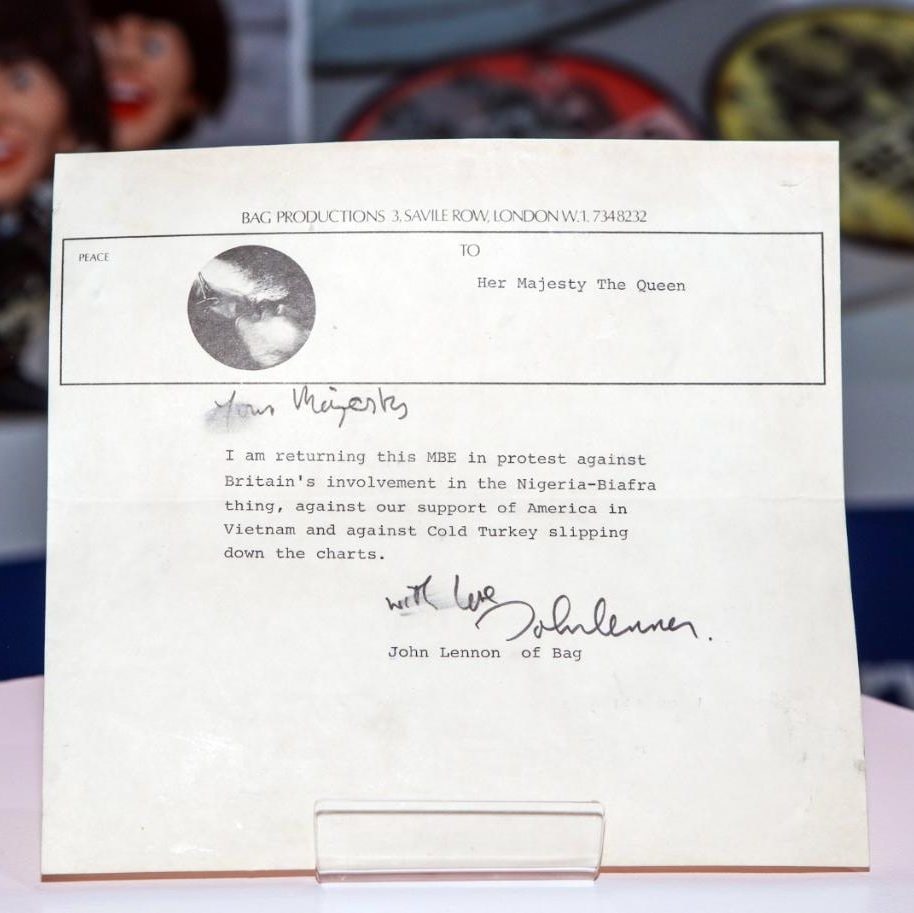
Draft of the Beatle’s John Lennon’s historic November 1969 letter to Queen Elizabeth II of England renouncing his MBE knighthood in protest against British role in Igbo genocide appears in Liverpool (England) car boot auction!

(John Lennon:... medal is sent back to Buckingham Palace, London, 25 November 1969)
FWD: The Telegraph reporters,  “John Lennon letter to the Queen explaining return of MBE valued at £60,000 after being found in car boot sale”, The Telegraph, London, 27 October 2016

A LETTER WRITTEN BY John Lennon to the Queen explaining why he returned his MBE has been valued at £60,000, say auctioneers.

The note remains in royal archives but a version of the letter was brought along by a member of the public to a memorabilia event in Liverpool on Wednesday.

The person, who wishes to remain anonymous, assumed it was a copy and said they found it tucked away inside the sleeve of a record contained in a collection of 45rpm singles they bought for £10 at a car boot sale 20 years ago.

Recently unearthed in the owner’s attic, the letter has been described as an “incredible find” by Darren Julien of Los Angeles-based Julien’s Auctions who believes it may be the original letter.

Mr Julien has a theory that Lennon’s letter was a draft version that he never sent to the Queen because the ink in the signature had been smudged.

He said: “If you’re writing to the Queen, you want the letter to look pretty perfect, you don’t want the ink to be smudged. This suggests that he wrote a second version of the letter, which was the one that was actually sent to the Queen.

“We’ll be doing some further research but this could be the Beatles find of the year. There is no doubt that the handwriting is definitely that of John Lennon.”

The letter (draft)

In his letter, Lennon wrote: “Your Majesty I am returning this MBE in protest against Britain’s involvement in the Nigeria-Biafra thing, against our support of America in Vietnam and against Cold Turkey slipping down the chart.

“With love John Lennon

“John Lennon of Bag.”
The letter was one of a number of items belonging to members of the public that were valued during the memorabilia day at The Beatles Story exhibition at the city’s Albert Dock. 

Martin King, of The Beatles Story, said: “This is an absolute gem and we are thrilled to have seen a piece of memorabilia with such historical significance. Ironically, 26th October was the day that The Beatles received their MBEs from The Queen so it’s quite fitting that the letter was brought into us on the exact same date many years later.”

Twitter@HerbertEkweEkwe


Lest we forget: The Igbo, vanguard outreaches, Nigeria – circ. 1934-29 May 1966

Herbert Ekwe-Ekwe

THE IGBO WERE ONE of the very few constituent nations in what was Nigeria, prior to 29 May 1966 – launch date of the Igbo genocide carried out by Nigeria and Britain, who understood, fully, the immense liberatory possibilities ushered in by 1 October 1960 (presumed, scheduled date of termination of 100 years of the British conquest and occupation of these southwestcentral states and peoples of Africa) and the interlocking challenges of the vast reconstructionary work required for state and societal transformation in the aftermath of foreign occupation.

Vanguard
The Igbo had the most robust economy in the country in their east region homeland, supplied the country with its leading writers, artists and scholars, supplied the country’s top universities with its vice-chancellors (president/rector) and leading professors and scientists, supplied the country with its first indigenous university (the prestigious university at Nsukka where, at its Enuugwu medical school, the first open-heart surgery in southwestcentral Africa was successfully performed on 1 February 1974), supplied the country with its leading and most spirited African World theorists, philosophers and practitioners, supplied the country with its top diplomats, supplied the country’s leading secondary schools/high schools with its head teachers and administrators, supplied the country with its top bureaucrats, supplied the country with its leading businesspeople, supplied the country with an educated, top-rated professional officers-corps for its military and police forces, supplied the country with its leading sportspersons, essentially and effectively worked the country’s rail, postal, telegraphic, power, shipping and aviation services to quality standards not seen since in Nigeria … And they were surely aware of the vicissitudes engendered by this historic age precisely because the Igbo nation played the vanguardist role in the freeing of Nigeria from Britain, beginning from the mid-1930s.

It is precisely in response to this defining Igbo role in this very strategic region of Africa that the Anglo-Nigeria empire struck back most gruesomely with the genocide, begun on Sunday 29 May 1966.
(Alice Coltrane Quartet, “Lord, help me to be” [personnel: Coltrane, piano; Pharoah Sanders, tenor saxophone;  Jimmy Garrison, bass; Ben Riley, drums; recorded: Coltrane home studio, Dix Hills, New York, US, 29 January 1968]) 
Twitter@HerbertEkweEkwe