Monday, 6 April 2015

April is Genocide Awareness and Prevention Month (4): Oba or king of Lagos’s proclamation to murder Igbo in Lagos


(Rilwan Akiolu)
Herbert Ekwe-Ekwe

Rilwan Akiolu, the oba or king of Lagos, genocidist Nigeria, has issued a proclamation to murder Igbo people domiciled in Lagos if they, the Igbo, do not vote for the king’s “preferred candidate” in the forthcoming Lagos region governor’s election. The king’s proclamation is published widely in the Nigeria media including saharareporters.com (New York), Premium Times (Lagos) and Vanguard (Lagos). According to saharareporters.com (6 April 2015), the “Oba of Lagos threatened Igbo during a meeting in his palace in downtown Lagos. The traditional king of Lagos, Rilwan Akiolu, told representatives of the Igbo during the meeting that if they refuse to vote for his preferred candidate, Akinwunmi Ambode of the All Progressive Congress [the party the overwhelming majority of the Igbo electorate voted against in the Saturday 28 March 2015 ‘poll’ for ‘president’ in Nigeria: http://re-thinkingafrica.blogspot.co.uk/2015/04/a_6.html] they will die in the Lagos lagoon in 7 days”. Saharareporters.com’s report, on its website, includes an audio clip of Akiolu’s murder threats with haunting “cheers” and chants by courtiers in Yoruba: kabiyesi, kabiyesi – “the unquestionable one”, “the unquestionable one”…

Outrage, clinical precision, no agency

Akiolu is a lawyer and was an assistant chief of the Nigeria police before his accession to the Lagos throne in 2003. He is respected if not revered by his subjects. The world can and must stop Akiolu from carrying through his proclamation. Akiolu’s proclamation is a grim alert to the world, just coming a few days after islamist insurgents operating in a university college in Kenya murdered 147 African christian students, initially separated from their muslim counterparts. The world’s heads of state, heads of government, the United Nations, statespersons, non-state/civil organisations, scholars, students, men and women of freedom and goodwill should today, now, register their unqualified outrage in response to this call by the Lagos hereditary monarch to murder the Igbo, based on the latter’s exercise of their choice in a seemingly democratic contest. Phone calls of protest should be made or emails sent at once to one’s nearest Nigeria consulate/embassy. Nigerian genocidist officials/operatives who not too unroutinely call openly for the mass murder of Igbo people over the decades have been so emboldened in their stock-in-trade especially since Nigeria secured unflinching backing from the British government at the onset of the Igbo genocide in 1966. To underscore the point, we should recall that it was to British Prime Minister Harold Wilson that Nigeria’s genocidist trooper Olusegun Obasanjo turned to in June 1969 to “sort out” the world-wide revulsion that followed Obasanjo’s orders to his air force to shoot down over south Biafra the International Committee of the Red Cross DC-7, clearly marked, relief-carrying aircraft to the encircled, blockaded and bombarded Igbo, resulting in the catastrophic loss of the plane’s 3-person crew (Olusegun Obasanjo, My Command, Ibadan and London: Heinemann, 1980, p. 165.).

Finally, back to the Igbo in Lagos and genocidist Akiolu... Millions of Igbo live in Lagos. Igbo experience in Nigeria since the 1945 Igbo pogrom in Jos (central region) has been that calls for the “murder of Igbo” by officials (religious, monarchial, other state operatives) have usually been carried out with almost clinical precision in orchestrated mass actions. Akiolu’s reference to the Lagos lagoon is therefore ominous because this is the bight where hundreds of Igbo slaughtered during phase-I of the Igbo genocide, especially after 29 July 1966, were dumped by their assailants.

Pointedly, Akiolu’s murder-proclamation comes in the wake of the expulsions of Igbo citizens from Lagos in recent years by Raji Fashola, the region’s governor, another lawyer, indeed a senior advocate of the Nigerian bar. As I indicated during the last expulsion, the Igbo must leave Lagos and relocate to Igboland. No agency in Lagos nor in the wider Nigeria virulent political space can or is willing to safeguard Igbo security and wellbeing: (http://re-thinkingafrica.blogspot.co.uk/2013/08/igbo-deportation-from-lagos_2.html)
(Herbie Hancock Quintet, “Little one” [personnel: Hancock, piano; Freddie Hubbard, trumpet; George Coleman, tenor saxophone; Ron Carter, bass; Tony Williams, drums; recorded: Van Gelder Studio, Englewoods Cliffs, NJ, US, 17 March 1965])
Twitter @HerbertEkweEkwe

That Saturday 28 March 2015 “election” in genocidist Nigeria: No finer hour indeed for the reaffirmation of Igbo freedom since 12 January 1970


Herbert Ekwe-Ekwe

FOR THE RECORD: On Saturday 28 March 2015, almost 49 years to the day of the launch of the Igbo genocide by Nigeria, 29 May 1966-12 January 1970 (phases I-III), the Igbo electorate in occupied Igboland, Biafra (Abia, Anambra, Delta, Ebonyi, Enuugwu, Imo, Rivers administrative regions), and Nigeria, is presented with the “choice” of voting in a “poll” for “president” of Nigeria between Muhammadu Buhari, a representative trooper of the Nigeria genocidist military, and Goodluck Jonathan, the Ijo zoologist untainted by this genocide. 

The Igbo voter, across the entire participatory electoral districts and precincts of the exercise, votes overwhelmingly against the génocidaire transcendence. In this foundational genocide of post-(European)conquest Africa, Nigeria and co-genocidist Britain murdered 3.1 million Igbo or 25 per cent of Igbo population. Millions of the 28 March electorate are of the “post”-genocide generation.

THERE has indeed been no finer hour of Igbo resilience and liberatory affirmation since 12 January 1970.  The determined march towards justice for the Igbo and restoration of sovereignty have been brought several months forward as a result of the Igbo collective testament of 28 March 2015.
(Ornette Coleman Quintet, “The sphinx” [personnel: Coleman, alto saxophone; Don Cherry, pocket trumpet; Walter Norris, piano; Don Payne, bass; Billy Higgins, drums; recorded: Contemporary’s Studio, Los Angeles, US, 10 February-24 March 1958])
Twitter @HerbertEkweEkwe

Saturday, 4 April 2015

87th birthday of Maya Angelou

(Born 4 April 1928, St Louis, Mo, US)
Poet, historian, actress, playwright, academic, human rights activist


Twitter @HerbertEkweEkwe

April is Genocide Awareness and Prevention Month (2): Presaging the Igbo genocide

In his Empire: What Ruling the World Did to the British (London: Viking, 2011), Jeremy Paxman allocates just 12 lines of the total 368-page study to British-occupied Nigeria. But the pithy commentary undoubtedly speaks volumes of the mindset of the occupation regime on the very eve of its presumed departure from Nigeria in October 1960. This is clearly a regime that is not prepared or willing to abandon the bounty harvest or lucre that is its Nigeria. Instead, it is exploring across a spectrum of strategies to subvert the goal of the restoration-of-independence movement for the peoples which the Igbo had led since the 1930s.

Using archival material, Paxman presents the crux of the panoramic conversation on the subject in Lagos, in January 1960, between James Robertson, the outgoing occupation governor, and visiting Prime Minister Harold Macmillan:

MACMILLAN: Are the people fit for self-government?

ROBERTSON: No, of course not.

According to Paxman, James Robertson reckons that it would take “another 20 or 25 years” for Nigeria to be “fit for self-government” (Paxman, 2011: 272). Interestingly, this is the same Robertson who had by the time of his Lagos meeting with Macmillan “concluded” the “terms” of the British “exit” from Nigeria in “negotiations” with the country’s restoration-of-independence movement – begun 15 years earlier and had been successively chaired by two previous occupation governors including sessions scheduled and held in England. This is the same Robertson who had just rigged the December 1959 countrywide elections in Nigeria (part of the restoration-of-independence “package”) in favour of the Hausa-Fulani north region (see the irrepressible Harold Smith, member of the occupation regime in Lagos at the time – http://www.thefreelibrary.com/A+squalid+end+to+empire.-a0189071322, accessed 28 March 2015)), Britain’s local clients, vehemently opposed to African independence – and, therefore, the British exit! (This north Nigeria region has the unenviable accolade across the entire Southern World of being home to one of the few peoples who wanted the occupation of their lands indefinitely by one of the pan-European powers of global conquest since the 15th century CE.) Furthermore, this is the same Robertson whose predecessor, in Lagos, had earlier rigged the countrywide census results – again, in favour of Britain’s Hausa-Fulani north regional clients (http://www.thefreelibrary.com/A+squalid+end+to+empire.-a0189071322, accessed 28 March 2015).

Macmillan then asks Robertson for his advice on the way forward for the British continuing occupation of Nigeria: “What do you recommend me to do?”

ROBERTSON: I recommend you give it to them at once.

Really?! What? Why? Doesn’t Roberston’s suggestion to his boss sound wholly contradictory to the tract that this conclave had trodden so far? Well, no, not really… Both prime minister and governor have no disagreement, whatsoever, on holding onto British “interests” in Nigeria in perpetuity; they do not believe that they are necessarily bound by the “terms” of the envisaged British “exit” from Nigeria “negotiated” since 1945 even though, ironically, these had largely preserved British “interests”, thanks to the veto-power that its Hausa-Fulani north region subalterns would exercise in the “new” dispensation; most crucially, both men do not subscribe to the inalienable rights of Africans to recover their conquered lands.

It is the case, though, that if the British officials were to renege on their “exit” from Nigeria at this 11th hour, they would have to contend with a serious crisis – at least in the short/medium term – right there on the ground in Nigeria: “The alternative [is] that most talented people [read: the Igbo and those others elsewhere in south Nigeria who demanded and supported the drive towards unfettered restoration-of-independence for the peoples] would become rebels and the British would spend the next two decades fighting to stave off what [is] inevitable, while incurring the opprobrium of the world” (Paxman: 272).

As the Lagos deliberations end, nine months before the designated British departure date, both prime minister and governor needn’t agonise, too much, over the future prospects of their country’s Nigeria stanglehold. After all, despite the “talented people”, Britain is aware that it holds the trump card to defend this stranglehold via its Hausa-Fulani clients. Twice in the previous 15 years (significantly, it should be noted, during the very years of British “negotiations” of its “exit” from Nigeria with the “talented people”), the clients organised and unleashed pogroms against Igbo people in northcentral town of Jos (1945) and north city of Kano (1953). Hundreds of Igbo were murdered during these massacres and tens of thousands of pounds sterling worth of their property looted or destroyed. No perpetrators of these murders were ever apprehended or punished by the occupation regime.

Six and one-half years hence, from Sunday 29 May 1966, these same British clients would unleash the genocide against the Igbo people. During the course of 44 months, 3.1 million Igbo children, women and men are murdered in this foundational and most gruesome genocide of post-(European)conquest Africa. The Igbo and the world suddenly realise that those anti-Igbo pogroms carried out during the years of the Anglo-“talented people”-in-Nigeria doubtful restoration-of-independence negotiations were indeed “dress rehearsals” for the 29 May 1966-12 January 1970 Igbo genocide.

Reexamination and restitution

Britain plays an instrumental role in the perpetration of the genocide – politically, diplomatically, militarily. Now, a new Harold-the-prime minister, this time Harold Wilson, has no qualms about the “opprobrium of the world” considered by the other Harold during those January 1960 talks with occupation governor Robertson. Wilson’s reasons are obvious: the architecture of control and execution of mass violence in Nigeria have altered, somehow, since January 1960, and the forces on the ground spearheading the Igbo genocide are the trusted Hausa-Fulani subalterns of old and their since locally expanded allies in west Nigeria – not Britain, directly; precisely, what Macmillan and Robertson had sought to avoid! So, as the slaughter of the Igbo intensifies, particularly in the catastrophic months of 1968-1969, Harold Wilson is totally unfazed as he informs Clyde Ferguson (United States state department special coordinator for relief to Biafra) that he, Harold Wilson, “would accept a half million dead Biafrans if that was what it took” Nigeria to destroy the Igbo resistance to the genocide (Roger Morris, Uncertain Greatness: Henry Kissinger and American Foreign Policy, London and New York: Quartet Books, 1977, p. 122). Such is the grotesquely expressed diminution of African life made by a supposedly leading politician of the world of the 1960s – barely 20 years after the deplorable perpetration of the Jewish genocide. As the final tally of the murder of the Igbo demonstrates, Harold Wilson probably has the perverted satisfaction of having his Nigerian subalterns perform far in excess of the prime minister’s grim target, a subject coldly stated in Wilson’s own memoirs where he notes that the Nigerian military, equipped zealously by Britain, expends more small arms ammunition in its campaign to achieve its annhilative mission in Igboland than the amount used by the British armed forces  “during the whole” of World War II (Harold Wilson, Labour Government, 1964-1970: A Personal Record, London: Weidenfeld & Nicolson, 1971, p. 630, added emphasis). On this, Colonel Robert Scott, military advisor in the British diplomatic mission in Nigeria, during the period, acknowledges, equally gravely, that as Nigerian genocidist military forces unleash their attacks on Igbo cities, towns and villages, they are the “best defoliant agent known” (Daily Telegraph, London, 11 January 1970).

Jeremy Paxman, a former senior journalist at the British Broadcasting Corporation who anchored the BBC2 “Newsnight” premier current affairs programme for 25 years (1989-2014), has a 3-minute follow-up video where he explains why he has written Empire. Two questions he poses are quite striking: (1) “Why did the British go out (sic) to conquer the world?” (2) “What did it do to them [the British, that is]?” For the Igbo of southwestcentral Africa, the double jeopardy of conquest and occupation and genocide is palpably incalculable. It is now clear that the contemporary British state cannot continue to ignore its responsibilities in embarking on a comprehensive reexamination of the history of its relationship with the Igbo people and make the long-overdue restitution.
(Ornette Coleman Quartet, “Tears inside” [personnel: Coleman, alto saxophone; Don Cherry, pocket trumpet; Percy Heath, bass; Shelly Manne, drums; recorded: Contemporary’s Studio, Los Angeles, US, 9 and 10 March 1959])
Twitter @HerbertEkweEkwe

Thursday, 2 April 2015

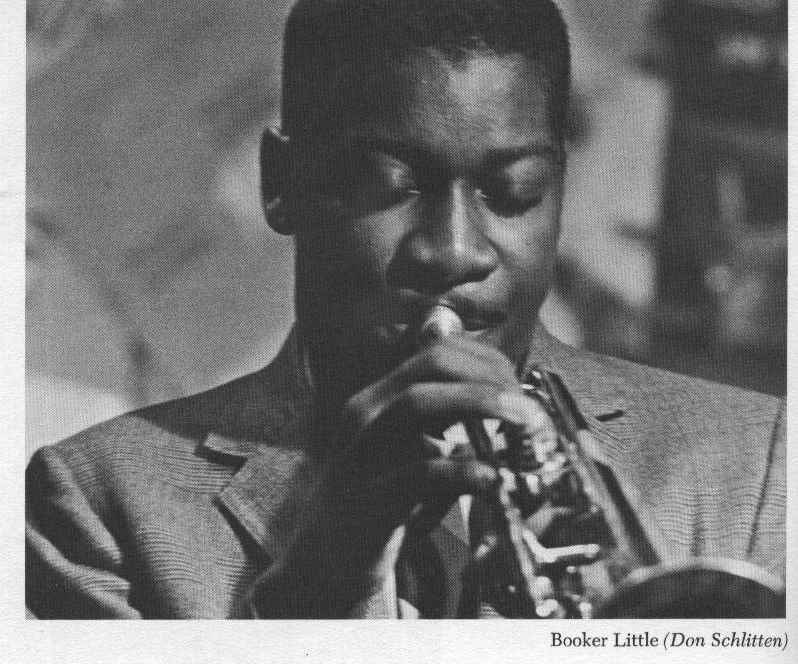
77th birthday of Booker Little

(Born 2 April 1938, Memphis, US)
Prodigiously creative trumpeter and composer who, whilst still in his teens/early 20s, records critically acclaimed albums with masters Roach, Coltrane, and Dolphy, with whom he co-leads a 3-volume classic recording of music their quintet (Little, trumpet; Dolphy, alto saxophone, bass clarinet, flute; Mal Waldron, piano; Richard Davis, bass; Ed Blackwell, drums) plays during a 2-week residency at New York’s Five Spot Café in July 1961

(Booker Little Sextet, “We speak” [personnel: Little, trumpet; Julian Priester, trombone; Dolphy, alto saxophone; Don Friedman, piano; Art Davis, bass; Roach, drums; recorded: Nola’s Penthouse Studios, New York, 17 March 1961])
Twitter @HerbertEkweEkwe

April is Genocide Awareness and Prevention Month (1): The sardauna, Britain, Nigeria and the Igbo

Igbo tenacity, drive and relentless optimism to pursue and overcome life’s challenges were acutely an affront to both the sardauna of Sokoto (northwest Nigeria) and British occupation sensibilities in Nigeria. This sardauna interview (video below) must have been recorded in the late 1950s/early 1960s – definitely after both the 1945 and 1953 north Nigeria-organised pogroms against Igbo immigrant populations in Jos and Kano respectively. Hundreds of Igbo were murdered during the pogroms and tens of thousands of pounds sterling worth of their property were looted/destroyed at the time. Each pogrom was carried out because of the Igbo vanguard role in the restoration-of-independence movement to free Nigeria from the British conquest and occupation, begun in the 1930s. North Nigeria’s sociopolitical leaderships, effectively British regional clients, were opposed to the restoration of African freedom. No other leadership across the entire Southern World (Africa, Asia, the Caribbean/South America) has such an unenviable record during this unprecedented epoch of transglobal freedom charge. North Nigeria leaderships, indeed, were disposed to the continuing British occupation of Nigeria.

Enslaved spaces and replicas

As a result, the occupation regime did not apprehend or prosecute anyone for either the 1945 or 1953 pogroms and the outrages became the “dress rehearsals” for the 29 May 1966-12 January 1970 Igbo genocide when the Nigeria state (as a whole, involving other constituent nations including the Yoruba, the Edo and Urhobo of the west region) with full Britain involvement, and others, murdered 3.1 million Igbo or one-quarter of this nation’s population. Britain, nor in fact any of the other pan-European conquerors of Africa (France, Portugal, Belgium, Spain, Germany), did not create a Nigeria, or whatever names these “Berlin states” in Africa are called, as precursor for African emancipation. On the contrary, the Nigerias of Africa are more of replicas of the enslaved plantations of the Americas (in the previous epoch of nearly 400 years) to perpetuate European World control and exploitation of Africa and Africans in perpetuity.

The enslaved Igbo encountered this with unrelenting courage and defiance in the enslaved estates in the Americas (north, south and the Caribbean), as history shows, and wouldn’t have it either at home! The sardauna interview should be part of History/Politics 101 course on Africa because it does tell one, in a nutshell, the “fate” of the Igbo in Nigeria that north Nigeria, with firm support of Britain, had, carefully, contrived right back in the 1950s. Except the Igbo people have signed up for a concerted suicide, they surely cannot see their destiny emplaced in this space of certain death.

This has been the cardinal lesson of the Igbo genocide. Thankfully, some Igbo who were still not sure of the long term implications of the continuing Nigerian occupation of their homeland (since 12 January 1970) have had a baptism of enlightenment since the video of the sardauna interview went viral! Suddenly, historical records become opportunities for rare streams of conscientisation...
Twitter @HerbertEkweEkwe

Wednesday, 1 April 2015

Arrow of God (1964) and Igbo genocide (29 May 1966-12 January 1970)***

***Paper presented at the Arrow of God at 50 Symposium, Centre for African Studies/Igbo Conference, School of Oriental and African Studies, University of London (symposium conveners: Dr Kwadwo Osei-Nyame Jnr and Dr Louisa Uchum Egbunike), Saturday 4 October 2014

Twitter @HerbertEkweEkwe