Showing posts with label Chinua Achebe. Show all posts

Friday, 27 September 2019

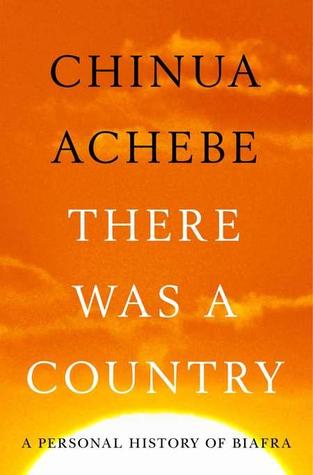
7th anniversary of the publication of Chinua Achebe’s There was a Country


Herbert Ekwe-Ekwe

Father of African Literature’s incomparable memoirs on the Igbo genocide, the foundational genocide of post-(European)conquest Africa, 29 May 1966-12 January 1970 (phases I-III), when Nigeria, headed by the African Yakubu Gowon-Obafemi Awolowo bubonic genocidist dyarchy, and its ruthless suzerain, co-genocidist state Britain, headed by Prime Minister Harold Wilson (“[I] would accept half a million dead Biafrans if that was what it took...”  {Roger MorrisUncertain Greatness: Henry Kissinger and American Foreign Policy, London and New York: Quartet Books, 1977: 122}) murdered 3.1 million Igbo people or 25 per cent of this nation’s population; the genocide continues unabated as these lines are written, phase-IV, beginning 13 January 1970, with tens of thousands of additional Igbo murdered since
(John Coltrane Duo, “Jupiter (variation)” [personnel: Coltrane, tenor saxophone, bells; Rashied Ali, drums; recorded: Van Geldar Studio, Englewood Cliffs, NJ, US, 22 February 1967)
*****Herbert Ekwe-Ekwe’s recently published books on the Igbo genocide and Biafra are The longest genocide – since 29 May 1966 (2019) and co-author, with Lakeson OkwuonichaWhy #DonaldTrump is #great for #Africa (2018)

Twitter @HerbertEkweEkwe


Tuesday, 18 June 2019

“If Siberia had been darkness and cold and marked by death and deprivation, Africa was heat and color and life”: How the same continent of Africa demonised in the Polish-British Joseph Conrad’s raving racist Heart of Darkness novella just 40 years earlier (1902) saves the lives of over 30,000 desperate Polish refugees forced from their homeland in east Europe during the 1939-1945 war

(Polish refugees fleeing the 1939-1945 war from their homeland in Europe safe in Tengeru, Tanzania, 1946 ... photo credit: Jonathan Duranddirector, Memory is our Homeland documentary on the history of these over 30,000 refugees from Poland in east/southern Africa, 1942-1952)

1. Abdi Latif Dahir, “The little known story of the Polish refugees who fled to East Africa during World War II”, Quartz Africa, 16 May 2019,
https://qz.com/africa/1620841/the-polish-refugees-in-tanzania-during-world-war-ii/?fbclid=IwAR1Pz1QG6Wv-eBlCfBzq5XfxAwhW3A4ZiCGYOTSRCWgARy64-EXeC_ltNVE (accessed 17 May 2019)

2. On Joseph Conrad’s Heart of Darkness, see Chinua Achebe’s incomparable exposition,
“An Image of Africa: Racism in Conrad’s ‘Heart of Darkness’” Massachusetts Review. 18. 1977. Rpt. in Heart of Darkness, An Authoritative Text, background and Sources Criticism. 1961. 3rd ed. Ed. Robert Kimbrough, London: W. W Norton and Co., 1988, pp.251-261:
(Wayne Shorter Septet, “The all seeing eye” [personnel: Shorter, tenor saxophone; Freddie Hubbard, trumpet; Grachan Moncur III, trombone, James Spaulding, alto saxophone; Herbie Hancock, piano; Ron Carter, bass; Joe Chambers, drums; recorded: Van Gelder Studio, Englewood CliffNJ,US, 15 October 1965)

*****Herbert Ekwe-Ekwe is the author of The longest genocide – since 29 May 1966 (2019) and co-author, with Lakeson Okwuonicha, of Why #DonaldTrump is #great for #Africa (2018)

Twitter @HerbertEkweEkwe


Monday, 1 April 2019

79th birthday of Wangari Maathai

(Born 1 April 1940, Ihithe, Kenya)
BIOLOGIST and iconic exponent of freedom and the environment
IN THE following review essay first published on 17 December 2013 and entitled “Daughter-of-the-soil”, Herbert Ekwe-Ekwe reflects on Wangari Maathai’s autobiography, Unbowed: One Woman’s Story (London: Arrow Books, 2008), 314pp:
It is unmistakeably evident in the early chapters of this remarkable autobiography by Wangari Maathai, especially those that cover her childhood to adolescence growing up in rural Kenya of the 1940s, how very little appears to exist on the ground to prepare her for the enormous challenges she confronts and overcomes, spectacularly, just a few years subsequently. 

RIGHT from the outset, Maathai is indeed the daughter-of-the-soil and she retains this prestigious accolade throughout her most fulfilling life. As she works full time with her mother on the farm, having been allocated a 15-sq.ft. plot to tend herself at the age of 7 cultivating “sweet potatoes, beans maize, and millet” (Wangari Maathai, 2008: 38), 
there is no certitude to Maathai’s formal education in a school eventually. But the following year, aged 8, an unexpected conversation between her mother and Maathai’s older brother on one late evening after another hardworking day on the farm, would change the direction of young Wangari’s life. Maathai learns, with staggering incredulity, of her parents and brother’s decision to send her to school:
[A]lthough [my mother] had almost no formal education, she agreed with my brother. How grateful I am that she made the decision she did because I could not have made it for myself, and it changed my life… To this day I do not know where the money for my education came from, but my mother probably raised it by working for people in the village, cultivating their land. At that time you could earn up to sixty cents doing such work. (Maathai: 40)
Contours of conquest and occupation

BUT THE deal for Maathai to go to school is not done, yet. Someone else’s approval must be sought, someone who is not even a member of her family. Just as the hundreds of thousands of Gĩkũyũ people’s families whose legendary fertile lands in the central and western Kenyan highlands have been seized by the British occupation regime and handed over to 40,000 European-descent immigrant-“settlers” (predominantly from Britain, Germany, South Africa, Australia and Canada) by the beginning of the 1950s (10), Maathai’s “displaced” family now lives on one such “settler” farm owned by a recent British arrival, D.N. Neylan. Maathai’s family’s official designation in their new abode, as the rest of these nascent landless Africans, is “tenant-at-will”, as distinguished writer Ngũgĩ wa Thiong’o, Maathai’s compatriot and contemporary recalls his own family’s experience (Herbert Ekwe-Ekwe, 2011: 46), or “squatter-on-the-farm” as Maathai prefers instead: “My father had no title to the land where he had established his household – he was effectively a squatter on the farm … [H]e could build housing for his family and cultivate crops on land Mr Neylan apportioned to him … [In return] the man, his wife, and children were all required to provide labor. They were really glorified slaves…” (Maathai: 14-15). 

So, given this evident use-of-labour status in the “squatters-on-the-farm” provision, Neylan pointedly asks Maathai’s father who would “pick his pyrethrum” on the farm (plant used as insecticide and picking it is a specialism reserved for African children!) if the young Wangari goes to school, to which her father replies: “Don’t worry, [Mr Neylan], there are still many children in my homestead” (Maathai: 29). Educating African children, Maathai recalls, gravely, “was not a priority for the settlers” (29).
Just as Ngũgĩ (Ekwe-Ekwe, 2011: 46-48), Maathai is a keen witness to the momentous clash of two fiercely contradictory streams of consciousness and movement in the Kenya of her childhood whose outcome would impact on her and others of her generation most profoundly subsequently. On the one hand, there is the juggernaut of an insistent, if not desperate occupation regime which wants to consolidate its stranglehold on strategic and wealthy Kenya, 50 years after the beginning of its conquest and despite the lessons of the recently concluded 1939-1945 war and the 1947 liberation of India, and the other hand is the challenge of the land and freedom-bound army of the Mau Mau resistance. 

The significance of this clash dawns on Maathai perhaps most acutely in her new school, a catholic school run by Italian nuns. She readily excels in all her lessons but is shocked to be confronted with a very important school rule, arguably the most important school rule, which bans the speaking or any other forms of communication in Gĩkũyũ as well as in other African languages throughout the school premises. The only language allowed in school is English. Any student who contravenes this law wears a button of shame known as the “monitor”:
It was sometimes inscribed with phrases in English such as ‘I am stupid. I was caught speaking my mother tongue’. At the end of the day, whoever ended up with the button received a [physical] punishment, such as cutting grass, sweeping, or doing work in the garden. But the greater punishment was the embarrassment you felt because you had talked in your mother tongue. In retrospect, I can see that this introduced us to the world of undermining our self-confidence … trivialization of anything African and lays the foundation for a deeper sense of self-doubt… (59-60)
Maathai soon realises that that much-cherished anchor of family and Gĩkũyũ national life which has sustained her for ten years, this daughter-of-the-soil, is at best tenuous… It is now evident to her that for her family, living on Neylan’s farm in the wake of being thrown out of their land by the occupation, it is not only a material loss, important as this is, but, more tragically, the loss of culture or a people’s identity. Neylan’s question of who would “pick his pyrethrum” is not just the seemingly casual remark uttered by a British head of a “settler”-farm on whether or not an 8-year-old African child in Kenya should go to school but a metaphor that captures, quite graphically, the aftermath of the subjugation of a people. The impact of this history on Ngũgĩ wa Thiong’o, for instance,  is that 50 years hence, he writes only in Gĩkũyũ as he makes his contribution to the literary, political and philosophical discourses of the peoples of the world (Ekwe-Ekwe, 2011: 49-50). As for Maathai, the impact of this history is that 50 years later, she takes an unbowed stand to defend Kenya’s environmental heritage.
IN THE mean time, the broader canvass of certain features of Maathai’s own family history begins to acquire some intelligibility, on further reflection by her, in the wake of her school’s encounter with the constrictive edict on African expressivity and being. A clear example is the story of uncle Thumbi, his father’s older brother who had been conscripted by the occupation regime to fight against the Italians and Germans in neighbouring Somalia and Tanganyika, respectively, during the 1914-1918 war. Thumbi never returns from the campaign (later confirmed dead by a fellow Gĩkũyũ comrade who survived and had seen Thumbi “fall” at the battlefield) and his name and memory never mentioned again within the family so as not to upset Maathai’s grandmother who still grieves for her son despite the passage of time. Most tellingly, though, the occupation regime never informs Maathai’s family of what happened to Thumbi. As would be the case of the 100,000 Gĩkũyũ conscripts who died during this campaign (27), the perversedouble-jeopardy fate of an already occupied African national forced by the occupier to fight in the latter’s subsequent wars of intra-imperialist rivalries and expropriations (Ekwe-Ekwe, 2011: 56-57), Maathai describes the death of Thumbi as “still an open wound [in my family]… I want to say to the British government, ‘My uncle went to war and never came back, and nobody ever bothered to come and tell my grandparents what had happened to their son’” (28).
Name, names, naming, presence

Yet if there is ever the singular site of a clearly discernible de-Africanisation programme that projects the searing, triumphal outcome of the pan-European conquest and occupation of Africa, the focus must be on that crucial subject of name and naming – precisely the reference to the individual an how he or she is identified by the rest of society: What is your name? In occupied Kenya, the African “loses” their surname or family name. They are “officially” identified by their forename(s). In Maathai’s example, before going to school, she is known, interchangeably, as Wangari Miriam or Mariam Wangari, both being her forenames! On arrival at school, following baptism as a catholic, Maathai becomes Mary Josephine Wangari or Mary Jo Wangari – again, all forenames and no surname. In a few years, in 1960, after wining a scholarship to study at university in the United States, she is called “Miss Wangari” by her professors and fellow students on campus because everyone assumes, of course, that “Wangari” is her second name/surname. Reacting to this development, with her infectious sense of humour, Maathai writes:
This began to seem absurd, since I knew the term ‘Miss’ meant the ‘unmarried daughter of …’ and I knew I was not the unmarried daughter of myself.  I decided to put this right and began writing my name as Mary Josephine Wangari Muta [father’s name!], so I’d be called Miss Muta. I then reversed my primary and personal names, becoming Wangari Mary Josephine Muta, and later dropped Mary Josephine because the name had become too long. When I returned to Kenya [1966], I was Wangari Muta. That was what I should always have been. (96)
Maathai is 20 when she finally reconnects with her family name – not within her country but in a foreign land. The legacy of the encompassing African World historical experience of the previous 400 years is not lost on Maathai as she sees a link between her, from east Africa, and African Americans in this country where she is studying for a bachelor’s degree: “The way surnames were forgotten in Kenya struck me as similar to how many African Americans in the times of [enslavement] and segregation were known only by their first names, yet had to address white people as Mr. or Miss, followed by their surnames” (96). On this overriding question of names and naming across the African World, Chinua Achebe, the Father of African Literature, has aptly observed and it is important to quote him at length:
[The European conquest of Africa] may indeed be a complex affair, but one thing is certain: You do not walk in, seize the land, the person, the history of another, and then sit back and compose hymns of praise in his honour. To do that would amount to calling yourself a bandit; and you won’t to do that. So what do you do? You construct very elaborate excuses for your action. You say, for instance, that the man in question is worthless and quite unfit to manage himself or his affairs. If there are valuable things like gold and diamonds which you are carting away from his territory, you proceed to prove that he doesn’t own them in the right sense of the word – that he and they had just happened to be lying around the same place when you arrived. Finally if the worse comes to the worse, you may even be prepared to question whether such as he can be, like you, fully human. From denying the presence of a man standing there before you, you end up questioning his very humanity …[I]n the [European conquest] situation presence was the critical question, the crucial word. Its denial was the keynote of [this conquest’s] ideology. (Chinua Achebe, 1990: 4; emphasis added)

The lift!

The scholarship on which Maathai goes to the US to study at Mount St Scholastica College, AtchisonKansas (now Benedictine College) is from the Joseph Kennedy Foundation. Three hundred Kenyans benefitted from this scholarship. The then young Senator John Kennedy of Massachusetts was very interested and personally involved in the programme which included covering transport costs for these students to their various colleges of admission in the US and back home after completion of studies. Following Maathai’s successful bachelor’s degree at Atchison, she studies and earns an MA in biology at the University of Pittsburgh before returning home. Besides enabling her resolve the legacy of historical identity denial, Maathai has fond memories of her six years living in the US: “… America transformed me. It made me into the person I am today. It taught me not to waste any opportunity to do what can be done – and there is a lot to do. The spirit of freedom and possibility that America nurtured in me made me want to foster the same in Kenya, and it was in this spirit that I returned home” (97).

Trees
SHE CONTINUES her study in Kenya, registering for a phd in the biological sciences at the University of Nairobi where she also teaches. She is awarded her doctorate degree in 1971 on completion of her research, making her the first woman in east and central Africa with such a qualification. Her main work subsequently is not focused on just teaching and researching in the academy but working outside – the daughter-of-the-soil returns, once again, to her roots, to protect the environment from the degradation of soil erosion and gullying, logging and unbridled deforestation, land-grab commercialisation to grow “cash-crops” tea and coffee, for instance, and ever-expanding desertification. The fate of that enduring fig tree that she had known, whilst growing up, appears to register the definitive spur for Maathai’s founding of the movement that would transform debates on the environment in Kenya and elsewhere in Africa: “I learned that someone had acquired the piece of land where the fig tree I was in awe as a child stood. The new owner perceived the tree to be a nuisance because it took up too much space and he felled it to make room to grow tea …[I]t did not surprise me that when  the fig tree was cut down, the stream where I played with tadpoles dried up. My children would never be able to play with the frogs’ eggs as I had … or … enjoy the cool, clear water of that stream. I mourned the loss of that tree” (122).
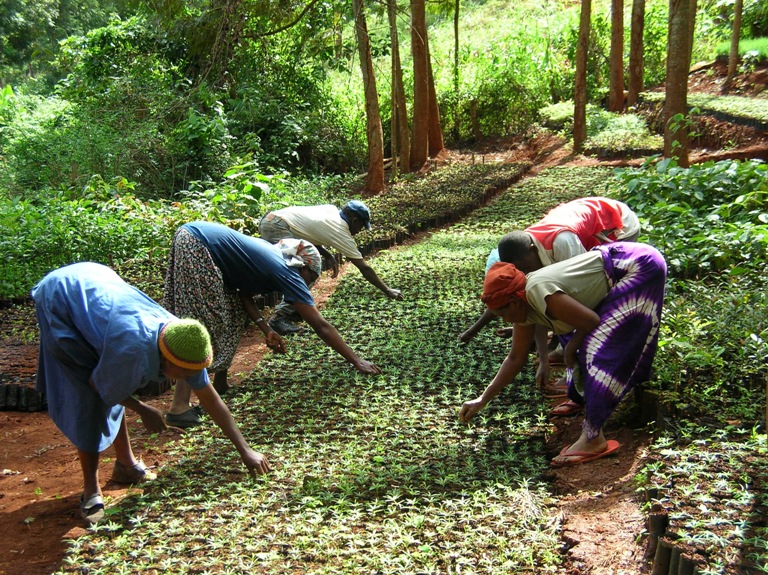
In 1977, Maathai begins to organise women to plant trees and her influential Green Belt Movement is born and soon spreads across the country, urban and rural, involving family and neighbourhood organisations, schools, churches, trades’ bodies and the like. Under the slogan, “One person, one tree”, the goal is to plant a tree in the country for every person in Kenya’s population of 15 million at the time. Soon, the country’s forestry commission is running short of seedlings, such is the demand to plant trees everywhere. After a decade’s work, an assessment of progress so far is hugely impressive: “several million trees” have been planted with the projection that by the year 2000, the movement would be able to plant 30 million trees, twice the target at initiation (175); about 200 women-groups are now working full time in the project – from nurturing nurseries to tending planted trees; more than a 1000 green belts are being overseen by schools and students; the movement is now spreading to other parts of Africa especially Uganda, Tanzania, Ethiopia, Mozambique and Rwanda with study groups from these countries visiting Kenya  regularly for exchange of  ideas and  solidarity (177); consequently, the Pan-African Green Belt Network emerges after workshops in Kenya involving 45 representatives from 15 African countries (177).
But these successes have had huge costs on Maathai. She is subjected to a series of harassments, intimidations, arbitrary arrests and detentions by the police and other state armed agencies and even imprisonment, on a number of occasions, by the increasingly authoritarian state led by Daniel arap Moi which views her work on the environment as essentially “political”.

MAATHAI has undoubtedly expanded the parameters of her work to incorporate organised protests against unlawful detentions and gaoling of citizens, support for freedom of speech and association, students’ and workers’ rights, and anti-corruption campaigns against public officials including those in such sensitive sectors that affect people’s everyday life such as the judiciary and law enforcement bureaus. The Maathai-led October 1989-January 1990 mass opposition to the Moi regime’s attempt to build a 60-storey tower office and a shopping complex fronted by an imposing stature of the tyrant in Uhuru Park, Nairobi’s equivalent of London’s Hyde Park or New York’s Central Park, is unquestionably the landmark, epic struggle of her illustrious career and her success in forcing the regime to abandon this project, utterly humiliated, marks the beginning of the end of that dictatorship.
To be

On a personal level, though, the strain of such high-profile and very busy work schedule begins to affect family life, and, in Maathai’s case, results in the breakdown of her marriage to an influential Kenyan politician and entrepreneur. The divorce proceedings are very bitter and play out in public with the husband, Mwangi Mathai, insisting that Maathai drop her married name (i.e., the man’s surname, “Mathai”) as part of the “final settlement” of the marriage’s dissolution. Ironically, Maathai had felt even before marriage in 1969, three years after returning from the US, that she would rather retain her name, Wangari Muta, in keeping to her historic resolution of the name-question earlier on in the decade. She didn’t want to be a Mrs Wangari Mathai! Besides, the “Mrs” is a title introduced to the country by the British as women in pre-conquest Gĩkũyũ and other African nations (including, for instance, the Igbo in the southwestcentral region, 2000 miles away) kept their names after marriage. Maathai only relented then on taking on the “Mrs” and becoming Wangari Mathai because the subject was creating some strain early on her marriage. Now, eight years later, she is challenged in court by her estranged husband to drop the name that she had not sought for in the first place. So nearly 20 years since Mount St Scholastica College, Atchison, Maathai faces yet another crisis on name and naming. True to type, she responds intelligently and resolutely:   
I remember thinking to myself, ‘I’m not an object the name of which can change with every new owner!’ And I had resisted adopting his name in the first place! As a way to deal with my terrible feelings of rejection, I got the idea of adding another ‘a’ to ‘Mathai’ and to write it as it is pronounced in [Gĩkũyũ]. And so I became ‘Maathai’. The extra syllable also signified that although a part of me would always be connected to Mwangi and his surname, I had a new identity. Henceforth, only I would define who I was: Wangari Muta Maathai. (147)
On 8 October 2004, the Norwegian Nobel Committee announces that the 2004 Nobel Peace Prize has been awarded to Wangari Muta Maathai for her “contribution to sustainable development, democracy and peace”.  As Maathai receives this news of her outstanding accomplishment, the daughter-of-the-soil turns and faces Mt Kenya: “the source of inspiration for me throughout my life, as well as for generations of people before me” (293).

SADLY, on 25 September 2011, the news is flashed across the world that Wangari Muta Maathai has died unexpectedly in Nairobi after a brief illness. She was 71. She receives a heroine’s funeral by both the Kenyan state and society. According to the latest, 2013 figures from the Green Belt Movement, 51 million trees have been planted in Kenya since the 1977 founding of the organisation. This is well over three times the number of trees envisaged by Maathai’s original conception.
(Alice Coltrane Quintet, “Blue Nile” [personnel: Coltrane, harp; Joe Henderson, alto flute, Pharoah Sanders, alto flute; Ron Carter, bass; Ben Riley, drums; recorded: Coltrane home studios, Dix Hills, New York, US, 26 January 1970])
References
Achebe, Chinua. “African Literature as Restoration of Celebration”. Kunapipi, 1990, 12, 2, 1-10.
Alice Coltrane Quintet.  “Blue Nile”. Coltrane home studios, Dix Hills, New York, US, 26 January 1970.

Ekwe-Ekwe, Herbert. Readings from Reading: Essays on African Politics, Genocide, LiteratureDakar and Reading: African Renaissance, 2011.

Maathai, Wangari. Unbowed: One Woman’s StoryLondon: Arrow Books, 2008.

*****Herbert Ekwe-Ekwe is the author of The longest genocide – since 29 May 1966 (2019) and co-author, with Lakeson Okwuonicha, of Why #DonaldTrump is #great for #Africa (2018)


Twitter @HerbertEkweEkwe

Saturday, 16 March 2019

Delusionary genocidist Nigeria...


(Olusegun Obasanjo: ... delusion ... fantasy ... hallucination)

Herbert Ekwe-Ekwe

Nigeria will be one of the ten leading nations in the world by the end of the centuryOlusegun Obasanjo, head of the genocidist Nigeria military junta, 1979 (Chinua Achebe, The Trouble with Nigeria [Enugu: Fourth Dimension, 1983, p. 9]).

FORTY YEARS after this Nigerïaña fantasy, proclaimed by a génocidaire in the Igbo genocide who the London Financial Times, it should be recalled, labelled admirably as the godfather of modern Nigeria” (London, 14 April 2012), this “country” is nothing else but arguably the globe’s most notorious genocidist state whose current regime, headed by jihadist Muhammadu Buhari, retains the Boko Haram and Fulani militia, two of the five deadliest terrorist groups on earth presently (Institute of Economics & Policy, “Global Terrorism Index 2015”, Sydney: IEP, November 2015), as adjunct brigades it deploys in its genocide against the Igbo people of Biafra and its expanded campaigns within Nigeria itself to destroy a constellation of constituent African nations, predominantly Christians, domiciled in the south Kaduna provinces of the northcentral region and  in the eastcentral Benue valley.
(George Russell Sextet here plays “Nardis”, a composition by Miles Davis [personnel: Russell, piano; Don Ellis, trumpet; Dave Baker, trombone; Eric Dolphy, bass clarinet; Steve Swallow, bass; Joe Hunt, drums; recorded: Riverside Records, New York, US, 8 May 1961])


*****Herbert Ekwe-Ekwe is author of the recently published The longest genocide  since 29 May 1966 (2019)  (https://re-thinkingafrica.blogspot.com/2019/01/published-longest-genocide-since-29-may.html)

Twitter @HerbertEkweEkwe


Sunday, 29 July 2018

Titans in conversation: James Baldwin and Chinua Achebe discuss history, art, politics

(James Baldwin and Chinua Achebe: … African Atlantic discourses, University of Florida, Gainesville, 9 April 1980…)
Herbert Ekwe-Ekwe

THURSDAY 2 August 2018 is the 94th birthday of James Baldwin – novelist, essayist, commentator, dramatist, arguably African America’s leading writer and intellectual during its age of freedom affirmation, 1950s-1990s. 

As part of this week’s commemoration of the birthday, re-thinkingafrica here reissues that Baldwin’s historic conversation with Chinua Achebe, Father of African Literature (University of Florida, Gainesville, 9 April 1980), originally published by brainpickings.

...Reflections on history, art, politics, brainpickings, 22 September 2014,
(https://www.brainpickings.org/2016/09/21/james-baldwin-chinua-achebe-art/), accessed 28 September 2014.
(Sam Rivers Quartet, “Ellipsis” [personnel: Rivers, tenor saxophone; Jaki Byard, piano; Ron Carter, bass; Tony Williams, drums; recorded: Van Gelder Studio, Englewood Cliffs, NJ, US, 11 December 1964])
 Twitter@HerbertEkweEkwe

Tuesday, 10 October 2017

Chuks Iloegbunam, the respected journalist and author, reviews The Asaba Massacre by S Elizabeth Bird and Fraser M Ottanelli

(Asaba Massacre Memorial)

Chuks Iloegbunam

The porter’s predicament

Book title: The Asaba Massacre: Trauma, Memory and the Nigerian Civil War

Authors: S Elizabeth Bird and Fraser M Ottanelli

Publishers: Cambridge University, 2017

Extent: 258pp

Price: £22.99pb/£80.00hb/£14.04kindle; US$29.97pb/US$99.97hb/US$18.64kindle

WE FIND this introduction in the book:

“In October 1967, early in the Nigerian Civil War, government troops entered Asaba in pursuit of the retreating Biafran army, slaughtering thousands of civilians and leaving the town in ruins. News of the atrocity was suppressed by the Nigerian government, with the complicity of Britain, and its significance in the subsequent progress of that conflict was misunderstood. Drawing on archival sources on both sides of the Atlantic and interviews with survivors of the killing, pillaging, and rape, as well as with high-ranking Nigerian military and political leaders, S. Elizabeth Bird and Fraser M. Ottanelli offer an interdisciplinary reconstruction of the history of the Asaba Massacre, redefining it as a pivotal point in the history of the war. Through this, they also explore the long afterlife of trauma, the reconstruction of memory and how it intersects with justice, and the task of reconciliation in a nation where a legacy of ethnic suspicion continues to reverberate.”

Having read the book, I attest to the veracity of the above claim. The credibility of the publication is grounded in the impeccable academic credentials of the authors. Bird is Professor of Anthropology at the University of South Florida. She has to her credit more than 80 articles and chapters on popular culture, media, heritage, and memory, as well as five books, two of which are award winning.

Ottanelli, her co-author, also of the University of South Florida, is Professor of History. He has authored and co-authored four books and several articles and essays on radical movements, ethnic history, and comparative migration in the twentieth century.

YET credibility often rides on more than the currency of academic triumph. On Africa, for instance, notable literary voices like Chinua Achebe and Ngügï wa Thiong’o have argued that the continent’s stories are better rendered by Africans and in their own tongues. But their standpoint does not invalidate the benefit of detachment often achieved by non-partisan non-Africans. This point profits from the consideration that, through half a century, Nigerians have failed to agree on what actually happened in Asaba on October 7, 1967.

The authors are mindful of the fact that they are liable to the charge of appropriating and running with a story not their own, a charge that, of course, pays scant attention to the reconstruction of today’s world as a Global Village in which what happens in Alaska is much the business of its denizens as it is the concern of the inhabitants of Sarawak. Thus, they take the pains to state that funding for their book did not come from Africa, while the story they have told is the result of extensive research, and the aggregation of the voices of massacre survivors, the relations of the victims and other assorted quarters. All told, 77 people were interviewed. The result is a 239-page book of six chapters:

1. The Road to War and Massacre

2. What Happened at Asaba

3. Causes and Consequences

4. Surviving the Occupation

5. Reclaiming Memory in an Age of New Media

6. Trauma, Identity, Memorialization, and Justice

WHAT emerged, therefore, is a particularly sad story whose continued denial can only be by bigots. The book also strikes a blow for hope, for justice and for renewal. The sequences of the sorry events of October 7, 1967 and the nonchalance with which they have been responded to in some quarters induces consternation and depression, in that in 1967, officers and men of the Nigerian Army lined up thousands of unarmed civilians, their fellow citizens, and mowed them down by machine gun fire. It represented impunity and callousness. But, the atrocity is not novel in contemporary history.

A few examples are apposite...

The My Lai Massacre
On March 16, 1968, U.S. Army soldiers of the C Company, 1st Battalion, 20th Infantry Regiment, 11th Brigade, 23rd (America) Infantry Division massacred some 504 unarmed civilians in My Lai, South Vietnam. Victims included men, women, children, and infants. Some of the women were gang-raped and their bodies mutilated. It was described as “the most shocking episode of the Vietnam War.”

The Rwandan Genocide
This was the genocidal slaughter of ethnic Tutsis in Rwanda by members of the Hutu majority. About a million Rwandans were killed during the 100-day period from April 7 to mid-July 1994. The killing orgy cut the Tutsi population by 70 percent.

The Khmer Rouge Killing Fields
These refer to sites in Cambodia where collectively between two and three million people were killed and buried by the Pol Pot Communist Khmer Rouge regime, between 1975 and 1979. The mass killings were a state-sponsored genocide (the Cambodian genocide) that targeted people suspected of connections with the former government or with foreign governments, as well as professionals, intellectuals, ethnic Vietnamese, ethnic Thai, ethnic Chinese, ethnic Cham, Cambodian monks and Cambodian Christians.

The Holocaust
The Holocaust was the Nazi programme of exterminating Jews under Adolf Hitler that cost the lives of six million Jews, and others during World War ll.

IN ALL, one ominous string ties massacres everywhere in the world, irrespective of their scale. And that is the string of evil. But that, precisely, is where the similarity ends with the evil of massacres in Nigeria. Massacres in Nigeria are rarely acknowledged in official quarters and never punished in Nigeria. The reverse is the case in most other parts of the world. For instance, there were spirited efforts in top political and military circles to cover up My Lai. But soldiers, who objected to the massacre, a determined American press, and an outraged public refused.

Twenty-six soldiers eventually faced trial for criminal offences, but only Lieutenant William Calley Jr., a platoon leader in C Company, was convicted for the killing of 22 villagers. Handed a life sentence, he ended up serving only three and a half years under house arrest. Minimal as the sanction was, and despite its exposition of American establishment’s reluctance to conclusively pursue the cause of justice, the trials served one big purpose. It demonstrated in America, in Vietnam and across the globe a universal acknowledgement of evil perpetrated by some of the loudest exponents of democratic credentials.

In 1997, 12 years after the toppling of the Khmer Rouge junta, the Cambodian government, with the UN’s
assistance, set up a genocide Tribunal. Nine years later, the Tribunal started sentencing the convicted. Nuon Chea, second in command of the Khmer Rouge and its most senior surviving member, was tried for war crimes and crimes against humanity. He was given a life sentence in August 2014. In July 2010, Kang Kek Iew (aka Comrade Duch), director of the S-21 prison camp, was convicted of crimes against humanity and sentenced to 35 years' imprisonment, later extended to life. Many others were similarly sentenced.

Some of the most celebrated trials for war crimes and crimes against humanity have to do with the Holocaust. At the end of World War ll, international and domestic courts conducted trials of accused war criminals. This followed the 1942 declaration by the United States, Great Britain, and the Soviet Union that officially noted the mass murder of European Jews, and resolved to prosecute those culpable. The trials of leading German officials before the International Military Tribunal took place in Nuremberg, Germany.

Twelve of those convicted were sentenced to death, among them Reich Marshall Hermann Göring, Hans Frank, Alfred Rosenberg and Julius Streicher. Three of them got life, while four others received long stretches behind bars that ranged from 10 to 20 years. Hundreds of other war criminals were tried in what was called Subsequent Nuremberg Proceedings. About half of these were convicted. About the most famous of the trials of German war crime perpetrators was held in Jerusalem in 1961: the trial of Adolf Eichmann, chief architect in the deportation of European Jews. He was condemned, executed and his remains dumped in the sea.

The trial of Rwandan perpetrators of genocide was particularly daunting. The judicial system was in shambles after the genocide; of 750 judges, 506 did not remain after the genocide – many were murdered and most of the survivors fled Rwanda. By 1997, Rwanda only had fifty lawyers in its judicial system. Yet, over one million people were potentially culpable for their role in the genocide. The trials proceeded at a very slow pace. Of the 130,000 suspects in Rwandan prisons, only 3,343 cases were handled between 1996 and 2000. Of those defendants, 20 percent received death sentences, 32 percent got life behind bars, and 20 percent were acquitted.

Twenty-two individuals were publicly executed by firing squad in April 1997. Meanwhile, the UN established the International Criminal Tribunal for Rwanda, based in Arusha, Tanzania, with jurisdiction over high-level members of the government and armed forces. Many of those that appeared before the Tribunal ended up in prison.

DESPITE THESE EXAMPLES of the trials and conviction of perpetrators of genocide and war crimes, Nigeria remains uninterested in emulating this course of justice. That is why it boasts a personality like General I. B. Haruna. The authors say the following of the man on page 80 of their book: 
(A 2001 news account quoted Haruna’s testimony to the Nigerian Human Rights Violations Investigations Commission [HRVIC], the “Oputa Panel,” which was formed in 2000):

“As the commanding officer and leader of the troops that massacred 500 men in Asaba, I have no apology . . . I acted as a soldier maintaining the peace and unity of Nigeria.” 
This quote has been widely circulated online, and Haruna has often been named as the perpetrator of the massacre. However, Haruna was nowhere near Asaba at the time and could not have been involved. In 2016, Haruna wrote to us that his words were taken out of context and used to bolster the Igbo case for genocide. Furthermore, in spite of all evidence to the contrary, he maintained his position that there never was a massacre: “The so-called Asaba massacre is a figment of propaganda!” Essentially, Haruna’s statements on Asaba are contradictory and self-serving, and are not useful in establishing what happened.
YET Haruna’s words are poignant. Because the man is not only an Army General but also a trained lawyer, his viewpoint properly situates wantonness in Nigeria. The point is not really his denial of Asaba. After all, they abound today who are adamantine in the insistence that the Holocaust is a figment of Jewish and pro-Zionist imagination. The problematic is, however, tied to the premeditated killing of “500” human beings indexed as unworthy of remorse and apology. People could ask what iron would do if gold rusted. They cannot fail to see the corollary between Haruna’s Nigerian template and Soviet ideologue Georgy Plekhanov’s observation that, “the dominant ideology in any society is that of the ruling class.” This, then, is the score: the all-powerful sit pretty at a pinnacle high above all laws, national and international. From this Olympian height, they could own up to serial atrocities and yet remain legally unscathed; they could brazenly deny even the self-evident and dare the nonplussed to self-destruct. It all explains why an argument with a uniformed and armed Nigerian could force from his mouth the ominous warning that, “If I kill you, you die for nothing.” That is also why cadres of the country’s Police Mobile Force are known as “Kill and Go” free.

THIS Kill and Go Free mentality was clearly at play in Asaba on October 7, 1967:
“Twenty of our men were selected and lined up in front of us and told as follows, ‘Today, I be your God. Me first, God second. God give you life, me I go takem. Two minute time you go die.’ ... Two minutes afterwards these 20 men were shot. Another 20 were picked up and the same ritual followed.” 
Apparently tiring of killing individuals with rifles, the soldiers then readied machine guns, both mounted on trucks and freestanding, and mass shooting began. Fifteen-year-old Ify Uraih had joined the parade with his father and three older brothers, Paul, Emmanuel (Emma), and Medua; he described what happened:
“Some people broke loose and tried to run away. My brother was holding me by the hand; he released me and pushed me further into the crowd . . . They shot my brother in the back, he fell down, and I saw blood coming out of his body. And then the rest of us … just fell down on top of each other. And they continued shooting, and shooting, and shooting ... I lost count of time, I don’t know how long it took … After some time there was silence. I stood up … my body was covered in blood, but I knew that I was safe. My father was lying not far away; his eyes were open but he was dead.”
Exactly how many died in this single incident is unclear; around 700–800 seems likely, in addition to many who had died in the previous days. Sporadic shooting continued for hours until darkness caused the soldiers to disperse…
“My cousin said we should wait till it was dark so that we could go together, and I agreed. You could hear the sound of the injured crying. One man, who heard us talking, he was as old as my father. He had his hand almost severed from the rest of his body. And he told me that he had a knife, that I should please help him amputate the hand ... I told him I could not do it. He died later. I knew his children.”
Ify Uraih and his cousin ran to their grandmother’s house, where they found his sisters and three younger brothers. He told them their father and three older brothers were dead; later he learned that Medua had survived, gravely wounded, and had been carried to the bush by his friend.
Community elders Michael Ugoh and Leo Okogwu were among large numbers of the leading age grades to die. With all the men in hiding, it was left to women and children to attempt to retrieve the bodies of their fathers, brothers, husbands, and other relatives and then drag them back to their compounds for burial. Joseph Nwajei, the boy who had returned with family from Ibadan, had escaped into the bush from the family compound after watching the earlier execution of his uncle George, a prominent civil servant. When he returned a few days later, he learned of the death of his two brothers, aged 12 and 17, in the mass shooting:
“Mum told me that in the evening hours of the 7th, she had to go and look for their corpses at the mass place where they were shot . . . Mum, in the evening, was able to identify their corpses, took them in a wheelbarrow, pushed them to the family house, where they were buried. So, I never saw their corpses, I never saw their bodies.” 
Most victims, however, were dumped in mass graves or thrown into the Niger. Few people had any opportunity to conduct requisite burial practices – an affront that is deeply resented to this day. When it was safe to move about, Frank Ijeh, a local Red Cross worker, enlisted surviving men to dig hurried, shallow graves wherever they found bodies around the town: “There are so many, I cannot remember. So many, so many, so many.”  In spite of these efforts, many lay unburied for several days. Interviewed in 1977, a Mrs. Mordi reported that “for nearly two days . . . the soldiers wouldn’t let us come near . . . without opening fire. It was only when the stench of decaying corpses was all over the place that the soldiers relented . . . ” She retrieved her husband’s body, but not that of a Catholic lay brother, Ignatius Barmah, who had died beside him. She was able to put tinyele’a, a white cloth, over him – an important ceremonial act usually done by close relatives. Esther Nwanze recalled how wives went searching for their husbands, dragging them home if they could find them: “Some dragged two days before they reached home.” (pp. 47-49)
FIFTY YEARS after the mass sacrifice at the Altar of Moloch, Asaba remains. Resilient. Resourceful. Thriving. Hopeful. Peaceful. Thanks are due to the authors for recognizing the laudable role of Asaba women who, when their menfolk were wiped out, moved in and held up the Asaba family. But the extremely sad memories of five decades linger. The people wait for closure. The authors mention and discuss “transitional justice.” That has its place, of course. But can it really happen in the absence of official acknowledgement of the evil done? Can it proceed without official apology?

While this is pondered, there are a number of assumptions and conclusions by the authors that lend themselves to interrogation. This may sound mundane but they describe the people of Asaba as Asabans. No. They are Ndi Asaba or Ndi Ahaba. More seriously, their narrative on the Aburi talks is astonishing: “In early January 1967, at a two-day summit in Aburi, Ghana, between federal authorities and the country’s regional governors, Gowon and Ojukwu were unable to reach a compromise over whether Nigeria should become a loose confederation of semi-independent states or remain a federation. The failure of the Aburi summit accelerated the Eastern Region’s movement toward secession.” (p. 10)

THIS account is unfortunate, to say the least. Gowon and Ojukwu did reach an agreement at Aburi. The records of meeting termed the Aburi Accord are public property, even available on the Internet. They show unequivocally that it was Gowon who reneged on the Accord, the last straw whose snapping inevitably led to the shooting war and the avoidable wastage of millions of precious lives. This embarrassing misrepresentation of a crucial piece of Nigerian history ought to be corrected in the next edition of the book.

The authors are spot on in concluding that the Asaba massacre and the shielding of the terrible development from public knowledge by Lagos and London helped to prolong the war for two main reasons. Had the story of the massacre hit the public domain, indignation in Britain and elsewhere could have forced Whitehall into reconsidering their unconditional supply of weaponry to the Federal side, thereby making Lagos more amenable to the idea of a peaceful resolution of the conflict. Again, the massacre compelled a lot of Ndi Asaba to join the war on the Biafran side, which used the macabre event to argue that laying down their arms would result in conclusive genocidal action against them. It was from this jump off point that the authors argued that Gowon had not prosecuted a war of genocide. Without playing on words, the Biafrans had a good case in terming the war genocidal.

THE ANTI-IGBO pogrom of 1966, a prelude to the war, had claimed an estimated 50,000 Igbo lives, according to the Massacre of Ndigbo in 1966: Report of the Justice G. C. M. Onyiuke Tribunal. That’s one. Two, the Gowon regime blockaded Biafra on the strength of a policy that proclaimed starvation a legitimate instrument of warfare. This cost kwashiorkor-induced deaths, mostly of children, by the tens of thousands. Three, throughout the war itself, the bombing and strafing of Biafran churches, hospitals, markets and refugee camps by Nigerian fighter-bombers were incessant, remorseless and systematic, leading to the deaths of thousands which never elicited official condemnation from a Britain solely interested in Nigeria’s oil. As a matter of fact, British Prime Minister Harold Wilson’s sanction of the punitive method of Gowon’s war underscored its genocidal configuration. Because of the importance of this point as a factor that framed the war, concise citation is imperative here:
“... Harold Wilson is totally unfazed as he informs Clyde Ferguson, the United States state department special coordinator for relief to Biafra, that he, Harold Wilson, ‘would accept a half million dead Biafrans if that was what it took’ Nigeria to destroy the Igbo resistance to the genocide ...” (Roger MorrisUncertain Greatness: Henry Kissinger and American Foreign Policy, London & New York: Quartet Books, 1977, p. 122 – quoted from Herbert Ekwe-Ekwe, “Igbo genocide, Britain and the United States”, re-thinkingafrica, 4 October 2015, http://re-thinkingafrica.blogspot.co.uk/2015/10/herbert-ekwe-ekwe-conquerors-concord-in.html)
ASABA remains to this day, it must be reiterated. But, to fully understand the Massacre of October 7, 1967, it must be seen as an integral part of the overall plan for and course of Nigeria’s prosecution of the civil war. Bizarrely, Radio Kaduna broadcast on a daily basis and throughout the war a Hausa song that gave a chilling message in translation:
 
Yes, let’s go, let’s march
Let’s go chase them from their homes
Kill them, plunder their homesteads
Ravage their wives
And abandon them in futile wailing

The entire experience of the Asaba Masaccre and the Nigerian Civil War itself is so bleak that recourse to a specific pattern of Igbo prayer is apposite here. Ozoemena (May it NOT happen again); Ozoemezina (May it NEVER happen again.) It is a fervent prayer indexed on hope. But it is also a prayer against the grain of the Nigerian condition, a country in which red-hot pepper has invariably been administered as the cure for conjunctivitis. The problems that landed Nigeria in internecine war over five decades ago have since been compounded. The country is today much more disunited than it ever was. The telltale signs of wild political excesses proliferating the contingences of fresh cataclysms are all too obvious for the realistic to be apprehensive. Solid foundations are being laid for further anniversaries of massacres. On December 12, 2015, peacetime Nigeria witnessed the Army troops’ massacre of hundreds of Shiite Muslims in Zaria. Since last year IPOB agitators for self-determination have become cannon fodder in the hands of the same military. And then there are the Fulani herdsmen invading communities and snuffing out the lives of unsuspecting hundreds.

IT IS at this point that the somber parable of the porter’s predicament must come in. He has quit moaning about the long decades it has been his unenviable lot to bear an oppressive burden; his worry now is tied to not knowing for how much longer he will be forced to groan under its dead weight.

This review was read at the 50th Anniversary of the Asaba Massacre in Asaba, Delta State, Nigeria, on Saturday October 7, 2017

Chuks Iloegbunam (chuks.iloegbunam@gmail.com)