Showing posts with label Osita Ebiem. Show all posts

Monday, 8 June 2015

FWD: Osita Ebiem, “Nigeria’s governance by slogans and propaganda”*****

Nigeria has just transitioned into a new political regime on May 29, 2015. (Incidentally, May 29 in history marks the official date when Igbo Genocide in Nigeria began in 1966.) The new Nigerian leader Muhammadu Buhari is an Islamic fundamentalist from the north region who took over from Goodluck Jonathan, a Christian, from the south. Buhari had first ruled the country 32 years ago as a military dictator. He led a coup d’état that overthrew a civilian government. Buhari is a Fulani whose ethnic group believes that only individuals from their ethnic and religious group are “born-to-rule” Nigeria as long as the country remains one country. Buhari as a Muslim is also a staunch believer in sharia implementation in Nigeria. This is how he expressed it: “I will continue to show openly and inside me the total commitment to the Sharia movement that is sweeping all over Nigeria (http://www.vanguardngr.com/2014/12/insurgency-buharis-call-full-sharia/#sthash.HoUcVfjW.dpu).
(Muhammadu Buhari)
 Buhari thinks that the implementation of sharia in Nigeria is “a legal responsibility which God has given us [Muslims leaders] within the context of one Nigeria to continue to uphold the practice of Sharia wholeheartedly and to educate non-Muslims.” For 12 years the fight to take over the presidency of Nigeria became a do-or-die affair for Buhari because “what remains for Muslims in Nigeria [to do] is for them to redouble their efforts [and] educate Muslims on the need to promote the full implementation of sharia law” (this and the one above are quoted from Buhari’s address in an Islamic seminar in Kaduna in 2012)

Nigeria that is sustained by slogans and propaganda

Over the years the Nigerian state has been sustained by propaganda and slogan-mongering political gladiators. Many critics believe that as a result of this trying to run a country’s government based on political sloganeering and gimmicks is largely responsible for the lack of any concrete political or sociological achievement in Nigeria since its independence from colonial Britain in 1960. The only visible real developments are usually those told by some unscrupulous international media people who many critics accuse are paid off by the northern Muslim oligarchs to doctor facts and paint hollow fantastic pictures of a “united Nigeria” that is not.

During the presidential campaign Buhari ran on the platform of a tough ruler who would stamp out corruption from the political and social life of the country, instil discipline and provide security for the lives and property of the populace. To successfully rout his predecessor in office, with the lobbied influence of some international politicians, Buhari’s team imputed on his opponent the unfounded image of “cluelessness and incompetence”. The slogan stuck and as a purpose-oriented political campaign creation, it served the purpose for which it was manufactured: to impugn and make the opponent appear incapable for the job. And with the deft use of these political gimmicks they successfully deflected the people’s attention from the fact that the “ungovernable political situation” in the country was created in the first place by the same creators of the “clueless” slogan. In 2011 when Buhari lost the presidency to Jonathan, record shows that he instigated so much post-election violence in which many Igbo people in the north were killed because the Muslim mob felt that the Igbo represented Christians of whom Jonathan is a part.

Creating ungovernable state through use of Boko Haram

Earlier, during the political parties’ primaries and nomination campaigns for the 2011 elections, an important northern politician Lawan Kaita made it very clear that it was either a northerner emerged as president in 2011 or the north would make the country “ungovernable” for President Goodluck Jonathan if he emerged the winner of the 2011 election. Lawan Kaita said in an interview that: “Anything short of a northern president is tantamount to stealing our presidency. Jonathan has to go and he will go. Even if he uses incumbency power to get his nomination on the platform of the PDP, he will be frustrated out”.  In conclusion to his threat Kaita said that the “North should not be blamed for the calamity that would befall Nigeria if Jonathan emerged as the president” (http://newsrescue.com/pdp-affair-revealed-man-promised-make-nigeria-ungovernable-jonathan-wins/#ixzz3cKG9TJQL).

Buhari on his own part never regretted the loss of lives that took place in the 2011 post-election violence. Rather in an interview when he was talking about the 2015 presidential election he declared very emphatically that “If what happened in 2011 [alleged rigging] should again happen in 2015, by the grace of God, the dog and the baboon would all be soaked in blood’’ (http://www.vanguardngr.com/2012/05/2015-ll-be-bloody-if-buhari/#sthash.unBxZDmH.dpuf).

 Of course Boko Haram, the Islamic terrorist group based in northeast Nigeria intensified its activities soon after Jonathan emerged the winner of the presidential election in 2011. Not surprisingly north politicians defended Boko Haram’s killings, burning Christian churches, conquering territories and declaring the conquered places sharia-compliant and the capturing of mostly Christian girls and women, selling them into slavery as well as using others as suicide bombers thus: “Boko Haram is fighting for justice. Boko Haram is another name for justice” (Bamanga Tukur a prominent north politician quoted by Nigerian Punch, May 16, 2012).

Innocent people falling prey to fanciful but deadly slogans

In the 2015 elections, Buhari’s team successfully pulled off its sloganeering stunt with the help of (as rumour has it) such formidable political campaign managers like David Axelrod from the United States. The intensity of the sloganeering campaign would become so severe that even the President of the United States of America Barack Obama got carried away by the effusive political gimmickry. Unfortunately on his own part President Obama would be deceived into using the wrong slogan – a Nigerian genocidal slogan. On March 23, 2015, in his goodwill message to Nigerians about the need to conduct a peaceful election Obama used a phrase in what appears to be an honest faux pas?: “To keep Nigeria one is a task that must be done”!

The president of the United States failed to check up on the origin of that slogan before using it in his otherwise innocent speech. The slogan originated in 1967 during the Biafra-Nigeria war when the Nigerian state carried out a genocidal campaign against the Igbo population of the country. In the process of that campaign and with the use of that slogan, Nigeria successfully exterminated 3.1 million of Igbo people and others who made up Biafra which had seceded from the country. “To keep Nigeria one is a task that must be done” is a genocidal cry that goaded Nigeria on till they murdered more than 3 million people. For this reason therefore no decent leader anywhere should ever use it in the context that Obama did. All Igbo people and other Biafrans abhor that slogan since it reminds them of Nigeria’s unrepentant genocide of them.

Buhari “to end” corruption in Nigeria

Let’s quickly look closely at Buhari’s declared intention to end corruption in Nigeria. At this point we need to remind readers that most Nigerian experts regard Sani Abacha, a former Nigerian Head of State as one of the most corrupt leaders that Nigeria has ever had. Yet it’s on record that Buhari served under Abacha’s administration with a portfolio that held billions of dollars in it budget. Buhari was the head of Petroleum Trust Fund (PTF) under Abacha’s regime. Probably because he was anxious to defend his former boss or that he was actually speaking sincerely, Buhari jointly defended Abacha’s regime with his close military comrade Abdulsalami Abubakar by declaring that “Abacha served Nigeria well” (The Guardian, Lagos, June 9, 2008). According to the report the two men made the statement in support of Abacha’s widow Miryam Abacha who complained that “there was no basis for accusing her husband of corruption”, In the report Buhari personally went further to say that “all the allegations levelled against the personality of the late Sani Abacha will remain allegations”. Furthermore, and in Buhari’s opinion, because “it is 10 years now [since Abacha’s death] things should be over by now”. So there you have it: Buhari, Nigeria’s corruption general who is leading, as the new slogan says, the “war against corruption”, advises Nigerians to just move on and away from talking about Abacha’s corrupt practices since “patience and time” of ten years should be enough to create the necessary collective amnesia.

Dictatorial & genocidal tendencies of excessive use of slogans and propaganda in running governments

History shows that dictatorial genocidaires in the past have been enamoured and pathologically attracted to the use of catchy slogans and propagandas. One of the main reasons that prompted this essay is an article titled “Nigeria's New President Lays Out ‘The Buhari Doctrine’” written by Robin Renee Sanders, a former U.S. ambassador to Nigeria & ECOWAS. The article appeared in the Huffington Post.

What caught my attention is the slogan that Sanders used in her article “The Buhari Doctrine”. Here we are talking about the dangers that are inherent in maliciously trying to create political cult figures and the manufacturing of high sounding political slogans and propaganda designed to distract the people from critically appraising their leaders and their performances in governance. This writer has wondered without coming up with any satisfactory answers as to why Sanders chose to undertake this thankless task of making a mountain out of a molehill about the new regime in Nigeria. May be she will need to stop and think for a while and remember that a people’s life and destiny depend on this path and it would be more sensible for her to tread with caution.

History teaches us as earlier said that running governments that are based on the pathological indiscriminate application of flatulent slogans and propaganda will always drive these pathetic political cult personalities that are so created into frenzies as they are pushed along this dangerous path. In most cases it drives these sick personalities to self-destruction and in the process they drag along the state which they oversee into the abyss as they begin to commit genocides against a section, sections or the entire population of their ill-fated country.

Examples abound here. We have already mentioned the Nigerian wartime slogan which the country used to kill 3 million Igbo people and the other Biafrans: “to keep Nigeria one is a task that must be done” (conspicuously, Buhari was part of that Nigerian genocidal squad that murdered the Igbo in during this genocide). The Armenian, the Greek and the other genocides committed by the dying Turkish Ottoman Empire in 1915 were also committed on slogans by the “Young Turks” who wanted to “Turkify” the Ottoman Empire by eliminating Christian Armenians, Greeks and others. The Three Pashas as the “Young Turks” were also called also had another slogan that sounds familiar: “Committee of Unity and Progress”. With these slogans the “Young Turks” exterminated 1.5 million Christian Armenians in order to cleanse the Islamic Ottoman Empire of “non-believers”. In the same way it seems people everywhere, starting from President Obama to Ambassador Sanders and of course Nigerian north leaders are talking about a baseless “unity and progress” of Nigeria. We are also reminded of Hitler’s slogan of the “final solution to the Jewish question”. With that slogan the Nazis killed 6 million Jews in what is today known as the Jewish Shoah or Holocaust. The Roma people and several others were also killed along the Jews.

In her article Sanders created a Buhari who would do no wrong, has all the answers, and who only needs “patience and time” and he would “fix” all of Nigeria’s problems. She also has an “interesting take-away” which is that “the inaugural activities . . . reflected the diversity of Nigeria”. And that “they were inclusive”. In this respect, Sanders could not have “taken away” a more deceptive “truth” than that. The truth however is that going by Buhari’s antecedents this writer and many other concerned individuals doubt very much Buhari’s ability to tackle successfully Nigeria’s problem.

Just for emphasis alone, we must remind the readers of the fact that Buhari was a visible part of Nigeria’s genocidal squad that murdered the 3 million Igbo people and the others in Biafra. And for this reason Sanders may need to be reminded that when she talks about “inclusiveness” that 98% Igbo people and the other people from the geographical stretch of the east region never voted for Buhari and they have expressly made it clear that they are very proud of that collective choice to reject Buhari for being a part of the team that murdered them. Additionally, and very important to note by anyone who cares: since the 29th of May, 1966, which is the official date marking the beginning of Igbo Genocide in Nigeria, Igbo people rejected forever Nigeria’s citizenship, its Buharis, and all others like him and that it’s only “patience and time” and hard work which the Igbo require and they will become free and independent of the Nigerian state forever.
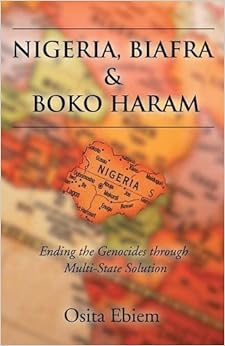
******Osita Ebiem is the author of Nigeria, Biafra & Boko Haram: Ending the Genocides through Multi-State Solution (New York: Page Publishing, 2014)
(Tina Brooks Quintet, “Back to the tracks” [personnel: Brooks, tenor saxophone; Blue Mitchell, trumpet; Kenny Drew, piano; Paul Chambers, bass; Art Taylor, drums; recorded: Van Gelder Studio, Englewood Cliffs, US, 20 October 1960])

Twitter@HerbertEkweEkwe

Monday, 30 June 2014

The antinomies of the “Berlin-state”

(Review essay of Chinua Achebe, A Man of the People [London: Heinemann, 1966], 167pp., £7.10, pb, £4.35, kindle ed/US$11.63, pb)

Arrow of God

This is the year of Arrow of God. 2014 is the 50th anniversary of the publication of Chinua Achebe’s tome. I have been rereading it lately to write a paper for a conference on this jubilee commemoration later on in the year. I decided, earlier on in the year, to first reread A Man of the People, Achebe’s fourth and later novel after Arrow of God, and then approach the latter – in other words, alternate the sequencing of the epochs of the groundings of the two texts by appearing to reread Arrow of God backwards! For now, I would like to keep the important discovery I think I may have encountered in this fascinating rereading format until my conference paper delivery. It will be published subsequently.

One by-product that has of course emerged in the exercise has been the opportunity to review A Man of the People even if this invariably anticipates its own jubilee two years away. Such a review has a pressing relevance for the present, though, as this year marks the centenary of the British conquest regime’s construction of the unmitigated catastrophe that goes by the name Nigeria, in these lands of southwestcentral Africa, to which A Man of the People interrogates most profoundly. The very gasping irony of this construction, as Osita Ebiem has shown in his recent excellent book, Nigeria, Biafra & Boko Haram (Page Publishing, 2014), is that the British were aware, right from the outset, of its cataclysmic outcome: Frederick Lugard, its chief conquest state operative at the time had indeed observed, “south and north [Nigeria] are like oil and water that do not mix” (Ebiem, 2014: 47) and Hugh Clifford, another conquest overseer, agreed, quite panoramically, in the context of both history and geography, “Nigeria is a collection of independent states, separated from one another by great distances, by differences of history and traditions and by racial, political, social and religious barriers” (Ebiem, 2014: 11). Despite the misgivings, the conquest regime “cobbled together” (12) these disparate peoples and worldviews for the express interests of British politicoeconomic and strategic expropriatory goals (12, 26-27).

(Oliver Nelson Quintet, “Six and Four” – personnel: Nelson, alto saxophone; Eric Dolphy, alto saxophone; Richard Wyands, piano; George Duvivier, bass; Roy Haynes, drums [recorded Van Gelder Studio, Englewood Cliffs, NJ, US, 1 March 1961])
Prophet?

A Man of the People (hereinafter, AMP) is published in early January 1966. This is a few days before the military coup d’état that overthrows the Abubakar Tafawa Balewa civilian government which the supposedly outgoing British occupation-governor had imposed on the country in 1959, following a fractious election that the British rigged in favour of its north regional sociopolitical clients. The latter would, in turn, safeguard those vast expropriatory interests of Britain’s in the country subsequently (Herbert Ekwe-Ekwe, “Elections in Africa – the voter, the court, the outcome”, 
http://rethinkingafrica.blogspot.co.uk/2014/03/elections-in-africa-voter-court-outcome.htmlaccessed 29 June 2014).

 A striking feature in the resolution of the grave crisis of this state that Achebe wrestles with in AMP is its degeneration into a military coup and rampaging violence (“But the Army obliged us by staging a coup at that point and locking up every member of the Government” – Achebe, A Man of the People, 1966: 165), an extraordinary predictive insight, if ever there was one, that confronts the reader, considering the gruesome trajectory of politics in Nigeria, in 1966, the year this same state launches the Igbo genocide, the foundational genocide of post(European)conquest Africa, in which 3.1 million Igbo are murdered. Indeed on the receipt of an advance copy of AMP, poet and playwright John Pepper Clarke-Bekederemo observes, “Chinua, I know you are a prophet. Everything in this book has happened except a military coup” (emphasis in the original). Ken Post, a British academic working in west Africa at the time, recalls: “Chinua Achebe proved to be a better prophet than any of the political scientists”. Once again, “Prophet”! Is Chinua Achebe, the Father of African Literature, also a prophet?

AMP focuses on two main protagonists: Nanga, or to refer to his official designation, Chief the Honourable M. A. Nanga, M.P., Minister of Culture, and Odili, the narrator. In case anyone is inclined to think that Nanga’s depiction is much of a parody, given the thrust of the novel, they need to be reassured that a Nanga actively walking the corridors of regime power in contemporary Nigeria, 50 years later, is more likely to wear the following even more bombastic tag: Chief (Prof) Dr Alhaji Sir (Gen, ret.) Mallam The Honourable M. A. Ph.D. Nanga, M.P., mni, Minister of Higher Priesthood & Culture, such is Achebe’s exceptional descriptive and imaginative insights so registered avidly throughout the novel. Nanga epitomises what public service entails for the typical politician in Nigeria, since 1960: corrupt and corrupting operative who fleeces the public treasury, “bloated by the flatulence of ill-gotten wealth, living in the big mansion built with public money” (Achebe, 1966: 85).

Odili, the school teacher, the reflective intellectual, and authorial voice, argues that the Chief (Prof) Dr Alhaji Sir (Gen, ret.) The Honourable Nangas of the times are so stubbornly confident that, “as long as [peoples in society] are swayed by their hearts and stomachs and not their heads the … Nangas of this world will continue to get away with anything” (73). The Nangas here, and in fact elsewhere, Odili continues, have “taken away enough for the owner to notice … It was not just a simple question of a [person’s] cup being full. A [person’s] cup might be full and none the wiser. But here the owner knew, and the owner … is the will of the people” (97). Besides the billions of US dollars which Britain and its allied interests have wrenched from its Nigeria creation over the years, what empirically constitutes that which has been “taken away enough for the owner to notice” by these fleecing brigands of African overseeing truckers between the 1960s and presently is US$700 billion.

Brigand & monster

Here, Franz Schurmann’s observation that these brigands are not “traditional but rather a phenomenon of modernity. They are fighting for power in a Western-type state” is hugely significant. What has been definitive in the past 48 years of this “fighting for power” in the restricted, calibrated spaces of just overseeing these African redoubts created by and for European World/overseas’ interests is that it is a fight to the death – genocides (Igbo, Tutsi, Darfuri, Blue Nile/South Kordofan/Nuba Mountains, Democratic Republic of the Congo), wars, immiseration, genocides, wars, immiseration... Between 29 May 1966 and today, 30 June 2014, the “Berlin-states” of Africa have been responsible for the murder of 15 million Africans. Its worst offender, its most notorious, its principal killer, remains Nigeria. This Nigeria. This haematophagous monster. This Nigeria, this killing machine which continues its murder of Africans most ruthlessly, most flagrantly, most unconscionably, even as these lines are written…

Africans now no longer need any reminders that the “Berlin-state” in their midst is not there for their interests, their wellbeing. Enough of this reminder! Enough! There couldn’t be any more eloquent interlocutors on this subject, in the case of Nigeria, for instance, than Messrs Lugard & Clifford, the very creators of this contraption, as was highlighted earlier. It is now an overriding imperative that each and every constituent people or nation in Africa embarks on the construction of a state that suits its wellbeing. This crisis, currently, is undoubtedly existential.

Freedom

Just as an empirical value has been offered to underscore the urgency of Odili’s philosophical musings on the pulverising economic legacy of the local overseer brigands of the still-occupied Africa, another empirical reference is available, thankfully, to address Odili’s own liberatory conclusion that “the owner knew”, “the will of the people”, at last, does know what is at stake in this human-made imbroglio. It also requires a human intervention to right this wrong of history. Osita Ebiem’s Nigeria, Biafra & Boko Haram, which I cited earlier, is at once positioned to operationalise Odili’s optimism with regards to the resolution of the case of Nigeria, at least, and, 100 years to the day, offers a historic reply to conquest operatives Lugard & Clifford:
No generation of human beings should live as if the world comes to an end after them ... [T]he people in this generation must work at freeing all the entrapped sovereign nations and their people from the traumatic union of one Nigeria … this generation cannot afford to depart this stage without dissolving the Nigerian union in the interest of the next ones. (added emphasis) (Ebiem: 184-185)
Twitter@HerbertEkweEkwe


Thursday, 29 May 2014

Live and let live

(Review essay of Osita Ebiem, Nigeria, Biafra & Boko Haram: Ending the Genocides through Multi-State Solution [New York: Page Publishing, 2014], 222 pp, US$12.84, pbk, US$10.00, kindle ed/£9.53, pbk, £5.99, kindle ed)

On this very day of 29 May 2014 that commemorates 48 years of Nigeria’s launch of the Igbo genocide, the foundational genocide of post-(European)conquest Africa, what more appropriate publication to read, and review, than Osita Ebiem’s  excellent book, Nigeria, Biafra & Boko Haram: Ending the Genocides through Multi-State Solution.

Ebiem wastes no time, at all, to locate the source of this catastrophe, human-made, lest we forget: Nigeria. His chosen epigram for his 222-page thesis is from cerebral playwright and poet Esiaba Irobi: “… Nigeria, a fiction on the edge of extinction”. What a choice! The great Irobi would be proud of Ebiem’s masterful production.

Ebiem’s discourse on the catastrophe that is Nigeria is an urgent reminder to the world of the responsibilities of the state in society and the dire consequences that could occur if there were any doubts or erosions on the salient features of these roles. Ebiem zeroes in on the Nigeria state as a genocide-state. Indeed. No organisation in human society has yet demonstrated a greater capacity and facility to carry out a genocide against a designated people as the state, as history clearly demonstrates in the past 150 years –  starting from the Belgian monarchy/state-organised genocide in the Congo basin in the 19th century/early 20th century (13 million African constituent peoples murdered), the German-state genocide against the Herero people in Namibia in the early 1900s (65,000 out of 80,000 Herero were murdered or 80 per cent of the total Herero population wiped out), the German state genocide against the Nama people in Namibia in the early 1900s (10,000 Nama were murdered or 50 per cent of the Nama population destroyed)  the Turkish state genocide against the Armenians in 1915 (1.5 million Armenians were murdered), the German state organised genocide against the Jews (1938-1945 [6 million Jews were murdered]), the Nigeria state organised genocide against the Igbo (29 May 1966- 12 January 1970 [3.1 million Igbo or one-quarter of Igbo population murdered], 13 January 1970-Present Day [tens of thousands of Igbo murdered]), Rwanda state genocide against the Tutsi (1994 [800,000 Tutsi murdered]), the Sudanese state genocide against the Darfuri (2003 [300,000 Darfuri murdered]) and other constituent nations in the south of the country (since 2006 - [tens of thousands murdered]), the Democratic Republic of the Congo/contiguous states/proxy states genocide against constituent peoples in the Democratic Republic of the Congo (since the mid-1990s [5 million constituent peoples murdered]).

(George Russell Sextet, “Nardis” – personnel: Russell, piano; Don Ellis, trumpet; Dave Baker, trombone; Eric Dolphy, bass clarinet; Steve Swallow, bass; Joe Hunt, drums [recorded Riverside Records, New York, 8 May 1961])
The irony of the Nigeria genocide-state is that its British conquest creators (human-made!) were aware, right from the outset, of this impending catastrophe: chief conquest state operative Frederick Lugard had intoned: “south and north [Nigeria] are like oil and water that do not mix” (Ebiem, Nigeria, Biafra & Boko Haram, 2014: 47). Another conquest overseer, Hugh Clifford, responds to the subject, quite profoundly, in the contexts of both history and geography: “Nigeria is a collection of independent states, separated from one another by great distances, by differences of history and traditions and by racial, political, social and religious barriers” (Ebiem, 2014: 11). Regardless of these thoughts, though, the conquest administration “cobbled together” (12) these disparate peoples and worldviews for the express interests of British political and economic expropriatory goals (12, 26-27). Igbo resistance to the conquest was instant and variegated, as Ebiem recalls, and the occupation’s response to the Igbo was consistently and uncompromisingly brutal. Thus, the occupation’s indifference and/or connivance at Hausa-Fulani-north region organised pogroms of Igbo immigrant populations in Jos and Kano (1945 and1953 respectively) and its police’s massacre of 21 unarmed, protesting Igbo mineworkers in the Enuugwu colliery in 1949 (Ebiem: 27) underscored this British trenchant policy to the Igbo. Against this sordid background of Anglo-Igbo relations, Ebiem contends, British activist involvement in the Igbo genocide, launched in north Nigeria on 29 May 1966, became largely predictable (77-81). This genocide is ongoing, as indicated earlier.

“[I]n the interest of the next ones”

If the catastrophe that is Nigeria is human-made, what about its solution? Human-agency, of course! Osita Ebiem:
No generation of human beings should live as if the world comes to an end after them ... [T]he people in this generation must work at freeing all the entrapped sovereign nations and their people from the traumatic union of one Nigeria … this generation cannot afford to depart this stage without dissolving the Nigerian union in the interest of the next ones. (added emphasis) (184-185)
It is not often that one reads a book on such an incalculable human-made catastrophe by an author of demanding honesty, some might say, “insistent honesty”. Ebiem is calmly but emphatically telling all the constituent peoples in the catastrophe that is Nigeria: Every people here, please go your own separate ways in peace; live and let live. Nothing more.

On this 29th day of May, every Igbo woman and man and every woman and man of goodwill across the world would do well to order Ebiem’s Nigeria, Biafra & Boko Haram. Please read it with family and especially children (10+). The world is surely a much safer place with this text.

Twitter @HerbertEkweEkwe