Rethinking Africa is a forward looking blog dedicated to the exchange of innovative thinking on issues affecting the advancement of African peoples wherever they are. We provide rigorous and insightful analyses on the issues affecting Africans and their vision of the world.
Award-winning prolific poet, novelist, children’s writer, editor, biographer, historian, and librarian, whose work plays a cardinal role in the emergence of contemporary African American letters
(Andrew Hill Quartet, “Cantarnos”[personnel: Hill, piano; Joe Henderson, tenor saxophone; Richard Davis, bass; Roy Haynes, drums; recorded: Van Gelder Studio, Englewood Cliffs, NJ, US, 8 November 1963])
Muhammadu Buhari, head of the genocidist Nigeria regime, embarks on a 3-day “state” visit
to Germany today. According to a regime spokesperson, “cooperation on security”, a euphemism for possible German arms exports/transfers to Nigeria, will be one of
the subjects of Buhari’s discussion with German officials. Indeed, Markus Elderer of the
German foreign ministry had been quoted in the Lagos (Nigeria) Vanguard (7 June 2016) that Nigeria had
asked for German weapons for “security challenges” especially in its
northcentral/northeast region, epicentre of the islamist Boko Haram insurgency.
Igbo genocide But
as I have argued, variously, Buhari is not really at war with Boko Haram not to
mention this organisation’s other ruthless cousin, Fulani militia. On the contrary, Buhari is an integral component
of Boko Haram/Fulani militants. Buhari’s war, since his March 2015
imposition as head of Nigeria regime by US President Obama and ex-British Prime
Minister Cameron, is to the south of Nigeria – in Biafra, occupied by Nigeria
since 13 January 1970.
Buhari has continued the Nigeria
state genocide against the Igbo people, fully supported by Britain,
which he, himself, as a lieutenant then in the genocidist army has been an active participant right from launch date, 29 May 1966. 3.1 million
Igbo people were murdered in
the three phases of the genocide prior to 13 January 1970. Hundreds of
thousands have been murdered subsequently including those murdered since
Buhari’s current position in power, especially beginning October 2015 and has
continued unabated.
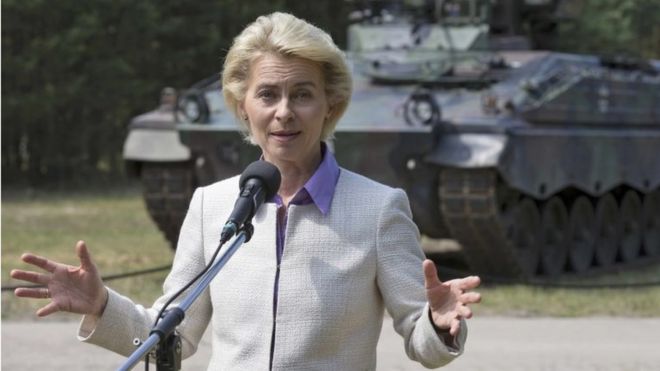
(Ursula von der Leyen: … German defence minister)
Any German weapons sold/transferred to
Nigeria presently, even a bullet, pistol or grenade, are more likely to be
deployed to murder Biafrans. This will amount clearly to German
complicity in the Igbo genocide, this foundational genocide of
post-(European)conquest Africa. Federal Germany, it must be recalled, in
commendation, was one of the first countries which placed a comprehensive arms
embargo on Nigeria during the May 1966- January 1970 phases I-III of the genocide unlike its “other
half”, the GDR (East Germany), which ignominiously supported the genocide,
particularly in its training and reequipping of squadrons of loaned Egyptian
air force pilots flying Soviet MiGs who specialised in the carpet bombing of
Biafran cities and towns and villages.
What relationship? Germany started its direct “relationship” with Africa in the early years of the first decade of the last century quite abominably with its organised genocides
against the following African peoples in the southwest region of the continent:
beginning in 1904 and through to 1907, the German military, operating in the
region, murdered 65,000 out of 80,000 Herero people
or 80 per cent of the total Herero population wiped out; beginning in 1904 and
through to 1907, the German military, operating in the same region, murdered 10,000
Nama people or 50 per cent of the Nama population destroyed. Thirty
years later, the German-state would resume this southwest Africa genocidist antecedent 5000 miles away in the heart of Europe, its
continental homeland, as it embarked on the gruesome genocide of Jewish people,
murdering 6 million of them by 1945. Given its catastrophic
history in the 20th century, it is hopefully inconceivable that Germany would
wish to “reengage” with Africa in this second decade of a new century, this
time in southwestcentral Africa, by intervening to send weapons to Nigeria to enable the latter intensify its campaign of savagery in the ongoing Igbo genocide, a genocide
in which Nigeria and Britain murdered 25 per cent of the Igbo population between
29 May 1966 and 12 January 1970.
(Andrew Hill Sextet, “Dedication”[personnel: Hill, piano; Kenny Dorham, trumpet; Eric Dolphy, bass clarinet; Joe Henderson, tenor saxophone; Richard Davis, bass; Tony Williams, drums; recorded: Van Gelder Studio, Englewood Cliffs, NJ, US, 21 March 1964])
(Born 12 October 1908, Old Saybrook, Connecticut, US)
Pharmacist, award-wining and influential novelist and journalist – publications include the classic,The Street(1946),Country Place(1947),The Narrows(1953),Tituba of Salem Village(1955, novel for children),Harriet Tubman: Conductor of the Underground Railroad(1960, non-fiction)
(Alice Coltrane Sextet, “Isis and Osiris” [personnel: Coltrane, harp, piano;Pharoah Sanders, soprano saxophone, percussion;Charlie Haden, bass;Vishnu Wood, oud; Rashied Ali, drums; recorded: live, Village Gate, New York, US, 4 July 1970])
PRODIGIOUS DRUMMER and bandleader whose band, The Jazz Messengers, cofounded with multifaceted pianist and composer Horace Silver in 1954, becomes a conservatoire for over 30 years, developing the careers ofscores of graduates who would subsequently contribute immensely to the landscape of improvisation and composition in the jazz repertoire – Messengers’ alumni include the following, grouped by their key performing instrument: trumpet (Clifford Brown, Donald Bryd, Kenny Dorham, Lee Morgan, Woody Shaw, Freddie Hubbard, Wynton Marsalis, Terence Blanchard), trombone (Curtis Fuller, Julian Priester, Slide Hampton, Steve Turre, Robin Eubanks), alto saxophone (Lou Donaldson, Jackie McLean, Bobby Watson, Donald Harrison), tenor saxophone (Benny Golson, Johnny Griffin, Hank Mobley, Wayne Shorter, John Gilmore, Billy Harper, Bill Pierce, Javon Jackson, Jean Toussaint, Branford Marsalis), piano (Kenny Drew, Walter Davis, Jr., Benny Green, Wynton Kelly, Bobby Timmons, Jaki Byard, Keith Garrett, Cedar Walton, John Hicks, Mulgrew Miller, James Williams), and bass (Doug Watkins, Wilbur Ware, Spanky DeBrest, Jymie Merritt, Reggie Workman, Charles Fambrough, Lonnie Plaxico, Essiet Okon Essiet)
(Art Blakey & the Jazz Messengers, “Mosaic” [personnel: Blakey, drums; Freddie Hubbard, trumpet; Curtis Fuller, trombone; Wayne Shorter, tenor saxophone; Cedar Walton, piano; Jymie Merritt, bass; recorded: Van Gelder Studio, Englewood Cliffs, NJ, US, 2 October 1961])
Perspicacious pianist and composer whose seminal works include a range of contributions to the jazz repertory standards with his “Round Midnight” being the most recorded standard of all time
(The master at work! Thelonious Monk’s solo here on the classic “Blue Monk” begins at 3.10 minutes into this performance [Thelonious Monk Quartet] for 3 minutes after tenorist Charlie Rouse’s own majestic offering [personnel: Monk, piano; Rouse, tenor saxophone; Larry Gales, bass; Ben Riley, drums; recorded: University Aula, Oslo, 15 April 1966])
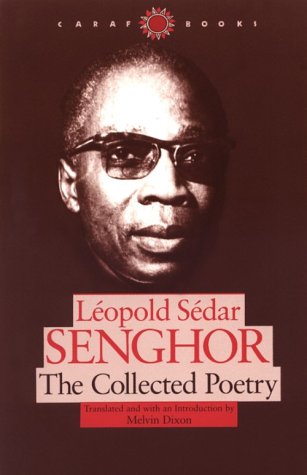
One of the most outstanding poets of the African World, academic, and race and culture theorist, statesperson, first African president of Sénégal, September 1960, following the termination of 300 years of the French conquest, occupation and immisiration, who lays foundation for transforming the country to arguably Africa’s most successful nations-state
(John Coltrane Sextet, Dakar [personnel: Coltrane, tenor saxophone, Cecil Payne, baritone saxophone; Pepper Adams, baritone saxophone; Mal Waldron, piano; Doug Watkins, bass; Art Taylor, drums; recorded: Van Gelder Studio, Hackensack, NJ, US, 20 April 1957])
Very influential tenor saxophonist and multiinstrumentalist (flute, oboe, arghul, shofar, shanai, xun), composer and academic who works uninterruptedly into his nineties
(Yusef Lateef Nonet, “The centaur and the phoenix” [personnel: Lateef, tenor saxophone; Clark Terry, trumpet; Richard Williams, trumpet; Curtis Fuller, trombone; Josea Taylor, bassoon; Tate Houston, baritone saxophone; Joe Zawinul, piano; Ben Tucker, bass; Lex Humphries, drums; recorded: Riverside, New York, 9 May 1960])
Herbert Ekwe-Ekwe is specialist on the state and on genocide & wars in Africa in the post-1966 epoch – beginning with the Igbo genocide, 29 May 1966-present day, the foundational and most gruesome genocide of post-(European)conquest Africa. 3.1 million Igbo or 25 per cent of this nation’s population were murdered by Nigeria and its allies, principally Britain. Africa and the rest of the world largely stood by and watched as the perpetrators enacted this horror most ruthlessly. The world could have stopped this genocide; the world should have stopped this genocide. This genocide inaugurated Africa’s current age of pestilence. During the period, 12 million additional Africans have been murdered in further genocide in Rwanda (1994), Zaïre/DRCongo (variously, since the late 1990s) and Darfur – west of the Sudan – (since 2004) and in other wars in Africa. African peoples have, presently, no other choice but exit/dismantle the extant genocide-state (the bane of their existence & progress) & construct own nation-centred states that serve their interests. He is author of several books & papers on the subject and his new book is entitled The longest genocide – since 29 May 1966 (2019).