Showing posts with label Germany. Show all posts

Friday, 4 May 2018

The archives project! Igbo people of Biafra: “The stink of genocide is everywhere...”


Herbert Ekwe-Ekwe

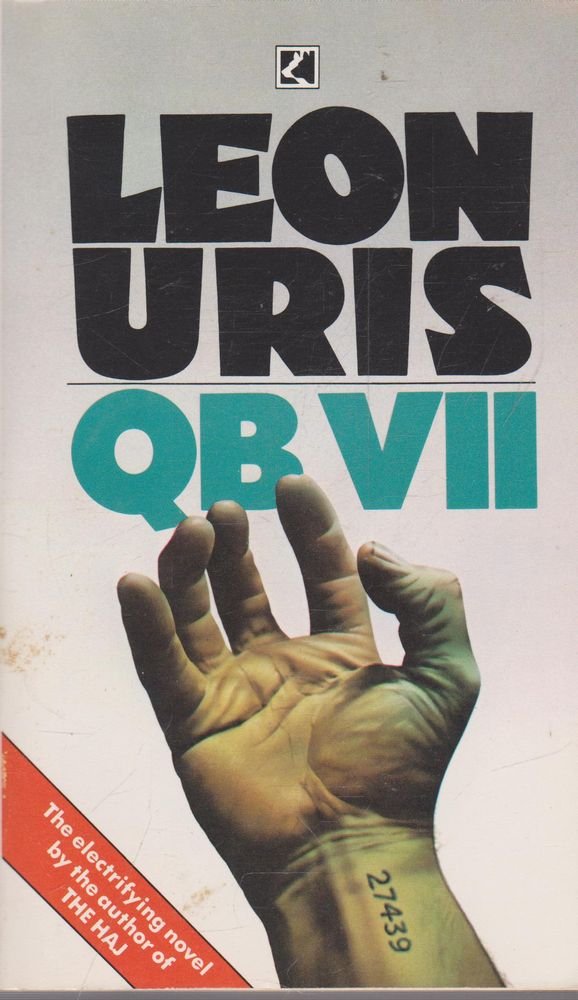
*****EXCERPTS from the gripping and indelible lines on the Igbo genocide (29 May 1966-12 January 1970), the foundational genocide of post-(European)conquest Africa, during which Britain and client-state Nigeria, led by Hausa-Fulani/islamist jihadists, southwestcentral Africa, murder 3.1 million Igbo people of Biafra, beginning 21 years after end of the Jewish genocide, in Leon Uri’s classic, QB VII (London: Bantam Books, 1970), pp. 392-393:
ABE studied them all, his worn-out little band of idealists. 
“Ladies and gentlemen of the jury,” he said in a voice that literally moaned with sorrow, “I would like to make a statement by quoting in effect the words of Thomas Bannister, Q.C., when he said that no one in their wildest imaginations would have believed Hitler’s Germany before it actually happened. And he said, if the civilized world knew what Hitler intended to do then they would have stopped him. Well, here we are in 1967, and the Arabs vow daily to finish Hitler’s work. Certainly the world will not stand for another chapter of this holocaust. There is a right and a wrong. It is right for a people to want to survive. It is wrong to want to destroy them. But alas, the kingdom of heaven is concerned with righteousness alone. The kingdoms of the earth run on oil. Well now, certainly the world should be appalled by what is happening in Biafra. The stink of genocide is everywhere. Certainly, after Hitler’s Germany, the world should step in and stop genocide in Biafra. However, that becomes impractical when one considers England’s investments in Nigeria conflict with France’s interests in Biafra. After all, members of the jury, it is only [African] people killing other [African] people.  
“We should like to think,” Abe said, “that Thomas Bannister was right, when he said more people, including the German people, should have risked punishment and death by refusing orders. We should like to believe there would have been a protest and ask why didn’t the Germans protest? Well today, young people march in the streets to protest Biafra and Vietnam and the principle of murdering their fellow man through the medium of war. And we say to them … why are you protesting so much? Why don’t you go there and kill like your father killed? …” (added emphasis)
(Eric Dolphy Duo, “Alone together” [personnel: Dolphy, bass clarinet; Richard Davis, double bass; recorded: Fuel Records, New York, US, {May?June?July?} 1963])
Twitter @HerbertEkweEkwe

Monday, 16 April 2018

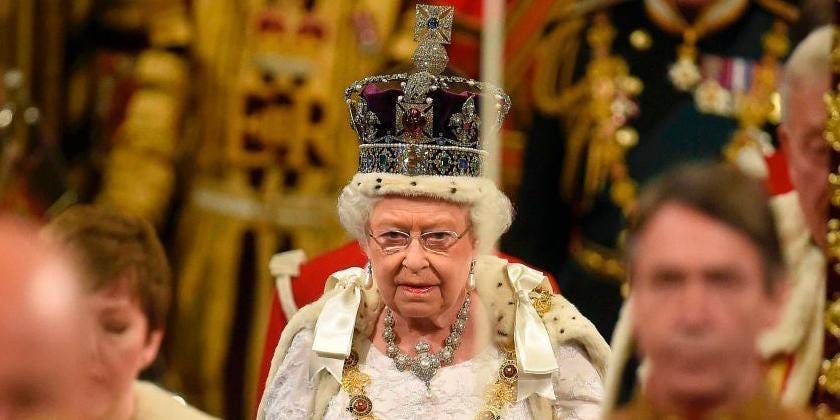
Kingsley Kanu, “The Queen should put pressure on the Nigerian government to respect the people of Biafra”, The Independent, London, Monday 16 April 2018

(British Queen Elizabeth II)
Kingsley Kanu*****

IT HAPPENED on the afternoon of 14 September last year, 2017.

I had come back to visit my family home in Biafra a few weeks earlier from Germany, where I now live. I call it Biafra because Biafra is my country, not Nigeria.

My mother and father, my older brother Nnamdi Kanu and I were in the house, along with friends. It was my son’s thirteenth birthday. I had just been on the phone congratulating him when the first gas canisters were thrown over the fence followed by gunfire. It was 4pm. The house was surrounded by Nigerian soldiers.

I found it hard to breathe. Everyone was panicking. I was witnessing a full on military attack on my parents’ home. I saw a soldier jump over the high fence that surrounds our house and open our main gate. He started shooting at the young men inside. That was when I realised if I didn’t escape now I would die.

There were soldiers and guns everywhere. How I got out only heaven knows. I remember I had to jump two walls. There was sporadic firing from the soldiers and one of the people who tried to follow me, a good family friend, was killed. My youngest brother, Emmanuel, had left a few minutes before and was only a few metres away. Since that afternoon, I’ve heard nothing from my mother and father and my brother Nnamdi.

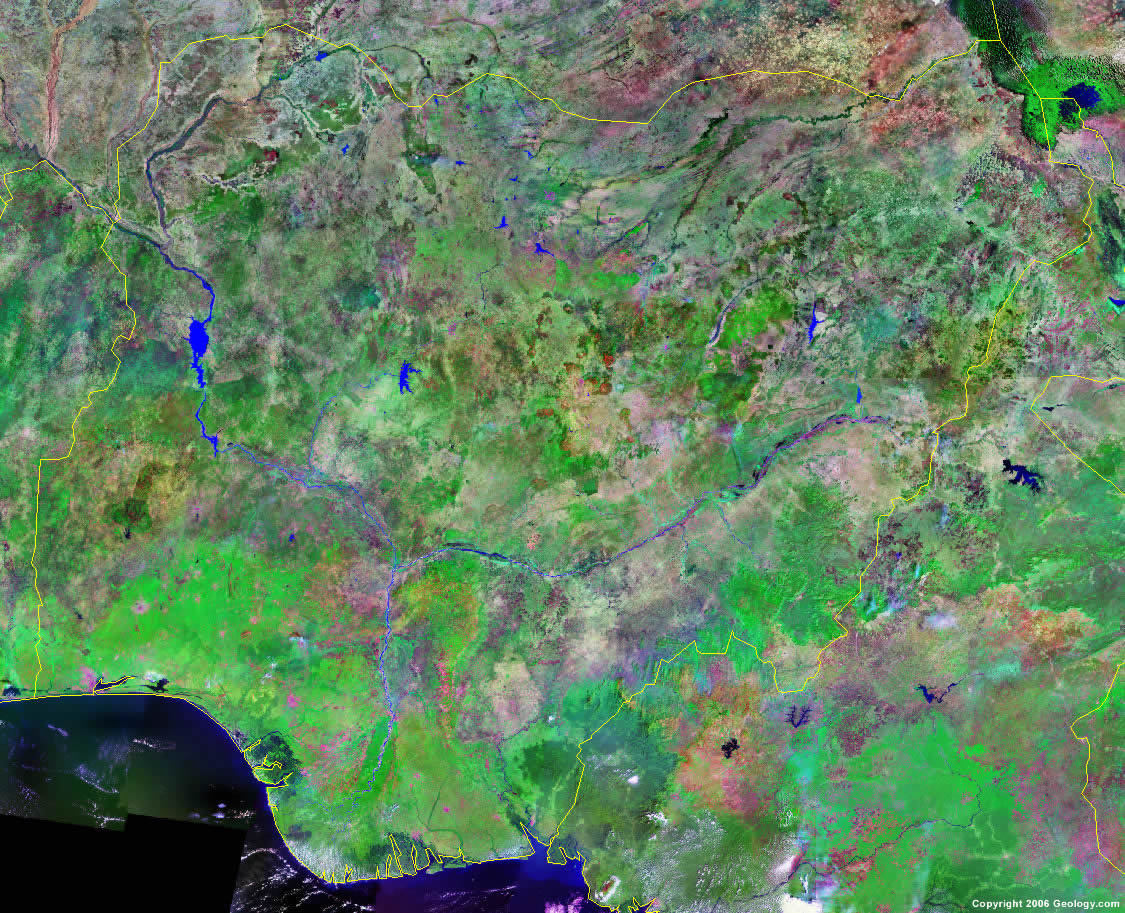
THE ONLY explanation for my family being targeted by the Nigerian government is that we believe in an independent Biafra. People may remember the Biafran War fifty years ago. For a few years, between 1967 and 1970 we were a free state. I was born during the war in December 1969. My family had to leave our home in Umuahia to escape the invasion by the Nigerian army then. My mother was pregnant with me and it was no longer safe. There was fighting just behind our house. 

Biafran people were shot and bombed and starved to death; millions of them. Our experience was genocide. My parents lost most of their relatives.

SO I GREW up in an occupied country, an unhappy country. We were forced to be part of a state manufactured by colonial rule: Nigeria. I remember my father, like everyone else, was given the equivalent of £20 in recompense, to start again.

But despite everything, we had a very happy childhood and a loving family life. My older brother Nnamdi and I did everything together. We were about the same height, so we even shared clothes and shoes. He took care of me as a younger brother and guided me. My father traded in farm produce. Now he is a traditional ruler. People look up to him. They trust him.

When I was younger I knew I couldn’t stay in Biafra. Since the mid-’70s our culture, our history, our people had been all but erased. My brother and I needed to do something to help people to remember and we couldn’t do it there.

I moved to Germany sixteen years ago and raised a family. He moved to London and began the online Radio Biafra, broadcasting in English and Igbo, the language of Biafra, stories about our country, music, commentary and news. The Nigerian government has wanted to shut this down since it first broadcast in 2010.

NNAMDI also started our organisation, Indigenous Peoples of Biafra, IPOB, seeking peaceful ways to bring about self-determination and independence for Biafra through democracy. We are a young organisation. Many of our members are too young to remember the war, but we are passionate that we will see an independent Biafra and a free Biafran people in our lifetimes.

Many Biafrans have been killed or detained before, during and after the 14th September 2017. There have been peaceful protests to commemorate the war where the security services have just opened fire on us.

AS FAR AS we are concerned, the government of Mohammadu Buhari is determined to stifle the independence movement. This week, President Buhari will meet the Queen at the Commonwealth Heads of Government Meeting. The Queen needs to know that, if my experience is anything to go by, Buhari’s government will resort to the most serious human rights violations in order to gag the people of Biafra.

 *****Kingsley Kanu who lives in Germany is younger brother of Nnamdi Kanu, leader of Indigenous People of Biafra

Twitter@HerbertEkweEkwe

Friday, 24 November 2017

83rd birthday of Zeal Onyia

(Born 24 November 1934, Asaba, Biafra)
MASTERLY trumpeter, composer and public intellectual whose 1958 composition, the effervescent “Egwu jazz bu egwu Igbo” (“Jazz is Igbo music”), leads him to research Igbo contribution to the development of jazz whilst studying in Germany and the United States, and receives the highest accolade of his career when none other than Satchmo himself, Louis Armstrong, visiting Lagos, Nigeria, in 1961, and listening to Onyia play at Surulere stadium, inquires in that unmistakeably popsian voice, “Who is that hip cat?
(Zeal Onyia and band play “Money trouble” and  “Lumumba” – latter composition is in memory of  Patrice Lumumba, leader of the the Congolese restoration-of-independence movement and prime minister,  who had been brutally murdered on 17 January 1961 by an amalgam of the forces of the notorious pro-Belgian Congolese putschist Mobutu Sese Seko, a brigade of Belgian special forces and operatives of other West espionage services [recording details of this performance, including, especially, full band personnel, are unknown except that it was sometime in 1961].)
Twitter @HerbertEkweEkwe

Friday, 3 November 2017

Indictment of genocidist Nigeria


Herbert Ekwe-Ekwe

FOR ALL intents and purposes, Nigeria collapsed as a functioning state with few prospects or possibilities on Sunday 29 May 1966 – the day it launched the Igbo genocide, this foundational genocide of post-(European)conquest Africa. 

Nigeria murdered 3.1 million Igbo people or 25 per cent of this nation’s population during phases I-III of the genocide, 44 months (29 May 1966-12 January 1970) of indescribable savagery not seen in Africa since the genocide of the Herero, Nama and Berg Damara peoples in southwest Africa, carried out by Germany in the early 1900s, 40 years before the latter embarked on the Jewish genocide in Germany and elsewhere in Europe when it murdered 6 million Jews.

DESPITE Nigeria’s subsequent seizure and looting of Biafra’s gargantuan wealth including, especially, the prodigious south Biafra Igwe Ocha and conurbation real estate gardens and sales from Biafra’s  expansive oil reserves since 13 January 1970 worth US$1000 billion, this genocide-state, this kakistocratic-state, has cascaded into a frighteningly degenerative slump politically, economically, intellectually, socially, morally, spiritually. And this terminal status, indeed, remains Nigeria’s epitaph.
(John Coltrane Quartet, “Consequences” – 4th movement in First Meditations {for Quartet} [personnel: Coltrane, tenor saxophone; McCoy Tyner, piano; Jimmy Garrison, bass; Elvin Jones, drums; recorded: Van Gelder Studio, Englewood Cliffs, NJ, US, 2 November 1965])
Twitter @HerbertEkweEkwe

Tuesday, 7 March 2017

Belgium, Germany & Britain’s relay-genocides race of first half of 20th century Africa: Herero, Nama, Derg Damara, Igbo


Herbert Ekwe-Ekwe

Genocidists’ suite
  

IN OCTOBER 1904, Lother von Trotha (pictured above), the general officer commanding the genocidist German military forces engaged in the genocide of the Herero, Nama and Derg Damara peoples of southwest Africa (contemporary Namibia) issued the following proclamation which he unambiguously captioned an “Extermination Order”: “The Herero people will have to leave the country. Otherwise I shall force them to do so by means of guns … [E]very Herero, whether found armed or unarmed, with or without cattle, will be shot. I shall not accept any more women and children. I shall drive them back to their people – otherwise I shall order shots to be fired at them. These are my orders to the Herero people” (Quoted in Horst Drechsler, “Let Us Die Fighting”: The Struggle of the Herero and Nama against German Imperialism, 1884-1915, London: Zed, 1980: 156-157)


A. Consequences: Haunting milestones

(1)  1904-1907: In this German state-organised genocide of Herero people, supervised by Lother von Trotha, the Germans murdered 65,000 out of 80,000 Herero during the period – i.e., 80 per cent of the total Herero population was wiped out
(2)  1904-1907: In this German state-organised genocide of Nama people, supervised by Lother von Trotha, the Germans murdered 10,000 Nama during the period  – i.e., 50 per cent of the total Nama population was wiped out
(3)  1904-1907: In this German state-organised genocide of Berg Damara people, supervised by Lother von Trotha, the Germans do not have the original population figure for the Berg Damara at the onset of the genocide, but, according to their own estimates, the genocidists may have wiped out 30 per cent of the total Berg Damara population by 1907
LEST WE FORGET, Germany had duly received the lead European-World powers’ instituted relay-genocides-in-Africa race baton from none other than Leopold II (pictured above), first cousin of Queen Victoria of England, grandson of  King Louis Philippe of France, and second king of the Belgians. It was now evident, if ever there were any doubts, that the European World-conqueror/conquest state in Africa, the “Berlin-state”, right from the outset, in the wake of the infamous November 1884-February 1885 Berlin conference, was at once an occupying and genocide state. During the course of 30 years, 1878-1908, genocidist Leopold II-led Belgian monarchy/state carried out the genocide of constituent peoples in the Congo basin of central Africa (2,442,240 sq km landmass, 80 times the size of Belgium). Leopold II and the Belgian state murdered 13 million African constituent peoples (Isidore Ndaywel  è Nziem, Histoire générale du Congo: De l'héritage ancien à la République Démocratique, Paris: Duculot, 1998: 344). The génocidaire Belgian king was adamant why he supervised this long-stretched genocide, equally obsessed, as his other European league of conquerors,  with Belgian’s own share of the conquest and occupation of Africa: “I do not want to risk … losing a fine chance to secure for ourselves a slice of this magnificent African cake” (Adam Hochschild, King Leopold’s Ghost, Boston: Houghton Mifflin Harcourt, 1999: 58).

B. Consequences: Haunting milestones
JUST OVER 60 YEARS to the day after German genocidist general von Throta’s “Extermination Order” to destroy the Herero, Nama and Berg Damara peoples of southwest Africa, Britain, occupying the prized lands of southwestcentral Africa 2200 miles away in the wake of the Berlin conference, took over the baton of the European World relay-genocides race in Africa from Germany. In May 1966, Britain, under the prime ministership of Harold Wilson (pictured above), embarked on the genocide of Igbo people. Beginning in the mid-1930s, the Igbo had spearheaded the restoration-of-independence movement for the constituent peoples in British-occupied Nigeria – an agglomeration of states that are a hefty slice indeed of the scrumptious African cake à la Leopold II. Harold Wilson sought to “punish” the Igbo for their historic role. Instructively, unlike the Belgians and Germans earlier, the British were able to construct a panoply of pan-African nations from north Nigeria (especially Hausa-Fulani, Kanuri, Nupe, Jukun, Bachama, Jawara) and west Nigeria (particularly Yoruba, Itsekiri, Edo) to directly execute this genocide against an African people on the ground, on its behalf. But the actual operationalising mission itself could easily have been taken directly from von Throta’s “Extermination Order”. For Britain, its eminent position in Africa (and the rest of the world) during this epoch could not be exaggerated. It was now the European World premier power in Africa after being part of the victorious US-led alliance that defeated its German global-domination rivals twice in the essentially intra-European wars of 1914-1918 (so-called World War I) and 1939-1945 (so-called World War II). 

Such was the sheer impudence of Harold Wilson as he oversaw the slaughter of the Igbo from his 10 Downing Street London official residence,  particularly in the catastrophic months of 1968-1969, that he went on record to inform Clyde Ferguson, the United States state department special coordinator for relief to Biafra, that he, Harold Wilson, “would accept a half million dead Biafrans if that was what it took” Nigeria to destroy the Igbo resistance to the genocide (Roger Morris, Uncertain Greatness: Henry Kissinger and American Foreign Policy, London & New York: Quartet Books, 1977: 122). Few would fail to note the  grotesquely expressed diminution of African life made by a supposedly leading politician of the world of the 1960s – barely 20 years after the deplorable perpetration of the Jewish genocide in Europe. Besides, Britain was a key participant in the drafting of the crucial 1948 UN convention on the crime of genocide, 18 years before it launched the Igbo genocide, and one of its early signatories. Britain and its pan-African allies eventually murdered 3.1 million Igbo, 25 per cent of this nation’s population. 

As the final tally of the murder of the Igbo people demonstrates, Harold Wilson probably had the perverted satisfaction of having his Nigerian subalterns perform far in excess of the prime minister’s grim target, a subject coldly stated in Wilson’s own memoirs where he notes that the Nigerian military, equipped zealously by Britain, expended more small arms ammunition in its campaign to achieve its annhilative mission in the Igbo genocide than the amount used by the British armed forces  “during the whole” of  the 1939-1945 war or “World War II” (Harold Wilson, Labour Government, 1964-1970: A Personal Record, London: Wiedenfeld & Nicolson, 1971: 630, added emphasis). On this feature, Colonel Robert Scott, military advisor in the British diplomatic mission in Nigeria during the Igbo genocide acknowledges, equally gravely, that as Nigerian genocidist military forces unleashed their attacks on Igbo cities, towns and villages, they were the “best defoliant agent known” (Daily Telegraph, London, 11 January 1970).

Survivors’ commitment

“And those that create out of the holocaust of their own inheritance anything more than a convenient self-made tomb shall be known as ‘Survivors’” (single sentence liner note on Keith Jarrett, The Survivors’ Suite, 1976)

Someone or a people that survives genocide is at once a survivor and victor, hence that stunning incantation of the triumph of life itself on the morrow of overcoming the slaughter, the dehumanisation, the immiseration: “Happy Survival”!

The Derg Damara, Herero, Igbo and Nama are survivors and victors and precisely because of these outcomes, these peoples will play a critical role in charting the very nature of the future relationship of Africa and Belgium, Germany, Britain and the rest of the European World. The perpetrators of these genocides, Belgium, Britain and Germany must acknowledge and atone, fully, for executing these crimes against humanity. These crimes will never be forgotten by the survivors and victors. This is the proclamation that surely endures and not General von Trotha’s “Extermination Order”.
(Keith Jarrett’s American Quartet, The Survivors’ Suite {beginning and conclusion} [personnel: Jarrett, piano, soprano saxophone, bass recorder, celeste, drums; Dewey Redman, tenor saxophone, percussion; Charlie Haden, bass; Paul Motian, drums, percussion; recorded: Tonstudio Bauer, Ludwigsburg, Germany, {?} April 1976])
Twitter @HerbertEkweEkwe

Tuesday, 13 December 2016

Nigeria genocide-state: Indictment


Herbert Ekwe-Ekwe

FOR ALL intents and purposes, Nigeria collapsed as a functioning state with few prospects or possibilities on Sunday 29 May 1966 – the day it launched the Igbo genocide, this foundational genocide of post-(European)conquest Africa. 

Nigeria murdered 3.1 million Igbo people or 25 per cent of this nation’s population during phases I-III of the genocide, 44 months (29 May 1966-12 January 1970) of indescribable savagery not seen in Africa since the genocide of the Herero, Nama and Berg Damara peoples in southwest Africa, carried out by Germany in the early 1900s, 40 years before the latter embarked on the Jewish genocide in Germany and elsewhere in Europe when it murdered 6 million Jews.

DESPITE Nigeria’s subsequent seizure and looting of Biafra’s gargantuan wealth including, especially, the prodigious Igwe Ocha and conurbation real estate gardens in south Biafra and sales from Biafra’s  expansive oil reserves since 13 January 1970 worth US$1000 billion, this genocide-state, this kakistocratic-state, has cascaded into a frighteningly degenerative slump politically, economically, intellectually, socially, morally, spiritually. And this terminal status, indeed, remains Nigeria’s epitaph.
(John Coltrane Quartet, “Sun ship” [personnel: Coltrane, tenor saxophone, McCoy Tyner, piano; Jimmy Garrison, bass; Elvin Jones, drums; recorded: Impulse!, New York, US, 26 August 1965])
Twitter @HerbertEkweEkwe

Friday, 9 December 2016

Nigeria genocide-state: Indictment


Herbert Ekwe-Ekwe

FOR ALL intents and purposes, Nigeria collapsed as a functioning state with few prospects or possibilities on Sunday 29 May 1966 – the day it launched the Igbo genocide, this foundational genocide of post-(European)conquest Africa. 

Nigeria murdered 3.1 million Igbo people or 25 per cent of this nation’s population during phases I-III of the genocide, 44 months (29 May 1966-12 January 1970) of indescribable savagery not seen in Africa since the genocide of the Herero, Nama and Berg Damara peoples in southwest Africa, carried out by Germany in the early 1900s, 40 years before the latter embarked on the Jewish genocide in Germany and elsewhere in Europe when it murdered 6 million Jews.

DESPITE Nigeria’s subsequent seizure and looting of Biafra’s gargantuan wealth including, especially, the prodigious south Biafra Igwe Ocha and conurbation real estate gardens and sales from Biafra’s  expansive oil reserves since 13 January 1970 worth US$1000 billion, this genocide-state, this kakistocratic-state, has cascaded into a frighteningly degenerative slump politically, economically, intellectually, socially, morally, spiritually. And this terminal status, indeed, remains Nigeria’s epitaph.
(John Coltrane Quartet, “Consequences” – 4th movement in First Meditations {for Quartet} [personnel: Coltrane, tenor saxophone; McCoy Tyner, piano; Jimmy Garrison, bass; Elvin Jones, drums; recorded: Van Gelder Studio, Englewood Cliffs, NJ, US, 2 November 1965])
Twitter @HerbertEkweEkwe


Friday, 14 October 2016

FWD: Berlin, Germany, Friday 14 October 2016 – When a news conference becomes a compulsory opportunity for innumerable tutorials/seminars/lectures/discourses/studies/essays...

(German Chancellor Angela Merkel and Muhammadu Buhari:... Berlin press conference, 14 October 2016)
*****BBC News, “Nigeria President Muhammadu Buhari: My wife belongs to my kitchen”, London, Friday 14 October 2016, 

*****Link to question posed by a correspondent in German that elicited the Buhari response, as carried by the Die Welt newspaper, Berlin, 14 October 2016,

Wednesday, 12 October 2016

No German arms to genocidist Nigeria

(Angela Merkel: … German chancellor)
Herbert Ekwe-Ekwe

Muhammadu Buhari, head of the genocidist Nigeria regime, embarks on a 3-day “state” visit to Germany today. According to a regime spokesperson, “cooperation on security”, a euphemism for possible German arms exports/transfers to Nigeria, will be one of the subjects of Buhari’s discussion with German officials. Indeed, Markus Elderer of the German foreign ministry had been quoted in the Lagos (Nigeria) Vanguard (7 June 2016) that Nigeria had asked for German weapons for “security challenges” especially in its northcentral/northeast region, epicentre of the islamist Boko Haram insurgency.

Igbo genocide

But as I have argued, variously, Buhari is not really at war with Boko Haram not to mention this organisation’s other ruthless cousin, Fulani militia. On the contrary, Buhari is an integral component of Boko Haram/Fulani militants. Buhari’s war, since his March 2015 imposition as head of Nigeria regime by US President Obama and ex-British Prime Minister Cameron, is to the south of Nigeria – in Biafra, occupied by Nigeria since 13 January 1970.

Buhari has continued the Nigeria state genocide against the Igbo people, fully supported by Britain, which he, himself, as a lieutenant then in the genocidist army has been an active participant right from launch date, 29 May 1966. 3.1 million Igbo people were murdered in the three phases of the genocide prior to 13 January 1970. Hundreds of thousands have been murdered subsequently including those murdered since Buhari’s current position in power, especially beginning October 2015 and has continued unabated.
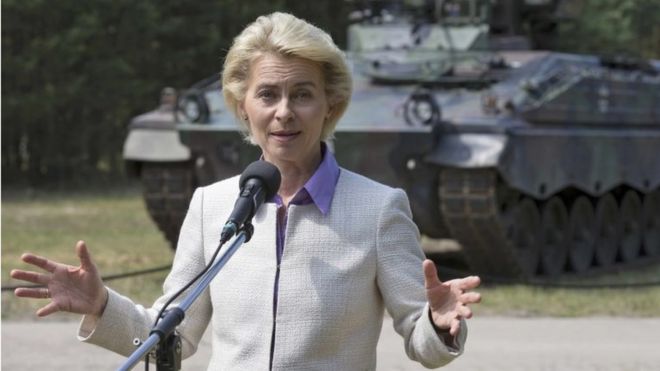
(Ursula von der Leyen: … German defence minister)
Any German weapons sold/transferred to Nigeria presently, even a bullet, pistol or grenade, are more likely to be deployed to murder Biafrans. This will amount clearly to German complicity in the Igbo genocide, this foundational genocide of post-(European)conquest Africa. Federal Germany, it must be recalled, in commendation, was one of the first countries which placed a comprehensive arms embargo on Nigeria during the May 1966- January 1970 phases I-III of the genocide unlike its “other half”, the GDR (East Germany), which ignominiously supported the genocide, particularly in its training and reequipping of squadrons of loaned Egyptian air force pilots flying Soviet MiGs who specialised in the carpet bombing of Biafran cities and towns and villages.

What relationship?

Germany started its direct “relationship” with Africa in the early years of the first decade of the last century quite abominably with its organised genocides against the following African peoples in the southwest region of the continent: beginning in 1904 and through to 1907, the German military, operating in the region, murdered 65,000 out of 80,000 Herero people or 80 per cent of the total Herero population wiped out; beginning in 1904 and through to 1907, the German military, operating in the same region, murdered 10,000 Nama people or 50 per cent of the Nama population destroyed. Thirty years later, the German-state would resume this southwest Africa genocidist antecedent 5000 miles away in the heart of Europe, its continental homeland, as it embarked on the gruesome genocide of Jewish people, murdering 6 million of them by 1945.

Given its catastrophic history in the 20th century, it is hopefully inconceivable that Germany would wish to “reengage” with Africa in this second decade of a new century, this time in southwestcentral Africa, by intervening to send weapons to Nigeria to enable the latter intensify its campaign of savagery in the ongoing Igbo genocide, a genocide in which Nigeria and Britain murdered 25 per cent of the Igbo population between 29 May 1966 and 12 January 1970.
(Andrew Hill Sextet, “Dedication” [personnel: Hill, piano; Kenny Dorham, trumpet; Eric Dolphy, bass clarinet; Joe Henderson, tenor saxophone;  Richard Davis, bass; Tony Williams, drums; recorded: Van Gelder Studio, Englewood Cliffs, NJ, US, 21 March 1964]) 
Twitter@HerbertEkweEkwe


Saturday, 20 February 2016

A comment on Claudia Moscovici, “The siege of Leningrad: Genocide by starvation”, HYPOCRISA, 16 February 2015


Herbert Ekwe-Ekwe

TWENTY-SIX years later, beginning on 31 March 1967, genocidist Nigeria, very similar to Claudia Moscovici’s reviewed Germany’s strategy in Leningrad, the Soviet Union (http://176.223.121.197/content/siege-leningrad-genocide-starvation, accessed 17 February 2015), embarks on the comprehensive land, naval and aerial blockade of Biafra in phase-II of the Igbo genocide which it enforces through phase III (beginning 6 July 1967) till 12 January 1970 with devastating consequences in Africa’s most densely populated region outside the Nile Delta. 

Nigeria employs starvation as one of its critical weapons to prosecute the genocide, this foundational genocide of post-(European)conquest Africa formally launched earlier on 29 May 1966 (phase-I). Obafemi Awolowo (lawyer and senior advocate of the Nigerian bar), Nigeria’s chief genocidist “theorist”, deputy head of the prosecuting regime in Lagos and head of the powerful finance ministry publicly states, right from the outset, that starvation of the Igbo is a “legitimate instrument” of the campaign, a policy voiced openly and variously throughout the period by several other senior regime officials including, especially, Anthony Enaharo (head of information ministry), Allison Ayida (regime special advisor), and field commanders Benjamin Adekunle and Olusegun Obasanjo.

Adekunle-Obusonjoist amalgam

Benjamin Adekunle, one of the most notorious of the genocidist commanders in south Biafra, reminds the world of his regime’s starvation strategy in an August 1968 press conference which includes foreign correspondents: “I want to prevent even one I[g]bo having even one piece to eat before their capitulation. We shoot at everything that moves, and when our forces march into the centre of I[g]bo territory, we shoot at everything, even at things that don’t move” (The Economist, London, 24 August 1968).
 
(Adekunle: “I want to prevent even one I[g]bo having even one piece to eat ... We shoot at everything that moves in ... I[g]bo territory ... even at things that don’t move”)
IT IS ALSO in pursuit of this starvation strategy that Olusegun Obasanjo, who takes over this sector’s command from Adekunle later in 1968, orders his air force, in May 1969, to shoot down any Red Cross planes flying in urgently-needed relief supplies to the millions of surviving but encircled, blockaded and bombarded Igbo. Within a week of his infamous order, 5 June 1969, Obasanjo recalls, nostalgically, in his memoirs, unambiguously titled My Command (London: Heinemann, 1981), genocidist air force pilot Gbadomosi King “redeem[s] his promise”, as Obasanjo clinically asserts (Obasanjo, 1981: 79) – the “promise”: Gbadomosi King shoots down a clearly marked, incoming relief-bearing International Committee of the Red Cross (ICRC) DC-7 aircraft near Eket, south Biafra, with the loss of its 3-person crew.  Obasanjo’s perverse satisfaction over the aftermath of this crime is fiendish, grotesquely revolting. He writes: “The effect of [this] singular achievement of the Air Force especially on 3 Marine Commando Division [name of the death squad Obasanjo, who subsequently becomes head of Nigeria regime for 11 years, commands] was profound. It raised morale of all service personnel, especially of the Air Force detachment concerned and the troops they supported in [my] 3 Marine Commando Division” (79).
(Obusonjo: “The effect of [this] singular achievement of the Air Force [shooting down of  Red Cross relief aircraft] especially on 3 Marine Commando Division was profound. It raised morale of all service personnel...”)
Harold Wilson’s “... a half million dead Biafrans ...” 

The British government under Prime Minister Harold Wilson is Nigeria’s strategic ally in this campaign – militarily, politically, diplomatically. Britain had since been riled by the Igbo vanguard role, begun in the 1930s, to terminate its conquest and occupation of Nigeria (one of the very prized lands of the British conquest of Africa). By supporting the genocide, Britain seeks to “punish” the Igbo for the latter’s historic role in the liberation of Nigeria. During the course of the 1968/69 gruesomely catastrophic apogee of the campaign when thousands of Igbo are dying daily from starvation, disease and enhanced land and aerial bombardment of survivors in ever-shrinking territory encapsulated by the siege, Harold Wilson is totally unfazed when he informs C. Clyde Ferguson, the US state department special coordinator for relief to Biafra, that he, Harold Wilson, “would accept a half million dead Biafrans if that was what it took” Nigeria to destroy the Igbo resistance to the genocide (Roger Morris, Uncertain Greatness: Henry Kissinger and American Foreign Policy [London and New York: Quartet Books, 1977]: 122). 

For the record, Wilson’s “a half a million dead Biafrans” represents 4.2 per cent of the Igbo population at this time; by the time that this third phase of the genocide comes to an end, 6-9 months after Wilson’s wish-declaration, 25 per cent of this nation’s population or 3.1 million Igbo people are murdered by the genocidists. Undoubtedly, the Nigerian toady “boys”  have handsomely obliged their “massa” Harold Wilson’s wish...
 (Wilson: “would accept a half million dead Biafrans if that was what it took...”)
IT MUST be stressed that Harold Wilson’s “[W]ould accept a half a million dead Biafrans”-wish is not a declaration made by some dictator, some leader of a loony party, a fascist party or anything of that ilk; on the contrary, this is a declaration made by an elected politician, a politician in an advanced western representative democracy, the leader of the British Labour party, one of Europe’s leading social democratic parties. “[W]ould accept a half million dead Biafrans if that was what it took”-declaration is made by the prime minister of Britain; not the prime minister of some “peripheral”, seemingly inconsequential country but the prime minister of a “centre” state and power that was part of the victorious alliance that defeated a fascist global amalgam in a global war that ended barely 23 years earlier. This is a prime minister of a “centre” state and power (sixth to occupy this exalted position since the end of the war) that was one of the key countries that worked on the panel that drafted the historic 1948 United Nations “Convention on the Prevention of the Crime of Genocide” – in the wake of the 1930s-1940s deplorable perpetration of the Jewish genocide and other genocides in Europe. 6 million Jews were murdered then by Germany. It is to ensure that no human beings are ever subjected to what the Jews and others went through in central Europe and elsewhere that this genocide convention is rated as one of the key international documents of the new age. Britain is a signatory to the convention. Surely, Harold Wilson’s “[W]ould accept a half million dead Biafrans if that was what it took”-declaration cannot fit into the hallowed pages of the UN “Convention on the prevention of the Crime of Genocide”.

“[L]etting the little buggers starve out”, Defoliant

FINALLY, a senior British foreign office official, who echoes Harold Wilson’s disposition to the Igbo slaughter, is no less chilling in their own characterisation of Britain’s strategic goal. Describing the British response to the concerted international humanitarian effort to dispatch urgently needed relief material to the blockaded and bombarded Igbo, this official notes that the British government position is designed to “show conspicuous zeal in relief while in fact letting the little buggers starve out” (Morris: 122). In a courageous and admirable public admission he makes in 1970, Colonel Robert Scott breaks ranks with his employer, the British diplomatic mission in Lagos where he works as military advisor, to acknowledge, gravely, that as the Nigerian genocidists unleash their Adekunleist campaigns across Igbo cities, towns and villages, they are the “best defoliant agent known” (Sunday Telegraph, London, 11 January 1970).
(John Coltrane Quartet, “Wise One” [Coltrane, tenor saxophone; McCoy Tyner, piano; Jimmy Garrison, bass; Elvin Jones, drums; recorded: Van Gelder Studios, Englewood Cliffs, NJ, US, 27 April 1964])
Twitter @HerbertEkweEkwe