Herbert Ekwe-Ekwe
Uncovering the tracks
ON 6 JULY 1967,
This phase-III of the genocide stretches for 30 months during which 3 million Igbo are murdered. Harold Wilson coordinates the campaign from his offices and home at 10 Downing Street London, 3150 miles away from Biafra, facilitated on the ground in client-state Nigeria by Francis Cumming-Bruce, the British chief representative and proconsul. Cumming-Bruce liases expansively with key Nigerian genocidists in charge of the crime, right from the outset in May 1966, as well as the coterie of Hausa-Fulani/islamist north region emirs, politicians and other leading public figures who Britain had arbitrarily handed over supreme overseeing political authority in October 1960 to “manage” Nigeria on London’s behalf ad infinitum as part of a bogus independence settlement.
These north region political forces had rigorously opposed the restoration of African independence which the Igbo had led for 30 years, beginning in the 1930s (http://re-thinkingafrica.blogspot.co.uk/2015/10/herbert-ekwe-ekwe-conquerors-concord-in.html). For the British, the Igbo genocide is “punishment” for the Igbo for daring to spearhead the campaign to terminate the control of its Nigeria “rich-prized land”. At the apogee of the Igbo slaughtering in 1968, Wilson, himself, insists that he “would accept half a million dead Biafrans if that was what it took” the Nigerian génocidaires to destroy the Igbo resistance to the genocide (Roger Morris, Uncertain Greatness: Henry Kissinger and American Foreign Policy, London and New York: Quartet Books, 1977: 122). In his memoirs published in 1971, Wilson reveals that the Nigerian military, equipped zealously by Britain, expended more small arms ammunition in its campaign to achieve its annihilative goal in Biafra than the amount used by the British armed forces “during the whole” of the Second World War (Harold Wilson, Labour Government, 1964-1970: A Personal Record,
London: Weidenfeld & Nicolson, 1971: 630,
added emphasis). Britain’s Lagos (Nigeria) diplomatic mission military advisor Robert
Scott’s acknowledgement (at the height of the genocide, mid 1968- January
1970) that as the Nigerian genocidists unleashed their campaigns across
Igbo cities, towns and villages, they were the “best defoliant agent known” (Sunday
Telegraph, London, 11 January 1970) is equally gravely harrowing.
TO COMPLEMENT this stupendous British military investment in the mass murder of Igbo people, the BBC world service, that state broadcaster funded by the British foreign office, assumes the chief publicity role to “rationalise” the genocide to the world’s public. The BBC effectively becomes the external broadcasting corporation of the on-the-ground Nigerian prosecuting genocidists, displacing the rambling and ramshackle Voice of Nigeria, spewing out hate, racist and fraudulent features and analyses to discredit the Biafra freedom movement decades before the world’s attention is drawn to the realisation that fake news programming and broadcasts are an embodiment in the practices of quite a few news organisations (http://re-thinkingafrica.blogspot.co.uk/2015/12/bbc-nationalists-or-secessionists.html).
Definitive goal
Right from the outset as its invasion of Biafra is launched, genocidist
Mu je mu kashe nyamiri
Mu kashe maza su da yan maza su
Mu chi mata su da yan mata su
Mu kwashe kaya su
(English translation: Let’s go murder the damned Igbo/Murder their men and boys/Rape their wives and daughters/Cart off their property)
This genocidist intent, particularly its empirically earmarked specifics, is unequivocally explicit and its overarching method sets the precedent of the savagery and barbarity that are the hallmarks of the genocide and subsequent genocides in Africa as Rwanda (1994), Darfur/Nuba Mountains/Blue Nile/South Kordofan (the Sudan, variously since 2004), and Democratic Republic of the Congo (since the late 1990s) attest.
AT THE HEIGHT of the Igbo genocide, beginning from the second-half of 1968 when thousands of Igbo children and older citizens die daily from starvation, one of the genocidist’s publicly-stated “weapons” in the prosecution of the crime as articulated by chief “theorist” Obafemi Awolowo himself, British Prime Minister Wilson as already stated, informs Clyde Ferguson (United States state department special coordinator for relief to Biafra) that he, Harold Wilson, “would accept half a million dead Biafrans if that was what it took” the Nigerian génocidaires to destroy the Igbo resistance to the genocide. Nigeria in fact ends up murdering 3 million Igbo – 2 and one-half million more than Wilson


Furthermore, it is indeed a telling irony, given British support for Nigeria and the génocidaires’ strategy of rape and abduction of Igbo womanhood in Biafra, that it is in London, in June 2014, forty-seven years later, that the first international conference on “rape and sexual violence” in war, with emphasis on Africa (and particular focus on the Democratic Republic of the Congo), is hosted by none other than the British government in which foreign secretary of state William Hague describes rape as “‘one of the great mass crimes’ of modern times” (BBC News, 10 June 2014).(Harold Wilson: “would accept a half million dead Biafrans if that was what it took...”)

(William Hague ... 47 years later: rape is “‘one of the great mass crimes’ of modern times”)
IN BIAFRA, beginning 6 July 1967, every Igbo town or village overrun by the Nigerian génocidaires becomes a gruesome milestone in an inexorable march of rape, death, and destruction: Obollo Afo ... Obollo Eke ... Enuugwu-Ezike ... Opi ... Ukehe … Nkalagu ... Owgwu ... Abakaleke … Eha Amuufu ... Nsukka ... Enuugwu ... Agbaani ... Asaba ... Ogwashi-Ukwu ... Isele-Ukwu ... Onicha-Ugbo …Agbo …Umunede ... Onicha ... Nkpo …Oka ... Aba ... Udi ... Ehuugbo ... Ehuugbo Road ... Okigwe ... Umuahia ... Owere ...Abagana ... Igwe Ocha ... Ahaoda ... Obiigbo ... Azumini ... Umu Ubani/Bonny ... Igwe Nga/Opobo ... Ugwuta ... Amasiri ... Akaeze ... Uzuakoli ...
Clearly invoking Nazi-style “search through population-round off-isolate-and-destroy”-tactics in overrun non-Igbo towns and cities such as Calabar, Oron, Ikot Ekpene, Uyo, Ogoja, Obubara, Obudu, Nkarasi and Eket, the genocidists meticulously profile Igbo nationals. Thousands of such profiled Igbo are shot at sight or marched off and later executed at city limits, forest firing-range sites, river banks, or at specifically dedicated genocidist-occupied barrack venues…
Clearly invoking Nazi-style “search through population-round off-isolate-and-destroy”-tactics in overrun non-Igbo towns and cities such as Calabar, Oron, Ikot Ekpene, Uyo, Ogoja, Obubara, Obudu, Nkarasi and Eket, the genocidists meticulously profile Igbo nationals. Thousands of such profiled Igbo are shot at sight or marched off and later executed at city limits, forest firing-range sites, river banks, or at specifically dedicated genocidist-occupied barrack venues…
Incubation & manifestation
As contemporary Nigeria demonstrates, most graphically, as these lines are written, grounded genocidist advocates/“theorists”/operatives especially Obafemi Awolowo, Tony Enaharo, Hassan Katsina, Alison Ayida, Olusegun Obasanjo, Gbadomosi King, Umaru Dikko, Maitama Sule, Benjamin Adekunle, Muhammadu Buhari, Yakubu Gowon, Murtala Muhammed, Yakubu Danjuma, Ibrahim Haruna and Ibrahim Taiwo are perhaps just coming to terms with the realisation that their thoughts and deeds have incubated within their very own and become hauntingly cyclical across generations – DNA signature. This is precisely why survivors from these purveyors of state-directed mass slaughter, such as the Igbo, for example, must keep well away from the latter’s tent. Boko Haram insurgents now ravaging swathes of territory across the north, northeast and northcentral and elsewhere in Nigeria are remarching along the paths first trodden by their parents/grandparents/greatgrandparents/Nigériãna-génocidaires, beginning 29 May 1966, 51 years ago to the day.
As for Nigeria’s genocide-prosecuting ally Britain, again 51 years to the day, it has, alas, caught up with Biafra, via Brexit, to engage, critically, with exercising its own right to self-determination – in this instance, to determine whether or not it wishes to be part of the supranational state called the European Union. Unlike the Biafrans, who, 51 years ago, exercised this same right but in staggeringly existential circumstances, Britain hasn’t sought Brexit from the European Union because it has been threatened or subjected to the crime of genocide by the latter nor indeed by any individual member state of the union such as Germany, Italy or France. On the contrary. Similarly, the 5 million constituent Scottish people in Britain do not, 51 years after Biafra, currently seek to exercise their right to self-determination from Britain because they have been threatened or subjected to the crime of genocide by Britain. Not at all.
Just as the Biafrans, 51 years ago, the underlying awareness by the British, as a whole, collectively, or the Scots, separately, is that this right to self-determination is inalienable and its exercise by any people across the world is not dependent on prevailing circumstance(s).
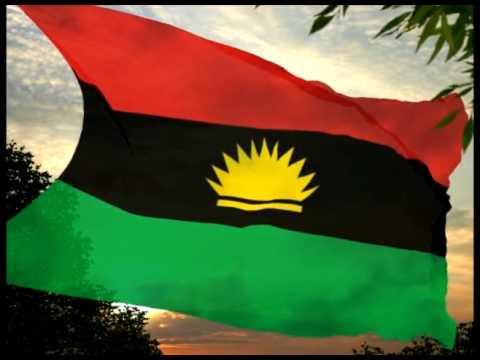
Biafra flag on the ascent
So, despite the the unflinching 51 years of British support for the prosecution of the Igbo genocide, despite the sheer savagery of the Nigeria genocidist regime’s military murder of 3.1 million Igbo people or 25 per cent of the Igbo population during phases I-III of the genocide (29 May 1966-12 January 1970) and tens of thousands of additional Igbo during phase-IV (since 13 January 1970 and continuing) including the military/Boko Haram/Fulani militia murders of 2000 Igbo people carried out across Biafra since October 2015 under the Muhammadu Buhari regime, despite the unconscionable support of the Igbo genocide by Barack Hussein Obama, the first African American president in 233 years of the US republic (https://www.pambazuka.org/human-security/obama-must-tell-world-why-he-supported-igbo-genocide), the Igbo have emerged even more focused, steadfast, resilient. They have converted their strategic mission of Biafra independence restoration to a tactical tool which they employ almost effortlessly here and there with exponential impact locally and internationally. This is extraordinary. The Biafra Sun is on the ascent. Any referendum conducted in Biafra presently on the restoration-of-independence for this population of 50 million will result in a high 90 per cent score. Biafrans now dictate the terms of this long drawn-out journey. Biafrans are redefining the tenor of the march for freedom in Africa. They are reshaping African history in this great epoch of our time.
And the freedom movement has done it, in these past 20 months, it must be stressed, without firing a single shot – either in defence or offence.
(Andrew Hill Sextet, “Dedication” [personnel: Hill, piano; Kenny Dorham, trumpet; Eric Dolphy, bass clarinet; Joe Henderson, tenor saxophone; Richard Davis, bass; Tony Williams, drums; recorded: Van Gelder Studio, Englewood Cliffs, NJ, US, 21 March 1964])
Twitter@HerbertEkweEkwe