Rethinking Africa is a forward looking blog dedicated to the exchange of innovative thinking on issues affecting the advancement of African peoples wherever they are. We provide rigorous and insightful analyses on the issues affecting Africans and their vision of the world.
Showing posts with label George Russell Sextet. Show all posts
Showing posts with label George Russell Sextet. Show all posts
(Olusegun Obasanjo: ... delusion ... fantasy ... hallucination) Herbert Ekwe-Ekwe “Nigeria will be one of the ten leading nations
in the world by the end of the century” – Olusegun Obasanjo, head of the
genocidist Nigeria military junta, 1979 (Chinua Achebe, The Trouble with Nigeria [Enugu: Fourth Dimension, 1983, p. 9]). FORTY YEARS after this Nigerïaña fantasy, proclaimed by a génocidaire in the Igbo genocide who the London Financial Times, it should be recalled, labelled admirably as the “godfather of modern Nigeria” (London, 14 April 2012), this “country” is nothing else but arguably
the globe’s most notorious genocidist state whose current regime, headed by jihadist Muhammadu
Buhari, retains the Boko Haram and Fulani militia, two of the five deadliest
terrorist groups on earth presently (Institute of Economics & Policy, “Global Terrorism Index 2015”, Sydney: IEP, November 2015), as adjunct brigades it deploys in its
genocide against the Igbo people of Biafra and its expanded campaigns within
Nigeria itself to destroy a constellation of constituent African nations, predominantly
Christians, domiciled in the south Kaduna provinces of the northcentral region
andin the eastcentral Benue valley.
(George Russell Sextet here plays “Nardis”, a composition by Miles Davis[personnel: Russell, piano;Don Ellis, trumpet;Dave Baker, trombone;Eric Dolphy, bass clarinet;Steve Swallow, bass;Joe Hunt, drums; recorded: Riverside Records, New York, US, 8 May 1961])
Selected works: Things
Fall Apart (1958) No Longer at Ease (1960), Arrow of God
(1964), A Man of the People (1966),
Beware Soul Brother (1971), Girls at War and other Stories (1973), Morning
Yet on Creation Day (1975), “An Image of Africa: Racism in Conrad’s Heart of
Darkness” (1975), Don’t let him die:
An anthology of memorial poems for Christopher Okigbo (ed., 1978), The Trouble with Nigeria (1984), Anthills of the
Savannah (1987), Hopes and Impediments (1988), “Our Mission”
(1989), “African Literature as Restoration of Celebration” (1990), Home and
Exile (2000), Collected Poems (2004), There was a Country
(2012)
(George Russell Sextet, “Ezzthetics” [personnel: Russell, piano;Don Ellis, trumpet;Dave Baker, trombone;Eric Dolphy, alto saxophone;Steve Swallow, bass;Joe Hunt, drums; recorded: Riverside Records, New York, US, 8 May 1961])
*****Herbert Ekwe-Ekwe is the author of African Literature in Defence of History: An essay on Chinua Achebe (2001) and author, with Lakeson Okwuonicha, of Why Donald Trump is great for Africa (2018)
(Born 25 September 1911, Port of Spain, Trinidad & Tobago)
Herbert Ekwe-Ekwe ONE OF THE most outstanding African Caribbean intellectuals of all time, author of Capitalism and Slavery(1944), classic on African enslavement in the Americas by the pan-European World – from his 1938 Oxford University doctoral thesis, and first prime minister of Trinidad and Tobago, 31 August 1962, after centuries of the British/European World conquest, enslaving and occupation
(George Russell Sextet, “Honesty” [personnel: Russell, piano; Don Ellis, trumpet; Dave Baker, trombone; Eric Dolphy, alto saxophone; Steve Swallow, Joe Hunt, bass; drums; recorded: Riverside Records, New York, US, 8 May 1961])
MWALIMU! Head of the Tanganyika African National Union, beginning 1954, which spearheads the restoration-of-independence movement in Tanzania that successfully frees the country in 1961 from 80 years ofdualGerman and British conquests and occupations... Such is Britain’s raging greed to gobble up every “slice of this magnificent African cake”, as génocidaire Belgian King Leopold II once ravenously described the gargantuan riches of Africa, that it seizes Tanganyika in 1918 after the defeat of Germany in the 1914-18 war to prevent the consequential freedom of the constituent African peoples in this state.
Southern Africa freedom MWALIMU: president of the freed Tanzania republic, October 1964-November 1985, providesrearguard bases for education, medical care and military training (in Tanzania) for numerous southern African restoration-of-independence movements especially from Mozambique, Zimbabwe, Namibia and South Africa (1960s-1990s) – focussing on the latter, South Africa, students and scholars of this conjunctural epoch of African history, 30-40 years ago, have watched, in recent years, usually incredulously as one can imagine, as hundreds of African émigrés inSouth Africa from Tanzania, Zimbabwe, Mozambique and elsewhere from Africa are murdered in premeditated campaigns clearly organised by groupings in the country with tacit and at times active support from personnages within the South Africa state ... additionally, in this vicious campaign, African émigrés’ residents and businesses have been destroyed and thousands of survivors sent into horrid South Africa refugee camps or forced to return to their various countries. Biafra freedom MWALIMU: one of thevery few leaders in Africawhounequivocally condemns the Igbo genocide, 29 May 1966-12 January 1970, during which an assemblage of pan-African nations in Nigeria including, especially, Hausa-Fulani, Kanuri, Tiv, Bachama, Nupe, Jukun, Yoruba, Edo and Urhobo in league with Britainmurder 3.1 million Igbo people, 25 per cent of this nation’s population, in this gruesome, foundational genocide of post-(European)conquest Africa, worst genocide in Africa since génocidaire King Leopold II slaughtered 13 Million Africans in the Congo Basin of central Africa, 1878-1908; supports the Biafra freedom movement.
East Africa freedom
MWALIMU: plays akey rolein the 1978 termination of the Idi Amin Dada (who had earlier on in the 1950s/60s served the British military across the border in Kenya in savage expansive operations to suppress the Mau Mau freedom movement) murderous islamist military junta in neighbouring Uganda which the British government in January 1971, under Prime Minister Edward Heath, participated centrally in installing to power principally over Uganda’s democratically elected government Milton Obote’s principled opposition to the Heath administration’s impending arms sales to the European-minority occupation regime in South Africa, expressly contrary to the existing UN comprehensive arms embargo on the regime to which British is a signatory – another consequence on rest of Africa of these “close encounters” with this country South Africa manifesting so dramatically (and brutally) yet again...
(George Russell Sextet, “Honesty” [personnel: Russell, piano; Don Ellis, trumpet; Dave Baker, trombone; Eric Dolphy, alto saxophone; Steve Swallow, bass; Joe Hunt, drums; recorded: Riverside Records, New York, US, 8 May 1961])
Herbert Ekwe-Ekwe THE Fulani islamist/jihadist-led
genocidist Nigeria, not Europe, not the
United States, not any extracontinental aggressor state, constitutes, currently, the principalretrograde agent of genocide and underdevelopment
across Africa:
1. It has murdered more Africans in Biafra, southwestcentral Africa, since 1945 than the total number of Africans murdered in Africa since 1900 by all of Europe’s conqueror-powers in Africa: Britain, Belgium, France, Germany, Portugal, Spain – including the number of Africans the Germans murdered in the genocide of the Herero, Nama and Berg Damara peoples of southwest Africa (1904-1907).
2. It now rates a not-too-distant second to Belgian King Leopold II’s notorious position as lead génocidaire of African peoples since the 19th century in the Leopold II/Belgian state’s genocide against Africans in the central regions of the Congo River basin (1878-1908).
(George Russell Sextet, “Nardis” [personnel: Russell, piano;Don Ellis, trumpet;Dave Baker, trombone;Eric Dolphy, bass clarinet;Steve Swallow, bass;Joe Hunt, drums; recorded: Riverside Records, New York, 8 May 1961])
HAUSA-FULANI/islamist-led Nigeria
focuses particularly on the murder of Igbo youth/children in Biafra in this genocide campaign
for obvious reasons (so blatantly and fiendishly recorded for the world in its
genocide anthem), especially the male,*** poignantly evident in the attack on
Nnamdi Kanu’s family home at Afaraukwu-Ibeku (eastcentral Biafra) on 14
September 2017 (scores of boys and men slaughtered and scores still unaccounted
for) and in its slaughter of 700 boys and men in Asaba (west Biafra) on 7
October 1967.
***genocide anthem line 2 in Hausa with
English translation: Mu kashe maza su da yan maza su (Kill off their men and boys)
(Herbert Ekwe-Ekwe)
(George Russell Sextet, “Nardis” [personnel: Russell, piano;Don Ellis, trumpet;Dave Baker, trombone;Eric Dolphy, bass clarinet;Steve Swallow, bass;Joe Hunt, drums; recorded: Riverside
Records, New York, 8 May 1961])
(Born 25 September 1911, Port of Spain, Trinidad & Tobago)
ONE OF THE most outstanding African Caribbean intellectuals of all time, author of Capitalism and Slavery(1944), classic on African enslavement in the Americas by the pan-European World – from his 1938 Oxford University doctoral thesis, and first prime minister of Trinidad and Tobago, 31 August 1962, after centuries of the British/European World conquest, enslaving and occupation
(George Russell Sextet, “Honesty” [personnel: Russell, piano; Don Ellis, trumpet; Dave Baker, trombone; Eric Dolphy, alto saxophone; Steve Swallow, Joe Hunt, bass; drums; recorded: Riverside Records, New York, US, 8 May 1961])
AS I OBSERVED recently (http://re-thinkingafrica.blogspot.co.uk/2017/06/herbert-ekwe-ekwe-biafra-freedom.html), the
preemptive return of the Biafra freedom movement (to Biafra) has not only confronted
and overridden the “conventional wisdom” that underscores the key trajectory of
comparable liberation projects, the movement’s return is indeed its
historic stamp of the imprimatur of the Biafra restoration-of-independence in
Biafra for the first time since 13 January 1970 – genocidist Nigeria’s launch
date of phase-IV of the Igbo genocide and the accompanying occupation of
Biafra. Appropriately to confront the
pressing emergency of the times, the movement has at once planned a referendum
throughout Biafra to democratically reestablish five decades of the loss of sovereign
rights of the people and withdrawn from participating in any future “elections”
organised in Biafra by the occupation. The latter exercises have in the past
been distinctively fraudulent and immensely contradictory as the feudal
Hausa-Fulani/islamist-led genocidist and occupying regime with no democratic
heritage in its culture or history, not to mention genocidist Nigeria itself
which has had no credible election throughout its history, would bizarrely posit
to organise elections in (occupied) Igboland that has enjoyed an advanced
republican democratic tradition for over a thousand years. For the occupation,
regimes in the Biafra administrative regions (Abia, Anambra, Delta, Enuugwu,
Rivers, etc., etc) that emerge from these “elections” exist solely to
contribute to police the occupation.
Nothing more. The operationalisation of this envisaged role was demonstrated
most tragically, just recently, when not one head of regime in any of these
administrative regions condemned the slaughter of their very own citizens by
the genocidist military/Fulani militia in the already mentioned pogroms across
Biafra since October 2015 in which a total of 2000 Igbo were murdered.
In July 2010, a high profile grouping
of Igbo human rights intellectuals met in a conference in Enuugwu to discuss
the state of this occupation of Biafra which the Biafra freedom movement,
seven years later, must now terminate. In its concluding communiqué, the conference captures most profoundly what it aptly
categorises as the “siege and occupation” of Igboland (http://re-thinkingafrica.blogspot.co.uk/2010/07/nigeria-perpetuates-violence-and.html):
[Igboland] has become militarized with a vast deployment of expeditionary and predatory police and army personnel who are from outside the region. For instance, there are 61 Police check-points between Abakal[e]k[e] … to Nsukka … (a distance of about 130km). In [contrast] between Obolo-Afo [Igboland] and Lokoja [Nigeria] (a distance of nearly 400 km) no checkpoints exist. This state of siege is exemplified by the current [situation] of … [Igbo] cities [including] Aba, [Enuugwu, Abakaleke, Onicha, Owere] and Nnewi – hitherto the fastest growing and thriving industrial cum commercial cities in the African continent now being turned into refuse dumps and ghettos. Businesses that would have provided jobs to engage our youths have been strangulated by incompetent and criminal leadership.
THERE CAN BE no other solution to this longest genocide of the
contemporary era but the freedom of the Igbo people from Nigerian subjugation
and occupation. The return of the Biafra freedom movement, shattering all known
“conventions”, is the most strategic development in 47 years of the course of this
journey. Freedom is inalienable. One does not ask for it; one takes it! The 50
million Igbo know they have to take their freedom as they head to the
referendum to pronounce this liberatory choice as the world awaits so eagerly.
(George Russell Sextet, “Honesty” [personnel: Russell. Piano; Don Ellis, trumpet; Dave Baker, trombone; Eric Dolphy, alto saxophone; Steve Swallow, bass; Joe Hunt, drums; recorded: Riverside Records, New York, US, 8 May 1961])
(George Russell Sextet, “Ezz-thetic” – personnel: Russell, piano; Don Ellis, trumpet; Dave Baker, trombone; Eric Dolphy, alto saxophone; Steve Swallow, bass; Joe Hunt, drums [recorded Riverside Records, New York, US, 8 May 1961])
One of the outstanding poets of the Harlem Renaissance of the 1920s-1930s, later develops the discipline to write a poem each day for a period stretching almost five decades
(George Russell Sextet, “Ezz-thetic” – personnel: Russell, piano; Don Ellis, trumpet; Dave Baker, trombone; Eric Dolphy, alto saxophone; Steve Swallow, bass; Joe Hunt, drums [recorded Riverside Records, New York, US, 8 May 1961])
MWALIMU! Head of the Tanganyika
African National Union, beginning 1954, which spearheads the
restoration-of-independence movement in Tanzania that successfully frees the
country in 1961 from 80 years ofdualGerman and British conquests and occupations... Southern Africa/Biafra freedom President of
the freed Tanzania republic, October 1964-November 1985, providesrearguard bases for
education, medical care and military training (in Tanzania) for numerous
southern African restoration-of-independence movements especially from Mozambique, Zimbabwe,
Namibia and South Africa (1960s-1990s) – focussing on the latter,
South Africa, students and scholars of this conjunctural
epoch of African history, 30-40 years ago, watch,
presently, usually incredulously as one can imagine, as hundreds of African émigrés inSouth Africa from Tanzania, Zimbabwe, Mozambique and elsewhere from Africa are murdered in premeditated campaigns clearly
organised by groupings in the country with tacit and at times active support
from personnages within the South Africa state and émigrés’ residents and businesses
destroyed and thousands of survivors sent into horrid South Africa refugee camps or forced
to return to their various countries; one of thevery few leaders in Africawhounequivocally condemns the Igbo
genocide, 29 May 1966-12 January 1970, during which Britain and client
state Nigeriamurder 3.1 million Igbo people, 25 per cent of this nation’s
population, in this foundational genocide of post-(European)conquest Africa, supports the Biafra freedom movement.
East Africa
Finally,
Mwalimu plays akey rolein the 1978 termination of the Idi Amin Dada (who had earlier on in the 1950s/60s served the British military across the border in Kenya in savage expansive operations to suppress the Mau Mau freedom movement) murderous islamist
military junta in neighbouring Uganda which the British government in
January 1971, under Prime Minister Edward Heath, participated centrally in
installing to power principally over Uganda’s democratically elected government
Milton Obote’s principled opposition to the Heath administration’s impending
arms sales to the European-minority occupation regime in South Africa, expressly contrary to the existing UN comprehensive arms embargo on the regime to which British is a signatory – another consequence on rest of Africa of these “close encounters” with this country South Africa manifesting so dramatically (and brutally) yet again...
(George Russell Sextet, “Honesty” [personnel: Russell, piano; Don Ellis, trumpet; Dave Baker, trombone; Eric Dolphy, alto saxophone; Steve Swallow, bass; Joe Hunt, drums; recorded: Riverside Records, New York, US, 8 May 1961])
Herbert Ekwe-Ekwe Unparalleled THE “Igbo question” is intrinsically linked to the Igbo strategic goal, presently, which is to end the occupation of their Biafra homeland by genocidist Nigeria– imposed since 13 January 1970, beginning of phase-IV of the genocide. This is the structural facet of the termination of the genocide itself which was launched byNigeria and its suzerain state Britain on 29 May 1966 (phases I-III). 3.1 million Igbo people or 25 per cent of this nation were murdered byNigeriaand Britain. Britain, which sought to “punish” the Igbo for leading the freedom movement to terminate 100 years of the British conquest and occupation of the states and peoples of this southwestcental region of Africa, supported the genocide right from from the outset, from conceptualisation to execution – politically, diplomatically, militarily. As a result, Britain and Nigeria subjected the Igbo to 44 months of uninterrupted, unimaginable carnage and barbarity perpetrated on a people. Pointedly, no single nation or people inAfricahas suffered this extent of gruesome and devastating state(s)-premeditated and organised genocide in history.
(George Russell Sextet, “Thoughts” [personnel: Russell, piano; Don Ellis, trumpet; Dave Baker, trombone; Eric Dolphy, bass clarinet; Steve Swallow, bass; Joe Hunt, drums; recorded Riverside Record, New York, US, 28 May 1961])
THE GENOCIDE CONTINUES unabatedand Britain’s support continues unflinchingly crucial, boosted by that dramatic March 2015 abominable support for the genocide by ex-US President Barack Obama, first African-descent president in 233 years of the founding of the United States republic. For Britain, contrary to the often clanking histrionics of prevailing international politics rhetoric, its strategic alliance here, in this African region, has always been with the islamist/jihadist, Arabist, north region Fulani leadership which vociferously opposed the restoration of African independence from the British occupation throughout the 1930s-1960s epoch. The Igbo steadfastly led this liberation mission. It is Britain’s alliance with the Fulani leadership, situated atop the prevailing congenital anti-African constellation-equation (which also includes, principally, the following constituent nations: Yoruba, Edo, Tiv Urhobo, Jukun, Bachama, Hausa, Nupe, Kanuri) emplaced in its Nigeria, that makes up the Anglo-Nigerian amalgam that executes the Igbo genocide. It is also from groupings with this same leadership that both Boko Haram (currently the world’s most ruthless terrorist organisation, according to the Sydney-based Institute for Economics & Peace, http://re-thinkingafrica.blogspot.co.uk/2015/11/institute-for-economics-peace-global.html) and the Fulani militia (see also the IE&P’s study on this militia) were created and unleashed to murder tens of thousands of Igbo and others in these times.
Saliency SO, given the critical links between the salient features of the politics of the Nigerian occupation of Biafra and the overarching architecture of the genocidal campaign, it is the case that the Igbo termination of the occupation is at once the beginning of their freedom march from Nigeriaand the implementation of an unprecedentedly expansive socioeconomic programme of reconstruction. The route remains Igbo freedom from Nigeria, an inalienable Igbo right with or without the genocide as I have argued severally. If the Scots, for instance, one-tenth of the Igbo population and without a genocide antecedent would wish to leave a union they have largely been exponential beneficiaries for 300 years (“Rights for Scots, Rights for the Igbo”, http://re-thinkingafrica.blogspot.co.uk/2012/01/rights-for-scots-rights-for-igbo.html), the Igbo, surely, don’t require any agonisingly turgid historical and sociological treatise to wish to leave Nigeria.
Reification CONTRARY to the amazingly ahistorical discourses on the nature of the state and its survivability in some circles, particularly in Africa where the extant eurocentric conquest social sciences and history curriculums essentially reify the “state”, the state is very much a transient relationship in human history: Kemet, Roman “empire”, Ghana “empire”, Mali “empire”, Sweden-Norway, Czarist “empire”, Austro-Hungarian “empire”, Ottoman “empire”, Portuguese “empire”, Spanish “empire”, British “empire”, French Indo-China, Malaya Federation, Anglo-Egyptian-Sudan, Central African Federation, United Arab Republic, Mali Federation, Senegambia Confederation, West & East Pakistan, Soviet Union, Yugoslavia, Czechoslovakia, Ethiopia, the Sudan... What has indeed been the enduring feature of the state in world history on this accord, thankfully, has rather been “divisibility”, “dissolubility”, “destructibility”, each the antonym of that 3-headed genocidist mantra mouthed off at random by quite a few spokespersons of especially the genocide-state in Africa.
Mission IT IS THEREFORE not surprising that twenty-three (23) new states have, for example, emerged in Europe since the end of the 1980s. Even though a population of about 350 million, one-third of Africa’s, Europeans presently have more states per capita than peoples of Africa! And as history shows, the catastrophe is not the collapse of the state; the catastrophe is the attempt to destroy constituent peoples within the state as the Anglo-Nigeria amalgam has sought in Biafra since 29 May 1966. Here lies the Igbo question and the historically grounded response of the Biafra mission.
(John Coltrane Quartet, “Sun ship” [personnel: Coltrane, tenor saxophone; McCoy Tyner, piano; Jimmy Garrison, bass; Elvin Jones, drums; recorded: Impulse!, New York, US, 26 August 1965])
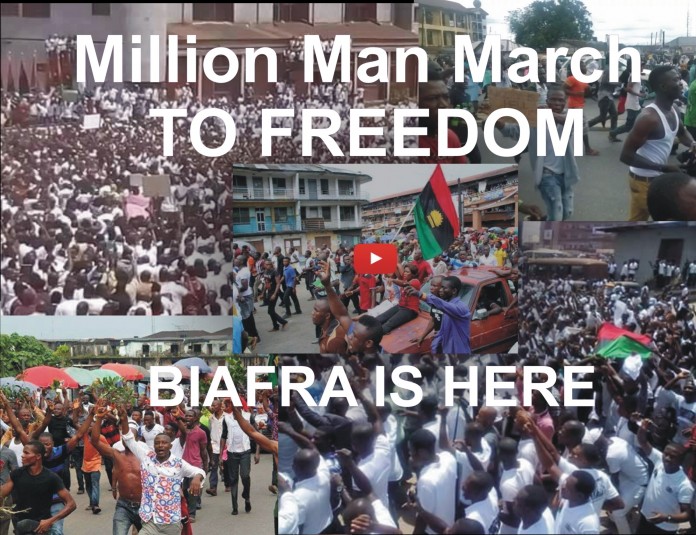
(Igbo one million-person march across Biafra [from Asaba/Onicha Oshimili River ports of the northwest to Igweocha on the Atlantic south coast] demanding unconditional release of freedom journalist Nnamdi Kanu, illegally detained by the regime in Nigeria, and restoration of sovereignty of Biafra: Friday 6 November 2015) Twitter @HerbertEkweEkwe
Herbert Ekwe-Ekwe The “Igbo Question” is intrinsically linked to the Igbo strategic goal, presently, which is to end the occupation of their homeland, Biafra, by genocidist Nigeria – imposed since 13 January 1970. This is phase-IV of the genocide, launched by Nigeria on Sunday 29 May 1966. 3.1 million Igbo people or 25 per cent of this nation’s population were murdered by Nigeria and its allies including, especially, Britain, which supported the genocide right from conceptualisation to execution – politically, diplomatically, militarily. These were 44 months of uninterrupted, unimaginable carnage and barbarity perpetrated on a people. No single nation or people in Africa has suffered such a gruesome and devastating state(s)-premeditated and organised genocide in history.
(George Russell Sextet, “Thoughts” – personnel: Russell, piano; Don Ellis, trumpet; Dave Baker, trombone; Eric Dolphy, bass clarinet; Steve Swallow, bass; Joe Hunt, drums [recorded Riverside Record, New York, US, 28 May 1961])
Architecture Given the critical links between the salient features of the politics of the occupation and the overarching architecture of the genocidal campaign, most agree that the Igbo termination of the occupation is at once the beginning of their freedom march from Nigeria and the implementation of an expansive socioeconomic programme of reconstruction unprecedented in this southwestcenral region of Africa. If this is the case, one does not need an Igbo “presidency” in Abuja to achieve this as some Igbo commentators as well as a few others have, at times, contended, but quite uncritically. Indeed no Igbo “presidency”, not even one reinforced with an all-Igbo personnel in the key cabinet military/police/“security”-positions can halt this genocide. This campaign has now acquired an inexorable logic to its being. What the emergence of Boko Haram and its other subalterns have demonstrated in Nigeria is that the prosecuting agency of the genocide has become very much decentred, very much motivated, very much engagingly virulent. The typical Boko Haram suicide-operating cell is a handful-strength, in single digits, and none in the group knows any of the others until they meet at the designated, targeted site of operation – in which they, invariably, are not expected to survive! If any survives, they, of course, become a member of new cell of hitherto unknown members and the cycle goes on...
Inalienable Prior to Boko Haram, still on the Igbo “presidency”, we mustn’t forget that Nigeria was under the leadership of an Igbo general when the genocide began on 29 May 1966. Thus, Igbo “presidency”, however attractive the proposition, offers no route to the Igbo halting the genocide. None whatsoever. The route remains Igbo freedom from Nigeria. This is an inalienable Igbo right with or without the genocide as I have argued severally. If the Scots, for instance, one-tenth of the Igbo population and without a genocide antecedent would wish to leave a union they have largely been exponential beneficiaries for 300 years (“Rights for Scots, Rights for the Igbo”, http://re-thinkingafrica.blogspot.co.uk/2012/01/rights-for-scots-rights-for-igbo.html, accessed 18 July 2015), the Igbo, surely, don’t require any agonisingly turgid historical and sociological treatise to wish to leave Nigeria.
Resolution Contrary to the amazingly ahistorical discourses on the nature of the state and its survivability in some circles, particularly in Africa, the state is very much a transient relationship in human history: Kemet, Roman “empire”, Ghana “empire”, Mali “empire”, Czarist “empire”, Austro-Hungarian “empire”, Ottoman “empire”, British “empire”, Malaya Federation, West & East Pakistan, Soviet Union, Yugoslavia, Czechoslovakia, Ethiopia, the Sudan... Twenty-three (23) new states have, for example, emerged in Europe since the end of the 1980s. Even though a population of about 350 million, one-third of Africa’s population, Europeans presently have more states per capita than Africans! And as history shows, the catastrophe is not the collapse of the state; the catastrophe isto destroy/attempt to destroy constituent peoples within the state as the Igbo, for instance, have faced in a Nigeria since 29 May 1966. Here lies the Igbo Question. Twitter@HerbertEkweEkwe
Herbert Ekwe-Ekwe is specialist on the state and on genocide & wars in Africa in the post-1966 epoch – beginning with the Igbo genocide, 29 May 1966-present day, the foundational and most gruesome genocide of post-(European)conquest Africa. 3.1 million Igbo or 25 per cent of this nation’s population were murdered by Nigeria and its allies, principally Britain. Africa and the rest of the world largely stood by and watched as the perpetrators enacted this horror most ruthlessly. The world could have stopped this genocide; the world should have stopped this genocide. This genocide inaugurated Africa’s current age of pestilence. During the period, 12 million additional Africans have been murdered in further genocide in Rwanda (1994), Zaïre/DRCongo (variously, since the late 1990s) and Darfur – west of the Sudan – (since 2004) and in other wars in Africa. African peoples have, presently, no other choice but exit/dismantle the extant genocide-state (the bane of their existence & progress) & construct own nation-centred states that serve their interests. He is author of several books & papers on the subject and his new book is entitled The longest genocide – since 29 May 1966 (2019).




.gif)