Showing posts with label 29 May 1966. Show all posts

Wednesday, 6 September 2017

The history of north “Nigeria”, early 1800s-1900, in 2 sentences


TWO imperialisms: British, from northwest Europe, and Fulani, from northwestcentral Africa, on the prowl in this Africa’s central region ... Both later, amicably, switch to a relay race, post-1900, conquering state after state with catastrophic consequences for scores of constituent African peoples, laying the foundation where they collaborate, beginning 29 May 1966, in executing the Igbo genocide.
(Herbert Ekwe-Ekwe)
(Mal Waldron Quartet, “Hymn from the inferno” [personnel: Waldron, piano; Clifford Jordan, tenor saxophone; Cecil McBee, bass; Dannie Richmond, drums; recorded: Vanguard Studios, New York, US, 15 August 1981]) 
Twitter @HerbertEkweEkwe


Saturday, 16 January 2016

Olusegun Obasanjo

Straight from the horse’s mouth itself: “[Nigeria] is jinxed and cursed; we should all go to hell”! 

This declaration is from none other but Olusegun Obasanjo – speaking in Ibadan, west Nigeria, in August 2013. In the speech, not surprisingly (saharareporters.com, 13 August 2013), Obasanjo, who had been head of regime for 11 years, totally absolves himself of being a key agency in facilitating the status of his “jinxed and cursed”-Nigeria as can be shown clearly in the following (“‘Cargo cult mentality’, Nigeria and the illusions of NEPAD”,
http://re-thinkingafrica.blogspot.com.br/2011/03/cargo-cult-mentality-nigeria-and.html).

(Obusonjo’s unmistakeable verdict: “[Nigeria] is jinxed and cursed...)
Age of pestilence
“[J]inxed and cursed”-Nigeria has the unenviable accolade of having carried out the foundational genocide of post-(European)conquest Africa against Igbo people, thus inaugurating the current age of pestilence in Africa that includes the ravaging terrorist campaigns which affect all regions of the continent with Nigeria’s Boko Haram emerging as the world’s deadliest (Institute of Economics & Policy, “Global Terrorism Index 2015”, New York: IEP, November 2015). 

During the course of 44 months, beginning from 29 May 1966, Nigeria murdered 3.1 million Igbo, or one-quarter of this nation’s population. And Olusegun Obasanjo is one of the most notorious Nigerian military commanders of this genocidal campaign. At its apogee, 1968/1969, the Obasanjo-led brigade, operating in the outstretched south Biafra, had converted this panhandle into a veritable killing field in which it slaughtered “… everything that moves … we shoot at everything, even at things that don’t move”, as its previous commander, the equally notorious Benjamin Adekunle, had  so grimly proffered. 

The skies of Biafra were neither spared from this “shoot-at-everything” monstrosity. In June 1969 Obasanjo ordered his air force to shoot down a 3-person crew international Red Cross aircraft bringing urgent relief to the encircled, blockaded and bombarded Igbo and he later boasted fiendishly of this crime in his memoirs, aptly entitled My Command (Ibadan & London, 1980: 78-79). 
(DC-7 aircraft similar to the ICRC relief-carrying plane shot down over south Biafra by genocidist Nigeria military on the orders of Obusonjo)
Not since the German genocide against the Herero, Nama and Berg Damara peoples in contemporary Namibia in the early 1900s had Africa witnessed such brazen act of savagery on expansive display. As I have argued, severally, Nigeria collapsed as a state with few prospects on that Sunday 29 May 1966 it launched the Igbo genocide (See, for instance, Herbert Ekwe-Ekwe, “29 May 1966”,
DNA signature
Obasanjo’s imprimatur is writ large on this catastrophe. Given that it is, after all, not just unbridled opportunism that the London Financial Times not too long ago dubbed this same Obasanjo “godfather of modern Nigeria” (Financial Times, London, 14 April 2012), the hardly disguised FT’s sardonic characterisation in the pointed reference to the kakistocracy that most know is Nigeria notwithstanding, the génocidaire’s Nigeria-is-“jinxed-and-cursed” acknowledgement, albeit belated, is testimony that the offspring indeed carries the unmistakeably doomed DNA signature of its paternity.
(The New York Contemporary Five plays Bill Dixon’s composition, “Trio” – [personnel: Archie Shepp, tenor saxophone; Don Cherry, pocket trumpet;  Tchicai, alto saxophone; Don Moore, bass; JC Moses, drums [recorded: live, Jazzhus Montmarte, Copenhagen, Denmark, 15 November 1963][note particularly Tchicai’s ethereal solo - first - at this session])
Twitter @HerbertEkweEkwe 

Sunday, 1 November 2015

Olusegun Obasanjo: From the horse’s mouth itself!

Straight from the horse’s mouth: “[Nigeria] is jinxed and cursed; we should all go to hell”! 

This declaration is from none other but Matthew Olusegun Okikiola Aremu Obasanjo – speaking in Ibadan, west Nigeria, in August 2013. In the speech, not surprisingly (saharareporters.com, 13 August 2013), Obasanjo, who had been head of regime for 11 years, totally absolves himself of being a key agency in facilitating the status of his “jinxed and cursed”-Nigeria as can be shown clearly in the following (“‘Cargo cult mentality’, Nigeria and the illusions of NEPAD”,
http://re-thinkingafrica.blogspot.com.br/2011/03/cargo-cult-mentality-nigeria-and.html).

(Olusegun Obasanjo:  “[Nigeria] is jinxed and cursed...)
Age of pestilence
“[J]inxed and cursed”-Nigeria has the unenviable accolade of having carried out the foundational genocide of post-(European)conquest Africa against Igbo people, thus inaugurating the current age of pestilence in Africa. During the course of 44 months, beginning from 29 May 1966, Nigeria murdered 3.1 million Igbo, or one-quarter of this nation’s population. And Olusegun Obasanjo is one of the most notorious Nigerian military commanders of this genocidal campaign. At its apogee, 1968/1969, the Obasanjo-led brigade, operating in the outstretched south Biafra, had converted this panhandle into a veritable killing field in which it slaughtered “… everything that moves … we shoot at everything, even at things that don’t move”, as its previous commander, the equally notorious Benjamin Adekunle, had  so grimly proffered. 

The skies of Biafra were neither spared from this “shoot-at-everything” monstrosity. In June 1969 Obasanjo ordered his air force to shoot down a 3-person crew international Red Cross aircraft bringing urgent relief to the encircled, blockaded and bombarded Igbo and he later boasted fiendishly of this crime in his memoirs, aptly entitled My Command (Ibadan & London, 1980: 78-79). 
(DC-7 aircraft similar to the ICRC relief-carrying plane shot down over south Biafra by genocidist Nigeria military on the orders of Olusegun Obasanjo)
Not since the German genocide against the Herero, Nama and Berg Damara peoples in contemporary Namibia in the early 1900s had Africa witnessed such brazen act of savagery on expansive display. As I have argued, severally, Nigeria collapsed as a state with few prospects on that Sunday 29 May 1966 it launched the Igbo genocide (See, for instance, Herbert Ekwe-Ekwe, “29 May 1966”,
DNA signature

Obasanjo’s imprimatur is writ large on this catastrophe. Given that it is, after all, not just unbridled opportunism that the London Financial Times not too long ago dubbed this same Obasanjo “godfather of modern Nigeria” (Financial Times, London, 14 April 2012), the hardly disguised FT’s sardonic characterisation in the pointed reference to the kakistocracy that most know is Nigeria notwithstanding, the genocidist’s Nigeria-is-“jinxed-and-cursed” acknowledgement, albeit belated, is testimony that the offspring indeed carries the unmistakeably doomed DNA signature of its paternity.

Twitter @HerbertEkweEkwe

Wednesday, 19 August 2015

What Igbo did for Nigeria

Where is the life we have lost in living?
Where is the wisdom we have lost in knowledge?
Where is the knowledge we have lost in information?
(TS Eliot, “Choruses from the Rock”, 1934)

FOR THE Igbo, prior to 29 May 1966, three important holidays were high up on their annual calendar: the Igbo National Day, the iri ji, or the New Yam Festival, and 1 October. The latter was the day of celebration for the restoration of independence for peoples in Nigeria after 60 years of the British conquest and occupation. Or, so were the thoughts predicated on this date’s designation...

Beacons

The Igbo were one of the very few constituent nations in what was Nigeria, again prior to 29 May 1966, who understood, fully, the immense liberatory possibilities ushered in by 1 October and the interlocking challenges of the vast reconstructionary work required for state and societal transformation in the aftermath of foreign occupation. The Igbo had the most robust economy in the country in their east region homeland, supplied the country with its leading writers, artists and scholars, supplied the country’s top universities with vice-chancellors (or presidents) and leading professors and scientists, supplied the country with its first indigenous university (the prestigious university at Nsukka), supplied the country with its leading and most spirited pan-Africanists, supplied the country with its top diplomats, supplied the country’s leading high schools with head teachers and administrators, supplied the country with its top bureaucrats, supplied the country with its leading businesspeople, supplied the country with an educated, top-rated professional officers-corps for its military and police forces, supplied the country with its leading sportspersons, essentially and effectively worked the country’s rail, postal, telegraphic, power, shipping and aviation services to quality standards not seen since in Nigeria…

And they were surely aware of the vicissitudes engendered by this historic age precisely because the Igbo nation played the vanguard role in the freeing of Nigeria from Britain, beginning from the mid-1930s. The commentator, Sabella Ogbobode Abidde, couldn’t have been more emphatic in summarising the thrust of the Igbo mission during the period:
The Igbo nation ha[s] attributes most other Nigerian nationalities can only dream of and are what most other nations [are] not. The Igbo made Nigeria better. Any wonder then that the Igbo can do without Nigeria; but Nigeria and her myriad nationalities cannot do without the Igbo? Take the Igbo out of the Nigeria equation … and Nigeria will be gasping for air (nigeriavillagesquare.com, 28 July 2004).
THE IGBO’s break with Nigeria occurred catastrophically on Sunday 29 May 1966. On this day, leaders of the Fulani islamist/jihadist north region (feudal overlords, muslim clergy, military, police, businesspeople, academics, civic servants, other public officials and patrons, alimajiri), who were long opposed to the liberation of Nigeria (there were no comparable clusters of political, cultural, ideational, religious, national or racial groupings anywhere else in the Southern World, during the era, which had a similar, unenviable disposition of hostility to emancipation from the European occupation of their lands as the Fulani leadership), launched waves of premeditated genocidal attacks on Igbo migrant populations resident in the north. These attacks were later expanded to Igboland itself, Biafra, during the third phase which began on 6 July 1967, boosted particularly by the robust participation in the slaughter by the Yoruba, Urhobo, and Edo nations of west Nigeria as well as others elsewhere in the country. 3.1 million Igbo or one-quarter of this nation’s population were murdered during those 44 dreadful months.

Opportunism

THE Yoruba support for the genocide, as from 6 July 1967, for instance, bears all the hallmark of a squelching cadence of opportunism. Influential Yoruba personages (especially Obasanjo, Adekunle, Gbadamosi King, Akinrinade, Rotimi, Are, Taiwo) under the operational gaze of chief genocidist “theorist” Obafemi Awolowo, plunged headlong, carrying out their own role in this gruesome foundational genocide of post-(European)conquest Africa most fiendishly, particularly across their chosen south Igboland killing fields. The Yoruba appeared to have lost, quite spectacularly, the 1930s-1960s Igbo-Yoruba competitive “preparatory drive” to develop the high-level humanpower and ancillary resources required to run the prospective post-conquest state after the British departure. They therefore viewed the outbreak of the mid-1966 Igbo mass killings in the north region and elsewhere as welcome season to “avenge” their “loss” during the great sociocultural rivalry of those previous three decades, clutching onto any bomb or missile available, from July 1967, on their onward death-march east to lob, remorselessly, into besieged Biafra, into an Igbo home, Igbo school, Igbo shrine, Igbo church, Igbo hospital, Igbo office, Igbo market, Igbo farmland, Igbo factory/industrial enterprise, Igbo children’s playground, Igbo town hall, Igbo refugee centre…

(Ornette Coleman Quartet, “C&D” {or Civilisation and its Discontents – Freud} [personnel: Coleman, alto saxophone; Don Cherry, pocket trumpet; Scott LaFaro, bass; Ed Blackwell, drums; recorded: Atlantic Studios, New York, US, 31 January 1961])
Twitter@HerbertEkweEkwe

Thursday, 16 July 2015

Lest we forget… What the Igbo did for Nigeria prior to the Igbo genocide – circa 1934-29 May 1966

The world turns and the world changes,
But one thing does not change.
In all my years, one thing does not change,
However you disguise it, this thing does not change:
The perpetual struggle between Good and Evil.
(TS Eliot, “Choruses from the Rock”, 1934)

For the Igbo, prior to 29 May 1966, three important holidays were high up on their annual calendar: the Igbo National Day, the iri ji, or the New Yam Festival, and 1 October. The latter was the day of celebration for the restoration of independence for peoples in Nigeria after 60 years of the British conquest and occupation. Or, so were the thoughts predicated on this date’s designation...

Beacons

The Igbo were one of the very few constituent nations in what was Nigeria, again prior to 29 May 1966, who understood, fully, the immense liberatory possibilities ushered in by 1 October and the interlocking challenges of the vast reconstructionary work required for state and societal transformation in the aftermath of foreign occupation. The Igbo had the most robust economy in the country in their east region homeland, supplied the country with its leading writers, artists and scholars, supplied the country’s top universities with vice-chancellors (or presidents) and leading professors and scientists, supplied the country with its first indigenous university (the prestigious university at Nsukka), supplied the country with its leading and most spirited pan-Africanists, supplied the country with its top diplomats, supplied the country’s leading high schools with head teachers and administrators, supplied the country with its top bureaucrats, supplied the country with its leading businesspeople, supplied the country with an educated, top-rated professional officers-corps for its military and police forces, supplied the country with its leading sportspersons, essentially and effectively worked the country’s rail, postal, telegraphic, power, shipping and aviation services to quality standards not seen since in Nigeria…

And they were surely aware of the vicissitudes engendered by this historic age precisely because the Igbo nation played the vanguard role in the freeing of Nigeria from Britain, beginning from the mid-1930s. The commentator, Sabella Ogbobode Abidde, couldn’t have been more emphatic in summarising the thrust of the Igbo mission during the period:
The Igbo nation ha[s] attributes most other Nigerian nationalities can only dream of and are what most other nations [are] not. The Igbo made Nigeria better. Any wonder then that the Igbo can do without Nigeria; but Nigeria and her myriad nationalities cannot do without the Igbo? Take the Igbo out of the Nigeria equation … and Nigeria will be gasping for air (nigeriavillagesquare.com, 28 July 2004).
The Igbo’s break with Nigeria occurred catastrophically on 29 May 1966. On this day, leaders of the Hausa-Fulani north region (feudal overlords, muslim clergy, military, police, businesspeople, academics, civic servants, other public officials and patrons, alimajiri), who were long opposed to the liberation of Nigeria (there were no comparable clusters of political, cultural, ideational, religious, national or racial groupings anywhere else in the Southern World, during the era, which had a similar, unenviable disposition of hostility to emancipation from the European occupation of their lands as the Hausa-Fulani leadership), launched waves of premeditated genocidal attacks on Igbo migrant populations resident in the north. These attacks were later expanded to Igboland itself, Biafra, during the third phase which began on 6 July 1967, boosted particularly by the robust participation in the slaughter by the Yoruba, Urhobo, and Edo nations of west Nigeria as well as others elsewhere in the country. 3.1 million Igbo or one-quarter of this nation’s population were murdered during those 44 dreadful months.

Opportunism

The Yoruba support for the genocide, as from 6 July 1967, for instance, bears all the hallmark of a squelching cadence of opportunism. Influential Yoruba personages (especially Obasanjo, Adekunle, Gbadamosi-King, Akinrinade, Rotimi, Are, Taiwo) under the operational gaze of chief genocidist “theorist” Obafemi Awolowo, plunged headlong, carrying out their own role in this gruesome foundational genocide of post-(European)conquest Africa most fiendishly, particularly across their chosen south Igboland killing fields. The Yoruba appeared to have lost, quite spectacularly, the 1930s-1960s Igbo-Yoruba competitive “preparatory drive” to develop the high-level humanpower and ancillary resources required to run the prospective post-conquest state after the British departure. They therefore viewed the outbreak of the mid-1966 Igbo mass killings in the north region and elsewhere as welcome season to “avenge” their “loss” during the great sociocultural rivalry of those previous three decades, clutching onto any bomb or missile available, from July 1967, on their onward death-march east to lob, remorselessly, into besieged Igboland, into an Igbo home, Igbo school, Igbo shrine, Igbo church, Igbo hospital, Igbo office, Igbo market, Igbo farmland, Igbo factory/industrial enterprise, Igbo children’s playground, Igbo town hall, Igbo refugee centre …
(Ornette Coleman Quartet, “C&D” {or Civilisation and its Discontents  Freud} [personnel: Coleman, alto saxophone; Don Cherry, pocket trumpet; Scott LaFaro, bass; Ed Blackwell, drums; recorded: Atlantic Studios, New York, US, 31 January 1961])
Twitter@HerbertEkweEkwe

Monday, 8 June 2015

FWD: Osita Ebiem, “Nigeria’s governance by slogans and propaganda”*****

Nigeria has just transitioned into a new political regime on May 29, 2015. (Incidentally, May 29 in history marks the official date when Igbo Genocide in Nigeria began in 1966.) The new Nigerian leader Muhammadu Buhari is an Islamic fundamentalist from the north region who took over from Goodluck Jonathan, a Christian, from the south. Buhari had first ruled the country 32 years ago as a military dictator. He led a coup d’état that overthrew a civilian government. Buhari is a Fulani whose ethnic group believes that only individuals from their ethnic and religious group are “born-to-rule” Nigeria as long as the country remains one country. Buhari as a Muslim is also a staunch believer in sharia implementation in Nigeria. This is how he expressed it: “I will continue to show openly and inside me the total commitment to the Sharia movement that is sweeping all over Nigeria (http://www.vanguardngr.com/2014/12/insurgency-buharis-call-full-sharia/#sthash.HoUcVfjW.dpu).
(Muhammadu Buhari)
 Buhari thinks that the implementation of sharia in Nigeria is “a legal responsibility which God has given us [Muslims leaders] within the context of one Nigeria to continue to uphold the practice of Sharia wholeheartedly and to educate non-Muslims.” For 12 years the fight to take over the presidency of Nigeria became a do-or-die affair for Buhari because “what remains for Muslims in Nigeria [to do] is for them to redouble their efforts [and] educate Muslims on the need to promote the full implementation of sharia law” (this and the one above are quoted from Buhari’s address in an Islamic seminar in Kaduna in 2012)

Nigeria that is sustained by slogans and propaganda

Over the years the Nigerian state has been sustained by propaganda and slogan-mongering political gladiators. Many critics believe that as a result of this trying to run a country’s government based on political sloganeering and gimmicks is largely responsible for the lack of any concrete political or sociological achievement in Nigeria since its independence from colonial Britain in 1960. The only visible real developments are usually those told by some unscrupulous international media people who many critics accuse are paid off by the northern Muslim oligarchs to doctor facts and paint hollow fantastic pictures of a “united Nigeria” that is not.

During the presidential campaign Buhari ran on the platform of a tough ruler who would stamp out corruption from the political and social life of the country, instil discipline and provide security for the lives and property of the populace. To successfully rout his predecessor in office, with the lobbied influence of some international politicians, Buhari’s team imputed on his opponent the unfounded image of “cluelessness and incompetence”. The slogan stuck and as a purpose-oriented political campaign creation, it served the purpose for which it was manufactured: to impugn and make the opponent appear incapable for the job. And with the deft use of these political gimmicks they successfully deflected the people’s attention from the fact that the “ungovernable political situation” in the country was created in the first place by the same creators of the “clueless” slogan. In 2011 when Buhari lost the presidency to Jonathan, record shows that he instigated so much post-election violence in which many Igbo people in the north were killed because the Muslim mob felt that the Igbo represented Christians of whom Jonathan is a part.

Creating ungovernable state through use of Boko Haram

Earlier, during the political parties’ primaries and nomination campaigns for the 2011 elections, an important northern politician Lawan Kaita made it very clear that it was either a northerner emerged as president in 2011 or the north would make the country “ungovernable” for President Goodluck Jonathan if he emerged the winner of the 2011 election. Lawan Kaita said in an interview that: “Anything short of a northern president is tantamount to stealing our presidency. Jonathan has to go and he will go. Even if he uses incumbency power to get his nomination on the platform of the PDP, he will be frustrated out”.  In conclusion to his threat Kaita said that the “North should not be blamed for the calamity that would befall Nigeria if Jonathan emerged as the president” (http://newsrescue.com/pdp-affair-revealed-man-promised-make-nigeria-ungovernable-jonathan-wins/#ixzz3cKG9TJQL).

Buhari on his own part never regretted the loss of lives that took place in the 2011 post-election violence. Rather in an interview when he was talking about the 2015 presidential election he declared very emphatically that “If what happened in 2011 [alleged rigging] should again happen in 2015, by the grace of God, the dog and the baboon would all be soaked in blood’’ (http://www.vanguardngr.com/2012/05/2015-ll-be-bloody-if-buhari/#sthash.unBxZDmH.dpuf).

 Of course Boko Haram, the Islamic terrorist group based in northeast Nigeria intensified its activities soon after Jonathan emerged the winner of the presidential election in 2011. Not surprisingly north politicians defended Boko Haram’s killings, burning Christian churches, conquering territories and declaring the conquered places sharia-compliant and the capturing of mostly Christian girls and women, selling them into slavery as well as using others as suicide bombers thus: “Boko Haram is fighting for justice. Boko Haram is another name for justice” (Bamanga Tukur a prominent north politician quoted by Nigerian Punch, May 16, 2012).

Innocent people falling prey to fanciful but deadly slogans

In the 2015 elections, Buhari’s team successfully pulled off its sloganeering stunt with the help of (as rumour has it) such formidable political campaign managers like David Axelrod from the United States. The intensity of the sloganeering campaign would become so severe that even the President of the United States of America Barack Obama got carried away by the effusive political gimmickry. Unfortunately on his own part President Obama would be deceived into using the wrong slogan – a Nigerian genocidal slogan. On March 23, 2015, in his goodwill message to Nigerians about the need to conduct a peaceful election Obama used a phrase in what appears to be an honest faux pas?: “To keep Nigeria one is a task that must be done”!

The president of the United States failed to check up on the origin of that slogan before using it in his otherwise innocent speech. The slogan originated in 1967 during the Biafra-Nigeria war when the Nigerian state carried out a genocidal campaign against the Igbo population of the country. In the process of that campaign and with the use of that slogan, Nigeria successfully exterminated 3.1 million of Igbo people and others who made up Biafra which had seceded from the country. “To keep Nigeria one is a task that must be done” is a genocidal cry that goaded Nigeria on till they murdered more than 3 million people. For this reason therefore no decent leader anywhere should ever use it in the context that Obama did. All Igbo people and other Biafrans abhor that slogan since it reminds them of Nigeria’s unrepentant genocide of them.

Buhari “to end” corruption in Nigeria

Let’s quickly look closely at Buhari’s declared intention to end corruption in Nigeria. At this point we need to remind readers that most Nigerian experts regard Sani Abacha, a former Nigerian Head of State as one of the most corrupt leaders that Nigeria has ever had. Yet it’s on record that Buhari served under Abacha’s administration with a portfolio that held billions of dollars in it budget. Buhari was the head of Petroleum Trust Fund (PTF) under Abacha’s regime. Probably because he was anxious to defend his former boss or that he was actually speaking sincerely, Buhari jointly defended Abacha’s regime with his close military comrade Abdulsalami Abubakar by declaring that “Abacha served Nigeria well” (The Guardian, Lagos, June 9, 2008). According to the report the two men made the statement in support of Abacha’s widow Miryam Abacha who complained that “there was no basis for accusing her husband of corruption”, In the report Buhari personally went further to say that “all the allegations levelled against the personality of the late Sani Abacha will remain allegations”. Furthermore, and in Buhari’s opinion, because “it is 10 years now [since Abacha’s death] things should be over by now”. So there you have it: Buhari, Nigeria’s corruption general who is leading, as the new slogan says, the “war against corruption”, advises Nigerians to just move on and away from talking about Abacha’s corrupt practices since “patience and time” of ten years should be enough to create the necessary collective amnesia.

Dictatorial & genocidal tendencies of excessive use of slogans and propaganda in running governments

History shows that dictatorial genocidaires in the past have been enamoured and pathologically attracted to the use of catchy slogans and propagandas. One of the main reasons that prompted this essay is an article titled “Nigeria's New President Lays Out ‘The Buhari Doctrine’” written by Robin Renee Sanders, a former U.S. ambassador to Nigeria & ECOWAS. The article appeared in the Huffington Post.

What caught my attention is the slogan that Sanders used in her article “The Buhari Doctrine”. Here we are talking about the dangers that are inherent in maliciously trying to create political cult figures and the manufacturing of high sounding political slogans and propaganda designed to distract the people from critically appraising their leaders and their performances in governance. This writer has wondered without coming up with any satisfactory answers as to why Sanders chose to undertake this thankless task of making a mountain out of a molehill about the new regime in Nigeria. May be she will need to stop and think for a while and remember that a people’s life and destiny depend on this path and it would be more sensible for her to tread with caution.

History teaches us as earlier said that running governments that are based on the pathological indiscriminate application of flatulent slogans and propaganda will always drive these pathetic political cult personalities that are so created into frenzies as they are pushed along this dangerous path. In most cases it drives these sick personalities to self-destruction and in the process they drag along the state which they oversee into the abyss as they begin to commit genocides against a section, sections or the entire population of their ill-fated country.

Examples abound here. We have already mentioned the Nigerian wartime slogan which the country used to kill 3 million Igbo people and the other Biafrans: “to keep Nigeria one is a task that must be done” (conspicuously, Buhari was part of that Nigerian genocidal squad that murdered the Igbo in during this genocide). The Armenian, the Greek and the other genocides committed by the dying Turkish Ottoman Empire in 1915 were also committed on slogans by the “Young Turks” who wanted to “Turkify” the Ottoman Empire by eliminating Christian Armenians, Greeks and others. The Three Pashas as the “Young Turks” were also called also had another slogan that sounds familiar: “Committee of Unity and Progress”. With these slogans the “Young Turks” exterminated 1.5 million Christian Armenians in order to cleanse the Islamic Ottoman Empire of “non-believers”. In the same way it seems people everywhere, starting from President Obama to Ambassador Sanders and of course Nigerian north leaders are talking about a baseless “unity and progress” of Nigeria. We are also reminded of Hitler’s slogan of the “final solution to the Jewish question”. With that slogan the Nazis killed 6 million Jews in what is today known as the Jewish Shoah or Holocaust. The Roma people and several others were also killed along the Jews.

In her article Sanders created a Buhari who would do no wrong, has all the answers, and who only needs “patience and time” and he would “fix” all of Nigeria’s problems. She also has an “interesting take-away” which is that “the inaugural activities . . . reflected the diversity of Nigeria”. And that “they were inclusive”. In this respect, Sanders could not have “taken away” a more deceptive “truth” than that. The truth however is that going by Buhari’s antecedents this writer and many other concerned individuals doubt very much Buhari’s ability to tackle successfully Nigeria’s problem.

Just for emphasis alone, we must remind the readers of the fact that Buhari was a visible part of Nigeria’s genocidal squad that murdered the 3 million Igbo people and the others in Biafra. And for this reason Sanders may need to be reminded that when she talks about “inclusiveness” that 98% Igbo people and the other people from the geographical stretch of the east region never voted for Buhari and they have expressly made it clear that they are very proud of that collective choice to reject Buhari for being a part of the team that murdered them. Additionally, and very important to note by anyone who cares: since the 29th of May, 1966, which is the official date marking the beginning of Igbo Genocide in Nigeria, Igbo people rejected forever Nigeria’s citizenship, its Buharis, and all others like him and that it’s only “patience and time” and hard work which the Igbo require and they will become free and independent of the Nigerian state forever.
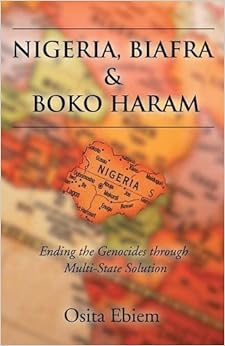
******Osita Ebiem is the author of Nigeria, Biafra & Boko Haram: Ending the Genocides through Multi-State Solution (New York: Page Publishing, 2014)
(Tina Brooks Quintet, “Back to the tracks” [personnel: Brooks, tenor saxophone; Blue Mitchell, trumpet; Kenny Drew, piano; Paul Chambers, bass; Art Taylor, drums; recorded: Van Gelder Studio, Englewood Cliffs, US, 20 October 1960])

Twitter@HerbertEkweEkwe

Friday, 29 May 2015

29 May 1966

Where is the life we have lost in living?
Where is the wisdom we have lost in knowledge?
Where is the knowledge we have lost in information?
(TS Eliot, “Choruses from the Rock”, 1934)

Sunday 29 May 1966, 49 years to the day, is undoubtedly the most tragic day in Igbo history. It is the launch date of the Igbo genocide carried out by Nigeria – the most gruesome, devastating and expansive genocide in 20th century Africa. Nigeria murdered 3.1 million Igbo, a quarter of this nation’s population, between 29 May 1966 and 12 January 1970.

Open season, erase“deny”, perverse

The Igbo genocide is the foundational genocide of post-(European)conquest Africa. Not since Germany’s genocide against the Herero, Nama and Berg Damara peoples of Namibia in the early 1900s had any African nation been subjected to such indescribable barbarity and carnage as the Igbo during the course of those 44 gory months. The genocide continues in multiforms and features. Only recently, in the wake of the 28 March 2015 “poll” for “president” in Nigeria, some very influential and easily recognisable public figures in the country including Rilwan Akiolu, the king or oba of Lagos (west region) and even intellectuals (such is this open season of staggeringly virulent pronouncements of Igbo hate and worse...) including, especially, a United States-domiciled cardiologist, called publicly for the mass murder of the Igbo because the Igbo electorate had voted overwhelmingly against the APC “political party”. The Igbo genocide is thus the longest and most remorselessly-sustained genocide of the contemporary era. This genocide inaugurated Africa’s current age of pestilence.

Yakubu Gowon headed the regime in Nigeria that executed the genocide and Obafemi Awolowo, a lawyer, a senior advocate of the Nigerian bar, was his deputy, effectively the prime minister, the genocidist “chief theorist” for the campaign and head of the all-powerful finance ministry. Awolowo also principally initiated and programmed phase-IV of the genocide (ongoing) aimed, strategically, to dismantle/degrade the Igbo economy in perpetuity. The Igbo economy, pre-genocide, was Africa’s most dynamic and resourceful.

Elsewhere, beginning in 1969, regime Awolowoists/Awolowoids were in the forefront in formulating and implementing Nigeria’s “post”-genocide decision to abolish the teaching of history in its schools as part of its “broad package” of measures to erase the history of the genocide from countrywide consciousness and thus “deny” its occurrence. Thirty years on, 1999, these same regime operatives played a key role in Nigeria’s perverse proclamation of 29th of May as the country’s (new) annual “democracy day”, a desperate, albeit belated effort to try to “neutralise” the historic import of 29 May 1966 for Igbo people if not “celebrate” the genocide itself as some of the leading genocidists of this wing of the Nigeria genocide-state such as Benjamin Adekunle, Oluwole Rotimi, Olusegun Obasanjo and Obafemi Awolowo, himself, have indeed demonstrated in their high-profile gloated commentaries and memoirs on the genocide during the slaughtering and subsequently. 

29 May 1966 was the day that Igbo people were subjected to an overwhelming violence and unremitting brutality by supposedly fellow countrymen and women. This atrocity was clinically organised, supervised and implemented by the very state, the Nigeria state, which the Igbo had played a vanguard role to liberate from the British conquest and occupation from the 1930s to October 1960. Consequently, the genocide was perpetrated with full complicity of the British government led by Harold Wilson. This state, now violently taken over by murderous anti-African sociopolitical forces in 1966, had pointedly violated its most sacred tenet of responsibility to its Igbo citizens – provision of security. Instead of providing security to these citizens, the Nigeria state murdered 3.1 million of them or a quarter of their population.

Anthem

The words in Hausa of the ghoulish anthem of the genocide, broadcast uninterruptedly on state-owned Kaduna radio and television throughout its duration and with editorial comments on the theme regularly published in both state-owned New Nigerian (daily) newspaper and weekly Gaskiya Ta fi Kwabo during the period, were unambiguously clear on the key objectives of this crime against humanity:

Mu je mu kashe nyamiri
Mu kashe maza su da yan maza su
Mu chi mata su da yan mata su
Mu kwashe kaya su
(English translation: Let’s go kill the damned Igbo/Kill off their men and boys/Rape their wives and daughters/Cart off their property)

Not-Nigerian

Yet this 29th day of May 1966 is also the Igbo Day of Affirmation, Recovery and Freedom. The Igbo people resolved on this day, the day that marked the beginning of the genocide, to survive the catastrophe. This was the day the Igbo ceased to be Nigerian forever – right there on the grounds of those death camps in the sabon gari residential districts (north Nigeria) and offices and churches and schools and colleges and shops and markets and hospitals and rail stations and trains and coach stations and coaches and trucks and airports and planes and highways and village tracks and brooks and rivers and gorges and bridges and woods across Nigeria. They created the state of Biafra in its place and tasked it to provide security to the Igbo and prevent Nigeria, a genocide state, from accomplishing its dreadful mission. The heuristic symbolism defined hitherto by 1 October 1960 (date of the presumed restoration of independence for peoples in Nigeria from the British occupation) shattered in the wake of this historic Igbo declaration.

For the Igbo, the renouncement of Nigerian citizenship is the permanent Igbo indictment of a state that had risen thunderously to murder one of its constituent peoples. The Igbo could not have survived the genocide if they still remained Nigerian. They rightly chose the former course of their fate and not the latter which they decisively cast adrift. Consequently, Nigeria collapsed as a state with scarce prospects. Despite the four murderous years of comprehensive land, naval and aerial siege of Igboland by the genocidists, unprecedented blockade imposed on no other peoples anywhere else in recent African history, the Igbo demonstrated a far greater creative drive towards constructing an advanced civilisation in Biafra than what Nigeria has all but wished it could achieve in the past four decades. Nigeria gburu ochu; Nigeria mere alu. Surely, Nigeria couldn’t recover from committing this heinous crime, this crime against humanity. This is its epitaph.

Freedom

Astonishingly, though, the world wonders what the Igbo are still doing in Nigeria, the burden of a strangulating occupation notwithstanding. In the past 49 years, the Igbo have written an extraordinary essay on human survival and resilience. These attributes have now been laudably demonstrated and the Igbo must now move on – to another dynamic threshold of their being. O zu gozie. No one should ever feel that they are trapped in the Nigeria quagmire. The Igbo must now actively begin to reconstruct their gravely battered homeland, transform the lives of their 50 million people, and contribute their ingenuity to working on the wider, inventive canvass of the African renaissance. To embark on these pressing tasks, the Igbo should, today, walk away from the Nigeria genocide state, this state of terror. The Igbo should go now. Go, Go, Go.

29 May is a beacon of the resilient spirit of human overcoming of the most desperate, unimaginably brutish forces. It is the new Igbo National Holiday. It is a day of meditation and remembrance in every Igbo household in Igboland and in the diaspora in Nigeria and the rest of the world for the 3.1 million murdered, gratitude and thanksgiving for those who survived, and the collective Igbo rededication to achieve the expectant goal of the restoration of Igbo sovereignty. Now is the time.

Igbo will never forget. Happy Survival! Land of the Rising Sun.

Twitter @HerbertEkweEkwe

Thursday, 7 May 2015

29 May 1966


Herbert Ekwe-Ekwe

SUNDAY 29 May 1966 is undoubtedly the most tragic day in Igbo history. It is the launch date of the Igbo genocide carried out by Nigeria – the most gruesome, devastating and expansive genocide in 20th century Africa. Nigeria murdered 3.1 million Igbo, 25 per cent of this nation’s population, between 29 May 1966 and 12 January 1970 (phases I-III of the genocide).

Open season, erase“deny”, perverse

The Igbo genocide is the foundational genocide of post-(European)conquest Africa. Not since Germany’s genocide against the Herero, Nama and Berg Damara peoples of Namibia in the early 1900s had any African nation been subjected to such indescribable barbarity and carnage as the Igbo during the course of those 44 gory months. The genocide continues in multiforms and features. Only recently, in the wake of the 28 March 2015 “poll” for “president” in Nigeria, some very influential and easily recognisable public figures in the country including Rilwan Akiolu, the king or oba of Lagos (west region) and even intellectuals (such is this open season of staggeringly virulent pronouncements of Igbo hate and worse...) including, especially, a United States-domiciled cardiologist, called publicly for the mass murder of the Igbo because the Igbo electorate had voted overwhelmingly against the APC “political party”. The Igbo genocide is thus the longest and most remorselessly-sustained genocide of the contemporary era. This genocide inaugurated Africa’s current age of pestilence.

YAKUBU GOWON headed the regime in Nigeria that executed the genocide and Obafemi Awolowo, a lawyer, a senior advocate of the Nigerian bar, was his deputy, effectively the prime minister, the genocidist “chief theorist” for the campaign and head of the all-powerful finance ministry. Awolowo also principally initiated and programmed phase-IV of the genocide (ongoing) aimed, strategically, to dismantle/degrade the Igbo economy in perpetuity. The Igbo economy, pre-genocide, was Africa’s most dynamic and resourceful.

Elsewhere, beginning in 1969, regime Awolowoists/Awolowoids were in the forefront in formulating and implementing Nigeria’s “post”-genocide decision to abolish the teaching of history in its schools as part of its “broad package” of measures to erase the history of the genocide from countrywide consciousness and thus “deny” its occurrence. Thirty years on, 1999, these same regime operatives played a key role in Nigeria’s perverse proclamation of 29th of May as the country’s (new) annual “democracy day”, a desperate, albeit belated effort to try to “neutralise” the historic import of 29 May 1966 for Igbo people if not “celebrate” the genocide itself as some of the leading genocidists of this wing of the Nigeria genocide-state such as Benjamin Adekunle, Oluwole Rotimi, Olusegun Obasanjo and Obafemi Awolowo, himself, have indeed demonstrated in their high-profile gloated commentaries and memoirs on the genocide during the slaughtering and subsequently. 

29 MAY 1966 was the day that Igbo people were subjected to an overwhelming violence and unremitting brutality by supposedly fellow countrymen and women. This atrocity was clinically organised, supervised and implemented by the very state, the Nigeria state, which the Igbo had played a vanguard role to liberate from the British conquest and occupation from the 1930s to October 1960. Consequently, the genocide was perpetrated with full complicity of the British government led by Harold Wilson. This state, now violently taken over by murderous anti-African sociopolitical forces in 1966, had pointedly violated its most sacred tenet of responsibility to its Igbo citizens – provision of security. Instead of providing security to these citizens, the Nigeria state murdered 3.1 million of them or a quarter of their population.

Anthem

THE words in Hausa of the ghoulish anthem of the genocide, broadcast uninterruptedly on state-owned Kaduna radio and television throughout its duration and with editorial comments on the theme regularly published in both state-owned New Nigerian (daily) newspaper and weekly Gaskiya Ta fi Kwabo during the period, were unambiguously clear on the key objectives of this crime against humanity:

Mu je mu kashe nyamiri
Mu kashe maza su da yan maza su
Mu chi mata su da yan mata su
Mu kwashe kaya su
(English translation: Let’s go kill the damned Igbo/Kill off their men and boys/Rape their wives and daughters/Cart off their property)

YET THIS 29th day of May 1966 is also the Igbo Day of Affirmation, Recovery and Freedom. The Igbo people resolved on this day, the day that marked the beginning of the genocide, to survive the catastrophe. This was the day the Igbo ceased to be Nigerian forever – right there on the grounds of those death camps in the sabon gari residential districts (north Nigeria) and offices and churches and schools and colleges and shops and markets and hospitals and rail stations and trains and coach stations and coaches and trucks and airports and planes and highways and village tracks and brooks and rivers and gorges and bridges and woods across Nigeria. They created the state of Biafra in its place and tasked it to provide security to the Igbo and prevent Nigeria, a genocide state, from accomplishing its dreadful mission. The heuristic symbolism defined hitherto by 1 October 1960 (date of the presumed restoration of independence for peoples in Nigeria from the British occupation) shattered in the wake of this historic Igbo declaration.

For the Igbo, the renouncement of Nigerian citizenship is the permanent Igbo indictment of a state that had risen thunderously to murder one of its constituent peoples. The Igbo could not have survived the genocide if they still remained Nigerian. They rightly chose the former course of their fate and not the latter which they decisively cast adrift. Consequently, Nigeria collapsed as a state with scarce prospects. Despite the four murderous years of comprehensive land, naval and aerial siege of Igboland by the genocidists, unprecedented blockade imposed on no other peoples anywhere else in recent African history, the Igbo demonstrated a far greater creative drive towards constructing an advanced civilisation in Biafra than what Nigeria has all but wished it could achieve in the past four decades. Nigeria gburu ochu; Nigeria mere alu. Surely, Nigeria couldn’t recover from committing this heinous crime, this crime against humanity. This is its epitaph.

Freedom

ASTONISHINGLY, though, the world wonders what the Igbo are still doing in Nigeria, the burden of a strangulating occupation notwithstanding. In the past 49 years, the Igbo have written an extraordinary essay on human survival and resilience. These attributes have now been laudably demonstrated and the Igbo must now move on – to another dynamic threshold of their being. O zu gozie. No one should ever feel that they are trapped in the Nigeria quagmire. The Igbo must now actively begin to reconstruct their gravely battered homeland, transform the lives of their 50 million people, and contribute their ingenuity to working on the wider, inventive canvass of the African renaissance. To embark on these pressing tasks, the Igbo should, today, walk away from the Nigeria genocide state, this state of terror. The Igbo should go now. Go, Go, Go.

29 May is a beacon of the resilient spirit of human overcoming of the most desperate, unimaginably brutish forces. It is the new Igbo National Holiday. It is a day of meditation and remembrance in every Igbo household in Igboland and in the diaspora in Nigeria and the rest of the world for the 3.1 million murdered, gratitude and thanksgiving for those who survived, and the collective Igbo rededication to achieve the expectant goal of the restoration of Igbo sovereignty. Now is the time.

IGBO will never forget. Happy Survival! Land of the Rising Sun.
(The New York Contemporary Five plays Bill Dixson’s composition, “Trio” – [personnel: Archie Shepp, tenor saxophone; Don Cherry, pocket trumpet; Tchicai, alto saxophone; Don Moore, bass; JC Moses, drums [recorded: live, Jazzhus Montmarte, Copenhagen, Denmark, 15 November 1963])
Twitter @HerbertEkweEkwe

Friday, 16 August 2013

From what other source are you still waiting for this news of the age?

Straight from the horse’s mouth: “[Nigeria] is jinxed and cursed; we should all go to hell”! This declaration is from none other but Matthew Olusegun Okikiola Aremu Obasanjo, speaking recently in Ibadan, west Nigeria. In the speech, not surprisingly (saharareporters.com, 13 August 2013), Obasanjo, who had been head of regime for 11 years,  totally absolves himself of being a key agency in facilitating the status of his “jinxed and cursed” Nigeria as can be shown clearly in the following (“‘Cargo cult mentality’, Nigeria and the illusions of NEPAD”,
http://re-thinkingafrica.blogspot.com.br/2011/03/cargo-cult-mentality-nigeria-and.html). 

“[J]inxed and cursed” Nigeria has the unenviable accolade of having carried out the foundational genocide of post-(European)conquest Africa against Igbo people. During the course of 44 months, beginning from 29 May 1966, Nigeria murdered 3.1 million Igbo, or one-quarter of this nation’s population. And Olusegun Obasanjo is one of the most notorious Nigerian military commanders of this genocidal campaign. At its apogee, 1968/1969, the Obasanjo-led brigade, operating in the outstretched south Igboland, had converted this panhandle into a veritable killing field in which it slaughtered “…
everything that moves … we shoot at everything, even at things that don’t move”, as its previous commander, the equally notorious Benjamin Adekunle, had  so grimly proffered. The skies of Igboland were neither spared from this “shoot-at-everything” monstrosity. In June 1969 Obasanjo ordered his air force to shoot down an international Red Cross aircraft bringing urgent relief to the encircled and blockaded Igbo and he later boasts fiendishly of this crime in his memoirs, aptly entitled My Command. Not since the German genocide against the Herero in Namibia in the early 1900s had Africa witnessed such brazen act of savagery on expansive display. As I have argued, severally, Nigeria collapsed as a state with few prospects on that Sunday it launched the Igbo genocide (See, for instance, Herbert Ekwe-Ekwe, “29 May 1966”,

Given Obasanjo’s imprimatur on this catastrophe and recalling that it is, after all, not just unbridled opportunism that the London Financial Times not too long ago dubbed the same Obasanjo “godfather of modern Nigeria” (Financial Times, London, 14 April 2012), the genocidist’s Nigeria-is-“jinxed-and-cursed” acknowledgement, albeit belated, is testimony that the offspring indeed carries the unmistakeably doomed DNA signature of its paternity.