Rethinking Africa is a forward looking blog dedicated to the exchange of innovative thinking on issues affecting the advancement of African peoples wherever they are. We provide rigorous and insightful analyses on the issues affecting Africans and their vision of the world.
Economist and theologian, first African American president (vice-chancellor/rector) of Howard University (1926-1960) during which the university attracted a range of luminaries to teaching positions including the philosopher Alain Locke, poet Sterling Brown, surgeon Charles Drew, political scientist Ralph Bunche and chemist Percy Lavon Julian
(John Coltrane Sextet, “Blue train” [personnel: Coltrane, tenor saxophone; Lee Morgan, trumpet; Curtis Fuller, trombone; Kenny Drew, piano; Paul Chambers, bass; Philly Joe Jones, drums; recorded: Van Gelder Studio, Hackensack, NJ, US, 15 September 1957])
(Born 10 January 1924, Newland, North Carolina, US)
Drummer, one of the influential innovators of the be-bop jazz revolution of the 1940s-1950swith fellow-drummer Kenny Clarke and lead proponents Charlie Parker (alto saxophone), Dizzy Gillespie (trumpet), Thelonious Monk (piano) and Bud Powell (piano) and later Charles Mingus (bass) and Miles Davis (trumpet), influential band leader, composer, academic
(Max Roach Quartet, “Speak, Brother, Speak!” [sides I and II; personnel: Roach, drums; Clifford Jordan, tenor saxophone; Mal Waldron, piano; Eddie Khan, bass; recorded live, The Jazz Workshop, San Francisco, US, 27 October 1962])
Arthur Agwuncha Nwankwo***** (unedited, originally published on Marvelous Nnatu’s Facebook Wall)
JUST LIKE THE birth pangs of a woman
in labour heralds the innocent cry of a new-born baby, so do the travails and
committed struggles of any oppressed people herald the dawn of their freedom.
This is the natural sequence of events in the integral calculus that create
freedom. History cannot afford me any parallel where a nation has emerged from
the womb of oppression into freedom without bitter struggle and sacrifice. In
the entire history of mankind it has been a constant war between the lord and
the serf; between the oppressed and the oppressor and between death and life.
If we bring home this truism to Africa, when it is not the Mau-Mau Revolt in
Kenya, it will be the Maji-Maji uprising in Tanganyika. In all these battles
for freedom, men have had to die that others will live.
The fate of Ndigbo in Nigeria is not
different from the dynamics that signal the end of an era and the birth of a
new dawn. As a people, our lives would be worse than the lives of dogs in a
manger if we fail to rise up and say to the Nigerian establishment “enough is
enough”. If as a people, we should ever fail to pursue our legitimate demands
and condemn the serial atrocities against the Igbo nation, we would cease to
have meaning. The contradictions of the Nigerian state have compelled Ndigbo
into coordinated demand for the state of Biafra and with each passing day,
stakes keep getting higher.
The emergence of nations like
Eritrea, South Sudan, Croatia, Czech Republic and the many independent Baltic
States followed this pattern. Even more instructive was the emergence of the
State of Israel in 1948. Time was in the history of Israel when King David, one
of the most outstanding and successful kings of Israel asked a very rhetorical
question. Faced with the conspiracy of the Gentiles David, in the second
chapter of the Book of Psalms, asked: “Why do the heathen rage and the people
imagine a vain thing? The kings of the earth set themselves, and the rulers
take counsel together, against the Lord and against his Anointed, saying: Let us
break their bands asunder and cast away their cords from us”. In verse 4 of the
same chapter, David declares the response of such plotters against the Lord’s
people. According to David, “He (God) that sitteth in the heavens shall laugh;
the Lord shall have them (those plotters) in derision”. But even after the
Holocaust and with renewed anti-Semitism, the State of Israel had to chose
between actions that pull down the Temple of Humanity itself rather than
surrender even a single member of the Jewish family to the oppressors.
Ndigbo, like the Jews, have risen to
say that we will no longer tolerate the continued cold-blooded murder of
harmless and innocent Igbo sons and daughters by the Nigerian state under any
guise or excuse. From 1966 to 1970, Ndigbo had to endure a genocidal pogrom
orchestrated by hate and jealousy. If any person or group in Nigeria thinks
that in 2016, we will sit idly by and watch a re-enactment of the macabre dance
of 1966 in Igboland, that person or group must have his or their heads
examined.
I say this because presently
virtually every part of South-east and South-south has been taken over by
combat-ready Nigerian troops. From Onitsha, to Enugu, Abakaliki, Umuahia, Aba,
Owerri, Port-Harcourt, Calabar and other south-eastern cities, the swarm of
these fierce-looking soldiers can be seen. This policy of military occupation
of our political space has been code-named “Operation Python Dance” by the
Buhari administration. The reason, I am told, is to forestall any break down of
law and order an account of the continued incarceration of Nnamdi Kanu, the
leader of the Indigenous Peoples of Biafra (IPoB). While the sinister intention
of this operation is not in doubt, what is curious is why the government has
chosen the Yuletide to execute such infamy. Our political space has been
significantly militarized by the Nigerian occupying forces. This has led to
heightened tension in the southeast and south-south and crippled commercial and
other economic activities.
According to the Deputy Director, Army Public Relations, 82 Division of the
Nigerian Army Enugu, Colonel Sagir Musa, “the prevalent security issues such as
armed robbery, kidnapping, abduction, herdsmen-farmers’ clashes, communal
clashes and violent secessionist attacks among others…” are the reasons driving
“Operation Python Dance”. I consider these reasons naïve and pedantic. There is
more to “Operation Python Dance” than meets the ordinary eye. The code name of
this operation is in itself very ominous. It has both spiritual and physical
implications.
On several occasions, I have had to
state that there is a calculated attempt to Islamize this country despite our
secularist pretensions. At each turn, apologists of the core northern
establishment have dismissed such fears with a wave of the hand; whereas in reality
this project is truly alive and well and is being systematically implemented.
If this is not so, I want somebody to explain to me why the motto of the
Nigerian Army is written in Arabic, which when translated into English means
“Victory is from God alone”? Arabic inscriptions, the official and acceptable
language of Islam, can be conspicuously seen on our N200, N500 and N1000 naira
notes in a country that is supposed to be a secular state.
For us to fully appreciate the
spiritual import of “Operation Python Dance”, it is important that we
understand the significance of snakes in the Islamic faith. The Islamic
understanding of the spiritual significance of snakes is directly linked to a
bizarre and ridiculous assumption that snakes are evil incarnation of morphed
jinn. In Islamic theology, jinn are regarded as free-willed creatures made by
Allah from smokeless fire. A variant of these jinn known as Iblis disobeyed
Allah when they refused to bow to Adam as Allah commanded. Consequently, Allah
expelled Iblis from Paradise and called him Satan. Snakes are Iblis and
representative of unbelievers or infidels. Large volumes of the Moslem Hadith
declare Prophet Mohammad’s instruction to warn snakes three times and then kill
them if they refuse to go away. Muhammad had commanded the killing of all
snakes because they are “the devil” and the emissaries of Satan.
Since snakes are representatives of
infidels in Islam, they are to be treated like infidels according to the Qur’an
wherever they are found. Our people are regarded as Iblis among the Moslems and
therefore should be eliminated on sight. This elimination, since the brutal
genocidal pogrom against our people, has continued unabated in the north. For
instance, in northern Nigeria, we have had instances where Moslems slaughtered
and beheaded our people, the latest one being the beheading of an Igbo woman
few months ago in Kano. These brutalities and bestiality in the name of
religion have never ceased appalling the sensibilities of civilization and one
wonders why people should behave in this grisly manner. The answer, I dare say,
can be found in the Qur’an. Surah 47:4 (Ali Translation) enjoins Moslems thus:
“When you meet the unbelievers, smite at their necks; at length, when you have
thoroughly subdued them, bind a bond firmly on them…”
It is in this context that “Operation
Python Dance” should be understood. The people of southeast and south-south are
regarded as snakes, that is, unbelievers and therefore must be eliminated. In
recent history we read of the desire of the core north to dip the Qur’an into
the Atlantic Ocean. If you take this as the imaginations of the mind, I urge
you to think twice. My age and national standing impels me to warn our people
of the impending journey to Golgotha. The emergence of this Buhari presidency
is seen by the north as the only opportunity to implement this agenda because
there could, and indeed will not be any other opportunity.
It is indeed worrisome that since
caming to power in 2015, over 3,000 thousand people of southeast and south-south
extraction have been murdered in cold blood for no other reason than peacefully
demanding an independent state of Biafra or at least for a renegotiated and
restructured Nigeria where our people would have unfettered freedom to externalize
their God-given faculties. The latest militarization of the southeast and
south-south by the Nigerian military has once more demonstrated the naivety of
the Buhari government and its penchant to shed the blood of our people. In
truth, Buhari’s brutal military assault on the southeast and south-south
code-named “Operation Python Dance’’ can best be described as criminal and a
full declaration of war against our people. This suffocating military operation
has been programmed to last till January 2017. Until then, the southeast and
south-south would remain in a state of siege by the Nigerian military, which
has effectively transformed itself into an occupying force.
This military onslaught is the latest in the litany of atrocities so far
unleashed on the people of the south-east and south-south in this country and a
continuation of the northern establishment resolve to over-run our political
space by force and impose Sharia law on our people. This evil imposition did
not start today. It is rooted in history. But what is also rooted in history is
that, as a people, we have weathered these storms. There is no doubt that in
the present circumstances, we will overcome because that is our heritage as the
sons and daughters of the living God. In the 19th century, the brutality and
high-handedness of the Royal Niger Company (RNC) was vehemently resisted by our
people especially during the Akassa war of that period. In 1929, our woman
courageously fought against the draconian British tax regime. From times past,
our people have always shown tremendous resolve to resist suppression and
oppression from the enemies.
There is no doubt that the Nigerian
establishment, over the years, has initiated several strategies to route us of
our homeland to no avail. The events of the Nigerian civil war, doubtless
presented the Nigerian establishment the rare opportunity to wipe us out in a
planned genocidal program. Buhari was part and parcel of that genocidal pogrom.
His brutality and cold efficiency in prosecuting the war against our people has
been recorded on the pristine walls of time. Even after the civil war, we were
further subjected to economic and physical genocide. Concerted and official
attempts have been made to cannibalize demographic strength and present us as
minority ethnic group. At each turn, we have come forth like pure gold. But let
it be known to all the forces of darkness in this country, that time is coming,
and now it is, when the scroll of the mindless iniquities committed against our
people will be unfolded and all the persons who dealt with us treacherously
will be judged.
It is the height of leadership idiocy for anybody to think that in 2016 the
government could fiddle with the idea of re-inventing the earth-scorch policy
of old, which was deployed to devastating effect in a choreographed plot to
annihilate our people. General Muhammadu Buhari should be told in clear
language that as his forebears failed woefully, so also he will fail miserably.
I am not surprised with what Boko Haram is doing in the far-north. Irrespective
of the interpretation anyone may adopt in explaining the bloodletting in the
region of the country, I am persuaded that Boko Haram is God’s own judgment in
avenging the gruesome killing of our people in Nigeria. The blood of our people
which the Nigerian soil has drunk is crying out to God for vengeance. God’s
ears are not closed nor His hands too short to redeem His people. The tide of
this Divine judgment cannot be reversed by using “Operation Python Dance’’ to
intimidate our people and cripple our economy.
That the present Buhari government
has not been able to read that hand writing on the wall is a sign of the
tragedy that awaits this country. Just like the handwriting appeared in the
time of Belshazzar to pass judgment on Babylon, the same handwriting has
appeared on the walls of Nigeria to proclaim that Nigeria has been weight in
the balance and found wanting, and very soon the country would be divided among
her ethnic nationalities. This is the truth starring us in the face. Yes! The
blindness and revulsion against our people may not allow the present leadership
to see or appreciate this imminent reality; but it is the reality all the same.
The truth is that you cannot force a
woman to remain in a marriage that has brought her nothing but pain and misery;
a marriage that has daily threatened her very existence and a marriage where
all the pillars of trust have been destroyed. Even God Almighty himself permits
divorce in matters of infidelity and lack of trust in any marriage. There is no
denying the fact that the Nigerian contraption is a marriage of convenience; an
“arranged marriage” package and delivered by British colonialism in the most
treacherous circumstance is a settled historical truth. Though our people initially
felt that in the course of time, some of level trust and confidence would be
established, time and time again we have been led to the slaughter slab in a
most unconscionable manner. We have watched our commonwealth lay to waste and
our faith repudiate. We have known nothing than treachery in this marriage and
therefore have come to the point of asking out. This divorce is sanctioned by
the provisions of self-determination and international law.
The divorce papers have been signed
and execution will soon follow. Not even a thousand “Operation Python Dance”
can abort the new dawn so patiently waiting to be born. The Biafra agitation is
not only legitimate; it is also active and well; and the coming referendum in
the form of BIAFRA-EXIT, will signify a new beginning for our people. Let no
one be in doubt of this.
*****Arthur Agwuncha Nwankwo is a prolific exponent-of-freedom scholar, chair and
publisher ofFourth Dimension
Publishing, Enuugwu, Biafra, Africa’s most enduring andsuccessful independent publishing organisation
(TheNew York Contemporary Five plays “Sound barrier” [personnel: Archie Shepp, tenor saxophone; Don Cherry, pocket trumpet; John Tchicai, alto saxophone; Don Moore, bass; JC Moses, drums; recorded: live, Jazzus Montmarte, Copenhagen, Denmark, 15 November 1963])
William Purvis (Philadelphia, US) patents his fountain pen invention, 7 January 1890, and reflects, quite perceptibly: “[T]he object of my invention is to provide a simple, durable and inexpensive construction of the fountain pen adapted to general use and which may be carried in the pocket”
(Ornette Coleman Quartet, “RPDD” {or “Relation of the poet to day dreaming”} [personnel:Coleman, alto saxophone;Don Cherry, pocket trumpet;Scott LaFaro, bass;Ed Blackwell, drums; recorded: Atlantic Records, New York, US, 31 January 1961])
AS FAMILIES and friends and peoples heartily exchange the customary best wishes for the new
year, west Africa’s most notorious Murdering Inc., genocidist Nigeria, is
already putting final touches to the launch of its new year’s early bloodbath
episode. But this time round, the target isn’t across the predictable borders
of the contiguous state of Biafra to the south but further to its west – the
Gambia, 1500 miles away.
“Elections”
for head of regime were held in the Gambia last month (December 2016) in which
Yahya Jammeh, the incumbent, apparently lost and conceded to opponent Adama
Barrow initially but soon changed his mind because he had “since [found] irregularities
in the polling” exercise. Jammeh has instead “appealed” to the country’s high
court, which he invariably controls, to “rule” on the dispute.
Bellicosity
In the
meantime, a 4-person representative body of ECOWAS, west Africa region’s
economic organisation, of which the Gambia is a member, travelled to Banjul, the
Gambia, to begin some mediation in the crisis. The delegation met both Jammeh
and Barrow, separately, but was unsuccessful in resolving the contentious
issues at stake. An ECOWAS summit in Abuja, Nigeria, later followed on the
subject but its resulting communiqué, prompted largely by Nigeria and the
organisation’s secretariat, was outlandishly bellicose.
Instead of
continuing and even expanding the parameters of its representative’s mediation
visit to Banjul, just begun with the very brief, mostly formal procedural sessions
with the Gambian protagonists, the communiqué was surprisingly emphatic that it
would “take all necessary actions to enforce the
results of 1st December 2016 elections”. To underscore the gravity of this
increasing bellicosity, some media organisations in the region have in the last
few days been publishing images of “battle ready Nigeria” troops “awaiting
orders” for “possibly invading” the Gambia to “topple”/“force” Jammeh out of
office. Marcel de Souza of the ECOWAS secretariat indeed confirmed in a separate
press briefing (Premier Times, Lagos,
23 December 2016) that the Abuja summit had “authorised” an ECOWAS “standby
force” to invade the Gambia from staging bases in Sénégal (not explicitly
stated in the communiqué) if Jammeh did not “step down” by 19 January 2017, the
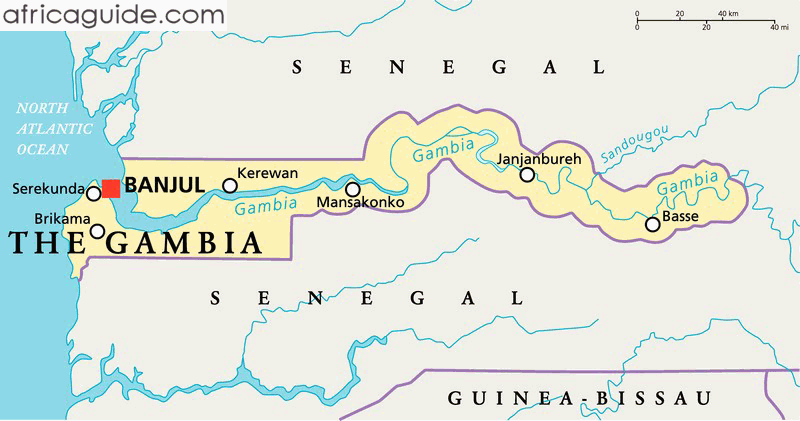
presumed end of “his mandate”. (Sénégal almost envelopes the Gambia land space completely,
as the map above indicates, thanks to those incredulously bizarre conquest
frontier lines darted out by the dual European occupying states France and
Britain in the region in the 19th century.)
Scant credible election
As most people know, what passes for election across
Africa is largely a farce. The murderous (European)conqueror “Berlin-state”
entrenched on the continent does not require an election to function and uphold
its definitive mission and as I have shown more expansively elsewhere (Herbert Ekwe-Ekwe, “Elections in Africa: the elector, the court, the outcome”, PENSAR-Revisita de Ciêcias Jurídicas,
http://www.unifor.br/images/pdfs/Pensar/v18n3_artigo6.pdf , accessed 20 March 2014), Europe’s
lead-occupation powers, particularly Britain and France, have ensured that
stipulated client-nations/nationalities (for instance islamist Hausa-Fulani in a
Nigeria, Arabised African islamists in the Sudan) in the contrived conquest
ensemble on the ground in Africa (Nigeria, Niger, Chad, the Congos, the
Guineas, the Sudan, whatever… ) run the “successor state” almost in perpetuity
– principally to oversee and safeguard extant European World strategic and
socioeconomic expropriated havens. It is in this context that Nigeria, the
archetype of the deathly ensemble in place created by none other than Britain,
the genocidist executioner of 3.1 million Igbo people in the most gruesome
genocide in Africa since Germany’s assault on the Herero and the Nama and the
Berg Damara peoples of southwest Africa in the early 1900s, is tellingly the
grave emergency to the peace and goodwill of contemporary west Africa; definitely
not a Yahya Jammeh.
APART FROM perhaps Sénégal and to a limited extent
Ghana, none other of the 16 countries of ECOWAS has had a credible election as
a “Berlin-state” of Africa. A credible election in a “Berlin-state” is intrinsically
a contradiction in terms. Just Botswana, Mauritius and South Africa,
paradoxically, given its very familiar history, would join Sénégal and Ghana in that league of rare exceptions
in Africa on this score (“Elections in Africa”).
It should be stressed, therefore, that the overwhelming
majority of the heads of regime gathered in the Abuja summit on the Gambia came
to power originally as military putschists or in rigged elections, often aided
by judiciaries they control (“Elections in Africa”). Nigeria regime’s Muhammadu Buhari, a trooper
actively involved in 50 years of the Igbo genocide, was imposed as chief of
state operations in March 2015 by the then British Prime Minister Cameron, born
five months after Buhari first got
involved in his murder of the Igbo in phase-I of the genocide, and US President
Obama, notably the first African-descent president in 233 years of the US republic.
Given particularly the monstrosity of the dehumanisation of African peoples in the United States throughout the course of this epoch, Barack
Obama’s support for the Igbo genocide in Africa, the land of his fathers, is an
incalculable tragedy, a catastrophic legacy. Since Buhari was installed in power, 2000 Igbo have been
murdered by his genocidist military and his two other adjunct forces, Boko
Haram and Fulani militia – two of the world’s five deadliest terrorist
organisations. Neither Obama’s White House nor his state department nor his
embassy in Nigeria has ever condemned any of these murders.
Hands off the Gambia!
Nigeria and ECOWAS must now abandon all plans
to invade the Gambia. They have demonstrated woefully that they are no worthy
arbiters in this dispute. The peoples in the Gambia must be allowed by essentially hostile neighbours,
and the rest of the world, to sort out the problems on the “elections” and
whatever else without threats and intimidations. There isn’t anything
sacrosanct about the 19 January 2017 “end of mandate” date in the Gambia for protagonists to
sit down and negotiate a way out of their differences. These negotiations
shouldn’t have deadlines. The Gambian parties must be encouraged to discuss and
discuss and discuss to resolve this crisis – however long it takes them.
Surely, the world can facilitate these
intra-Gambian talks. The lead arms supplying countries to Africa, especially Britain, the US, Russia, China, the Ukraine and Pakistan should immediately ban all arms
supplies to the Gambia and Nigeria as
well as to the rest of the 14 ECOWAS member states. These regimes and states,
with the obviously negligible manufacturing base of their own, rely heavily on
the world outside for the lethal range of armaments to murder peoples and
devastate communities within and without their frontiers. West Africa is arguably
the continent’s most troubled region and another front of confrontation, this
time in the Gambia, must be stopped.
(New York Art Quartet plays “Mohawk”, a composition by Charlie Parker [personnel: John Tchicai, alto saxophone; Roswell Rudd, trombone; Reggie Workman, bass; Milford Graves, drums; recorded: Nippon Phonogram, New York, US, 16 July 1965])
Herbert Ekwe-Ekwe I HAVE argued variously that without the ferociously pursued British military, diplomatic and political support to its client Nigeria state in southwestcentral Africa, right from the outset, the Igbo genocide, this foundational genocide of post-(European)conquest Africa, would probably not have occurred (see, for instance, Herbert Ekwe-Ekwe, “Rights for Scots, Rights for the Igbo”, http://re-thinkingafrica.blogspot.com.br/2012/01/rights-for-scots-rights-for-igbo.html). Definitely, the Nigerians would not have embarked on the third phase of the genocide, the direct invasion of Biafra, beginning on 6 July 1967, without receiving firm support for the operation from Britain. Colonel Robert Scott, who was a British military advisor on the invasion, later broke ranks with his employer, to acknowledge, gravely, that as the Nigerians unleashed their attacks on Biafran towns and villages, they were the “best defoliant agent known” (Daily Telegraph, London, 11 January 1970). 3 million Igbo people were slaughtered during the course of the 30-month stretch of invasion.
Resilience despite catastrophe Earlier on, 100,000 Igbo had been murdered by the genocidists in waves after waves of meticulously-coordinated savage campaigns across the entire north region of Nigeria as well as in parts of the country’s Yoruba/west, Lagos and midwest regions during phases I and II of the slaughter – 29 May 1966-5 July 1967. Two million Igbo survived and escaped from these killing fields and returned to the east. Such a sudden influx of displaced people was a major task that confronted the Chukwuemeka Odumegwu-Ojukwu government in Enuugwu. The resources of the east had been stretched extensively between 29 May 1966 and December 1966 after it allocated £3 million in emergency funding for the expansion of housing units, office space, schools, and recreation facilities to cope with the returnees. Thanks to the region’s booming economy and the remarkable intervention of its extended-family system in “absorbing” a high proportion of the welfare needs of the returnees, the east was able to avert what was potentially a major humanitarian catastrophe. Unlike the distressful imagery often associated with comparable emergencies in contemporary Africa, there was no outside aid involved in this extraordinarily resourceful and successful resettlement programme – not from the Organisation of African Unity, not from the United Nations, and not least from the Yakubu Gowon military junta in Lagos that had itself coordinated the genocide from the end of July 1966. Biafrans and the rest of Africa must be proud of this thrust of resilience.
IT WAS against this background of the brazen brutalisation of Igbo people by fellow compatriots that the head of neighbouring Ghana’s military administration, General Joseph Ankrah, invited Odumegwu-Ojukwu, Gowon and the rest of the members of Nigeria’s pre-Igbo genocide governing military council to Aburi, Ghana, in January 1967 to discuss the Nigerian débâcle. Just prior to the Aburi invitation (the previous month, December 1966), Odumegwu-Ojukwu had turned down a British-sponsored “conference of mediation” that would involve all the members of the same council on board a British naval frigate anchored off Lagos in which the British would chair. The east governor could not accept the presumption of “neutrality” or “even-handedness” inherent in London’s invitation to host such a summit, considering Britain’s activist role in the Igbo genocide since the weeks and months leading to the outbreak in May 1966, especially its work with the Gowon-Muhammed-Danjuma genocidist cells in the military and the north emirs, as well as with staff and students at the Ahmadu Bello University, the epicentre of the planning and execution of the genocide. Furthermore, Odumegwu-Ojukwu, the historian, could not have ignored the lessons of a similar event in the 19th century. Then, King Jaja of Igwe Nga/Opobo, an Igbo nationalist monarch opposed to British territorial aggression and expansionism along the Atlantic coast of Igboland, was kidnapped by the British navy and exiled to the Caribbean (where he eventually died) after accepting, in good faith, a British offer of “peace talks” on board a British vessel berthed off the Igwe Nga shores.
Extraordinary The Aburi African-led and controlled diplomatic initiative and resultant summit are indeed extraordinary, the likes of which we haven’t seen on the African political scene since. After two days of talks, 4-5 January 1967, the delegates achieved an exceptional degree of agreement, in spite of the genocide of the previous seven months. A brief examination of the key points of the agreement underscores our conclusion. Two areas require comment. First, the resolution that focuses on the renouncement of force and the importation of arms: (1) “renounce the use of force as a means of settling the present crisis in Nigeria” (2) “agree that there should be no more importation of arms and ammunition until normalcy [is] restored”. Second, the provisions that deal with the ruling military council of which Gowon had declared himself “supreme commander” since he seized power (29 July 1966) during the course of the genocide and the reorganisation of the army. Four articles are relevant here: (1) “military is to be governed by the Supreme Military Council” (2) “creation of area command corresponding with the existing region and under the charge of an area commander” (3) “during the period of the military government, military governors will have control over their area commands on matters of internal security” (4) “agree that any decision affecting the whole country must be determined by the Supreme Military Council and where a meeting is not possible such a matter must be referred to military governors for comment and concurrence”.
Jackie McLean Sextet, “Appointment in Ghana” [personnel: McLean, alto saxophone; Blue Mitchell, trumpet; Tina Brooks, tenor saxophone; Kenny Drew, piano; Paul Chambers, bass; Art Taylor, drums; recorded: Van Gelder Studio, Englewood Cliffs, NJ, US, 1 September 1960])
Peer-review: “cleverest”, “compulsive-logic”
IN EFFECT, the Aburi decision to transfer the constitutional responsibility of the Nigeria military from the position of the supreme commander to the supreme military council extensively limited the executive (and legislature) powers of the position of “supreme commander and head of state” which Gowon had exercised since the genocide (these powers were originally contained in General Aguyi-Ironsi’s January 1966 decree no.1 which had made the occupant of that office, and not the SMC, the principal person in charge of decision making in the country). In future, following the Aburi accord, “any decision affecting the whole country must be decided by the Supreme Military Council” (added emphasis) – namely, the eight members that made up the body gathered in Ghana including, pointedly, the military governors of the regions of which Odumegwu-Ojukwu, the only member that had refused to recognise genocidist Gowon in that position, was one.
It is of immense significance that this provision on the new powers of the SMC also states that “where a meeting [of the SMC] is not possible such a matter must be referred to military governors for comment and concurrence” (added emphasis). This referral procedure was aimed evidently at meeting Odumegwu-Ojukwu’s contention, repeatedly stated throughout the meeting, that he would not attend any meetings in Nigeria where the Nigerian military, which had played the central role in the prosecution of the Igbo genocide, was positioned and operating. Odumegwu-Ojukwu had in fact converted the Aburi gathering into a peer-review session, unprecedented in recent African history. Here at Aburi, an African leader bluntly told his colleagues, who only 18 months earlier would have all shared the conviviality of an officers’ mess or one of the other’s residence to wine and dine, that he had no confidence in them and the troops they commanded because they had been involved in the perpetration of a genocide that claimed the lives of 100,000 Africans within seven months. This was indeed an historic rendezvous. It would take another 40 years for the world at large to increasingly begin to lecture African leaders to openly condemn crimes committed by one of their own (Herbert Ekwe-Ekwe, “Nigeria does not deserve UN Security Council”,
Back to Aburi (1967), Odumegwu-Ojukwu had laid bare, for the crucial reckoning of African history, the apposite moral and juridical dilemma surrounding the status of lead-genocidist leader Yakubu Gowon. Odumegwu-Ojukwu had insisted at the talks that Gowon must neither be seen nor aided by his peers to appropriatethe position and the powers invested in Nigeria’s top political and military leadership after his perpetration of the mass murder of tens of thousands of Igbo people and the murder of General Aguyi-Ironsi, the commander-in-chief, under whom Gowon served as chief of army staff. Odumegwu-Ojukwu’s reply to a question about Gowon’s status, posed by Mobalaji Johnson (governor of Lagos), was undoubtedly the turning point at Aburi. It led to the challenge and dramatic reconfiguration of Gowon’s acquired position and powers that he had exercised so ruthlessly since 29 July 1966. Astonishingly, this outcome was approved and signed by all the eight principal participants at the meeting, including Gowon himself! – Colonel* Adebayo, west governor; Colonel Ejoor, midwest governor; Colonel Gowon, head of the genocidist forces in control of Lagos/west/north regions; Major Johnson, Lagos governor; Colonel Katsina, north governor; Colonel Odumegwu-Ojukwu, east governor; Mr Salem, head of the police, and Commodore Wey, head of navy.
Following objections that Odumegwu-Ojukwu had earlier made during the proceedings to one of the participants who referred to Gowon as “supreme commander”, Johnson had asked: “Is there a government in Nigeria today? Is there a central government in Nigeria today?” Odumegwu-Ojukwu: “That question is such a simple one that anybody who has been listening to what I have been saying would know that I do not see a central government in Nigeria today. [Following the genocide] Nigeria resolved itself into three areas – Lagos, West and North area; the Mid-West area; and the East area”. ODUMEGWU-OJUKWU was in effect highlighting the territorial reach and distribution of the Gowon-controlled genocidist forces across the country – Lagos/west-north regions where they occupied, and the east and midwest regions, which were still free of their presence. In the light of Aburi, Gowon’s overall control of the Lagos/west/north regions had in fact come under question. With the newly acquired powers of individual governors on the supreme military council at the expense of those hitherto wielded by Gowon, it followed, for instance, that the governors of Lagos, west and north (where the Gowonist forces were entrenched) would in future be expected to exercise greater powers of control in their respective regions than Gowon.
IF AN audio-recorded transcript of the entire deliberations of the Aburi conference did not exist today** as a treasured historic document, it would have been extremely difficult to appreciate Odumegwu-Ojukwu’s phenomenal success in persuading the rest of the participants to accept an extensively decentralised structural solution to Nigeria’s crisis after the devastating first and second phases of genocide, looting, and the displacement of 2 million Igbo people. That Gowon, himself, appended his signature to this Odumegwu-Ojukwu prepared text at a gathering that had, as a result of these developments, clipped his powers so extensively, was not just because the east governor was the “cleverest … the only one who understood the real issues” (quoted in Olusegun Obasanjo, My Command, Ibadan and London: Heinemann, 1980, p. 10), as writer Walter Schwarz has observed, or that the rest of the conferees were “too unserious[ly] minded to meet with [Odumegwu-]Ojukwu’s compulsive logic” (ThisWeek, Lagos, 13 July 1987, p. 23), as Joe Garba, a leading genocidist officer in the Gowonist forces and Nigeria’s foreign minister in the 1970s, has noted. On the contrary, Gowon and each of the other Nigerian leaders at Aburi (Adebayo, Ejoor, Johnson, Katsina, Salem, Wey – all of whom, bar Odumegwu-Ojukwu, had recognised Gowon as “supreme commander and head of state” since end of July 1966) signed this remarkable document because they were each and collectively in awe of the frankness and rectitude of Odumegwu-Ojukwu’s strictures of them for executing such a despicable act of genocide against Igbo people during the course of 1966.
Britain, Yoruba, and them all
OVERNIGHT, the outcome of the Aburi discourses radically altered the contours of the political landscape of Nigeria. The centralising features of Aguyi-Ironsi’s decree no. 34 dispensation of the previous year, since adopted by the Gowon junta despite the irony, had been abandoned. More importantly, though, the powers of the regions vis-à-vis the centre had become more enhanced – much more than at any time in Nigeria’s history, even including the epoch of the feverishly-pursued British occupation’s “regionalisation drive” of the 1950s. Aburi had in effect inaugurated a confederal, extensively decentralised constitutional solution to the Nigerian impasse, to the consternation of the British, who had followed the talks with nervousness, the north, the military, and the central, essentially Yoruba(now)-run bureaucratic establishment in Lagos. Obafemi Awolowo, the Yoruba leader, would later join the opposition to Aburi when offered the princely position of deputy to Gowon’s genocide prosecution-cabinet, effectively regime prime-minister, and head of the powerful finance ministry and “chief theorist” of the genocide campaign.
BRITAIN rejected the Aburi outcome out of hand and began to pressurise Gowon, who for two days during the Ghana conference was out of reach from his British intelligence minders for the first time in almost a year, to renege on it. Britain was therefore pleased when the north and other interest groups in Nigeria joined in the opposition against the accord. Gowon’s ultimate renegation of an accord that he signed, willingly, in Ghana, in the presence of all the other seven members of the Nigerian governing military council, their five secretaries, and General Ankrah, their host, was a reminder, if ever such an evidence was sought, of who, eventually called the shots at the crucial junctures of the course of the Igbo genocide: Britain. Such was the British disappointment of Gowon’s performance in Aburi that they ensured that Gowon would in future no longer be “exposed” to Odumegwu-Ojukwu or any of these Igbo with “compulsive logic”. Subsequently, the often more “coherent” spokespersons who tried to put across some “form of explanation” of the Anglo/Nigerian position on the Igbo genocide, especially in Britain where there was a groundswell popular opposition to the slaughter, were from a hired pool of consultants of ex-British conquest administrators who had served in Nigeria.
SO, the Aburi critics launched a chorus of fierce opposition on the accord, forcing the Gowon junta to renege on the agreement a few days after returning to Nigeria from Ghana. The groups felt that Gowon and the rest of the non-east delegation at Aburi had capitulated to Odumegwu-Ojukwu’s uncompromising censure of his former colleagues’ involvement in the Igbo genocide. As a consequence, notes the critics, Odumegwu-Ojukwu had out-manoeuvred fellow conferees in accepting as de jure the increasingly autonomous political direction which the east had embarked upon in the wake of the genocide, in addition to according this same status to the other regions of Nigeria – a move that further eclipsed Gowon’s powers as “head of state”. But for the east, the implementation of the Aburi agreement was the minimal condition for maintaining further political links with Nigeria: “It was Aburi or a clean break with Nigeria”. In a radio broadcast in Enuugwu in February 1967, Odumegwu-Ojukwu gave notice that the east would begin to implement the Aburi agreement as from the end of March (1967) even if Gowon and the rest of the accord’s signatories did not do so. Gowon responded by threatening to attack the east if it went ahead to implement the agreement. Ironically, Gowon’s threat was itself a clear violation of one of the key articles of the accord, which pronounced unambiguously: “renounce[d] the use of force as a means of settling the Nigerian crisis”. Odumegwu-Ojukwu nonetheless went ahead to implement the Aburi accord after 31 March. This move further enhanced the virtually autonomous position that the east had had in relation to the rest of the country since especially October 1966. For his part, Gowon imposed a total economic blockade of the east. Effectively, this was the prelude to his forces’ invasion, the expansion of the territorial reach of their yearlong genocidal campaign on the Igbo to Igboland, Biafra, itself. Phase-III THIS “final solution” of the “Igbo Question” had become the proffered one sought by the British and their Nigerian genocidist allies since. And they soon unleashed a cataclysmic surge of violence in Biafra in which 3 million Igbo children, women and men or 25 per cent of this nation’s population were murdered by 12 January 1970.
++++++++++++++++++++++
*All military rank references here to the Aburi conference participants are statuses achieved and recognised prior to the outbreak of the Igbo genocide, 29 May 1966.
**There are persistent indications that the east conference staff may have additionally filmed the Aburi meetings and their tape(s) are lodged safely in some archives.
Herbert Ekwe-Ekwe is specialist on the state and on genocide & wars in Africa in the post-1966 epoch – beginning with the Igbo genocide, 29 May 1966-present day, the foundational and most gruesome genocide of post-(European)conquest Africa. 3.1 million Igbo or 25 per cent of this nation’s population were murdered by Nigeria and its allies, principally Britain. Africa and the rest of the world largely stood by and watched as the perpetrators enacted this horror most ruthlessly. The world could have stopped this genocide; the world should have stopped this genocide. This genocide inaugurated Africa’s current age of pestilence. During the period, 12 million additional Africans have been murdered in further genocide in Rwanda (1994), Zaïre/DRCongo (variously, since the late 1990s) and Darfur – west of the Sudan – (since 2004) and in other wars in Africa. African peoples have, presently, no other choice but exit/dismantle the extant genocide-state (the bane of their existence & progress) & construct own nation-centred states that serve their interests. He is author of several books & papers on the subject and his new book is entitled The longest genocide – since 29 May 1966 (2019).