Showing posts with label Hilary Beckles. Show all posts

Friday, 11 August 2017

62nd birthday of Hilary Beckles

(Born 11 August 1955, Bridgetown, Barbados)
DISTINGUISHED historian on African peoples’ enslavement in the Caribbean by Britain/pan-European World and advocate of programmed reparations to African peoples worldwide by the European perpetrators of this crime against humanity; Britain emerges as lead beneficiary of African enslavement across the Americas during this 400 year-epoch, beginning in the 17th century soon after it takes over the statuses of the Iberian states of Spain and Portugal exercised hitherto since the 1490s
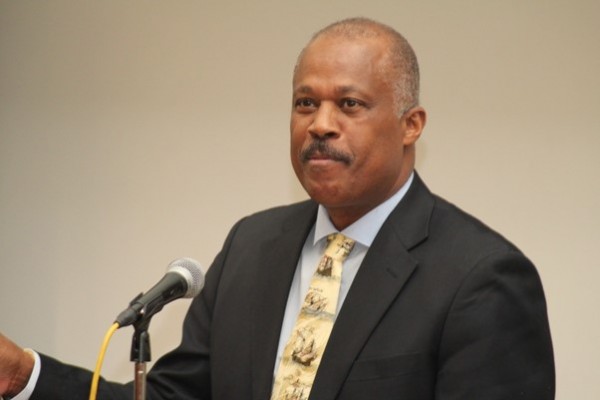
(Professor Beckles delivers his landmark lecture on African reparations from Britain/pan-Europe on the latter’s centuries of the enslavement of African peoples in the Caribbean and elsewhere in the Americas; venue: Methodist Church Hall, Kingstown, St Vincent and the Grenadines, 20 August 2013)
(Peter Tosh: ..“400 years”, 1975)
400 YEARS (400 years, 400 years. Wo-o-o-o)
And it’s the same –
The same (wo-o-o-o) philosophy
I’ve said it’s four hundred years;
(400 years, 400 years. Wo-o-o-o, wo-o-o-o)
Look, how long (wo-o-o-o)
And the people they (wo-o-o-o) still can’t see
Why do they fight against the poor youth of today?
And without these youths, they would be gone –
All gone astray

Come on, let’s make a move:
(make a move, make a move. Wo-o-o-o, wo-o-o-o)
I can (wo-o-o-o) see time (wo-o-o-o) - time has come
And if-a fools don’t see
(fools don’t see, fools don’t see. Wo-o-o-o)
I can’t save the youth:
The youth (wo-o-o-o) is gonna be strong
So, won’t you come with me;
I’ll take you to a land of liberty
Where we can live – live a good, good life
And be free

Look how long: 400 years, (400 years, 400 years) – 
Way too long! (wo-o-o-o)
That’s the reason my people (wo-o-o-o) - my people can’t see
Said, it’s four hundred long years – (400 years, 400 years. Wo-o-o-o)
Give me patience (wo-o-o-o) – same philosophy
It’s been 400 years, (400 years, 400 years)
Wait so long! Wo-o-o-o, wo-o-o-o
How long? 400 long, long years
(lyrics: “400 years”)

Twitter@HerbertEkweEkwe


Thursday, 29 September 2016

1st anniversary of landmark letter from eminent historian Hilary Beckles, chair of Caricom Reparations Committee and vice-chancellor (president) of the University of West Indies, to David Cameron, former British prime minister, on the subject of reparations from Britain for centuries of the latter’s enslavement of African peoples in the Caribbean and elsewhere in the Americas (Jamaica Observer, Kingston, Monday 28 September 2015)

(Hilary Beckles)
Dear Honourable Prime Minister
(David Cameron)
I join with the resolute and resilient people of Jamaica and their Government in extending to you a warm and glorious welcome to our homeland. We recognise you, Prime Minister, given your family’s long and significant relationship to our country, as an internal stakeholder with historically assigned credentials.

To us, therefore, you are more than a prime minister. You are a grandson of the Jamaican soil who has been privileged and enriched by your forebears’ sins of the enslavement of our ancestors.
As we prepare for you a red carpet befitting your formal status we invite you to cast your eyes upon the colours of our national flag that symbolise the history we share. You are, Sir, a prized product of this land and the bonanza benefits reaped by your family and inherited by you continue to bind us together like birds of a feather.

Be assured, Prime Minister, that you will find no more generous people on our planet Earth than those who will greet you with golden hearts and civilised consciousness. I urge that you embrace the sincerity of our salutations. It is born and bred in the cauldron of our enslavement by your family and society.

Consider it a golden gift of friendship and not simply the empty expression of protocols relevant to the events you will attend. It is furthermore, an overture to an expectation of a dialogue of reparatory justice that can redefine for us a new intimacy for this long 21st century on which we are embarked.

Your advisors would have informed you that beyond the boundary of the affairs of State, civil society welcomes you without reservation, though with a qualification that bears the burden of our tortured past within the historically textured present. I speak of outstanding and unresolved matters that are relevant to our sense of mutual respect as equal nations dedicated to the cause of furthering humanity's finest imagined destiny.

I speak, Sir, of the legacies of slavery that continue to derail, undermine and haunt our best efforts at sustainable economic development and the psychological and cultural rehabilitation of our people from the ravishes of the crimes against humanity committed by your British State and its citizens in the form of chattel slavery and native genocide.

In this regard, I urge you to be aware that the issue of reparatory justice for these crimes is now before our respective nations, and the wider world. It is not an issue that can be further ignored, remain under the rug, or placed on back burners, as your minister who recently visited us so aptly described your agenda for Jamaica and the Caribbean.

It will generate the greatest global political movement of our time unless respected and resolved by you, the leader of the State that extracted more wealth from our enslavement than any other.

The Jamaican economy, more than any other, at a critical moment in your nation's economic development, fuelled its sustainable growth. Britain, as a result, became great and Jamaica has remained the poorer. Jamaica now calls upon Britain to reciprocate, not in the context of crime and compulsion, but in friendly, mutually respected dialogue.

It is an offer of opportunity written not in the blood of our enslaved ancestors, but in the imagination of their offspring and progeny who have survived the holocaust and are looking to the future for salvation.

As a man, a humane man, with responsibility for the humanity of your nation, we call upon you to rise to this moment as you realise and internalise that without the wealth made by your enslaving ancestors, right here in our Jamaica, we would not be enchained together, today, called upon to treat with this shared past.

Successive governments in this land, a place still groaning under the weight of this injustice, have done well during the 53 years of sovereignty, but the burden of the inherited mess from slavery and colonialism has overwhelmed many of our best efforts. You owe it to us as you return here to communicate a commitment to reparatory justice that will enable your nation to play its part in cleaning up this monumental mess of Empire.

We ask not for handouts or any such acts of indecent submission. We merely ask that you acknowledge responsibility for your share of this situation and move to contribute in a joint programme of rehabilitation and renewal. The continuing suffering of our people, Sir, is as much your nation's duty to alleviate as it is ours to resolve in steadfast acts of self-responsibility.

In the four corners of Kingston there are already whispers that your strategy will be to seek a way to weaken Jamaica's commitment to Caribbean reparations in a singular act of gift-granting designed to divide and rule and to subvert the regional discourse and movement.

You, Sir, are a Briton, not a Greek, and we have no reason therefore to fear what you bear. But we do ask that you recall the Caribbean region was once your nation’s unified field for taxation, theatre for warfare, and space for the implementation of trade law and policy. Seeing the region as one is therefore in your diplomatic DNA, and this we urge that you remember.

Finally, Sir, I write from the perspective of an academic bred in Britain and reared in the University of the West Indies, an institution your nation planted in Kingston in 1948 with a small but significant grant. It would honour us to show you what we the people have reaped from this single seed.

We have created a flourishing federal farm that now cultivates the minds of millions, a symbol of our collective determination to take seriously our self-responsibility and to place our dignity as an emerging nation before any other consideration. From this singular seed we have grown one of the finest universities in the world crafted by our hands and inspired by our dreams.

This story, Sir, can guide your reflection as to who we are and what we expect of you. We urge you then, in this light, to indicate your nation's willingness to work towards a reparatory justice programme for the Caribbean, with a view to allowing us to come together in order to come to closure, put this terrible past behind us, and to leave it to us to continue the making of our future.

Kindest regards

Hilary Beckles
Chairman, Caricom Reparations Commission
+++++++++++++++++++++++++++++++++++++++++++
(Professor Hilary Beckles delivers his milestone lecture on African reparations from Britain/pan-Europe on the latter’s centuries of the enslavement of African peoples in the Caribbean and elsewhere in the Americas; venue: Methodist Church Hall, Kingstown, St Vincent and the Grenadines, 20 August 2013)
 Twitter @HerbertEkweEkwe

Thursday, 11 August 2016

61st birthday of Hilary Beckles

(Born 11 August 1955, Bridgetown, Barbados)
Distinguished historian on African enslavement in the Caribbean by Britain/pan-European World, freedom and reparations, university vice-chancellor (president)
(Professor Beckles delivers his landmark lecture on African reparations from Britain/pan-Europe on the latter’s centuries of the enslavement of African peoples in the Caribbean and elsewhere in the Americas; venue: Methodist Church Hall, Kingstown, St Vincent and the Grenadines, 20 August 2013)
 Twitter @HerbertEkweEkwe

Thursday, 15 October 2015

FWD: PJ Patterson, former Jamaican prime minister, writes David Cameron, British prime minister, on reparations from Britain for the enslavement of African peoples in the Caribbean (Pambazuka News: Pan-African Voices for Freedom and Justice, Issue 746, Monday 12 October 2015/openDemocracy, London, Wednesday 14 October 2015)

(PJ Patterson)
 Dear Prime Minister Cameron
(David Cameron)
We who belong to the Commonwealth Parliamentary Association and cherish the value of the Westminster tradition should seek continually to foster rather than diminish it.

Given the honour which you were afforded to address the Joint Sitting of Jamaica’s Parliament on Tuesday, September 30, 2015, the traditional Parliamentary right of debate and reply could not be exercised by any of our Members who were in attendance. As I watched your presentation, knowing them on both sides of the aisle as I do, their good behaviour which you commended ought not to be interpreted as acquiescence in everything you said.

The gifts you presented in Gordon House were both welcome and timely. Only the shrewdest observers of Parliamentary custom would have noticed that the package you offered there discreetly omitted any mention of a ₤25 million contribution for the building of a prison.

That was understandable, as what exists constitutes no more than a Non-binding Memorandum of Understanding. You rightfully appreciated that its inclusion would have been premature as the framework Agreement has to be followed by further intensive negotiations and then the requisite legislation.

You wisely chose instead to add there the announcement of ₤30 million to make our hospitals more resilient to natural disasters. Given our vulnerability and the danger of climate change, this donation was highly appreciated.

Despite your recognition of not being “the only show in town”, the words of strengthening the bonds of friendship and the down-payment you brought would have been well received throughout the entire Caribbean.

Prime Minister, the most noble intentions were jarred by those portions of your address which asserted that slavery was a long time ago, in the historical past and “as friends we can move on together to build for the future.”

Your host, The Most Hon. Portia Simpson-Miller, in her gracious welcome referred to the difficult issue of reparation which should be discussed in “a spirit of mutual respect, openness and understanding as we seek to actively engage the U.K. on the matter.” 

You chose instead to throw down the gauntlet.


Mere acknowledgement of its horror will not suffice. It was and still is a most heinous crime against humanity—a stain which cannot be removed merely by the passage of time.

Those who perished in the Middle Passage and the fatal victims on the sugar plantations were victims of genocide. This is a crime in accordance with International Law.

It was and still is a most heinous crime against humanity — a stain which cannot be removed merely by the passage of time.
The attempt to trivialise and diminish the significance of 300 years of British enslavement of Africans and the trade in their bodies reflect the continued ethnic targeting of our ancestors and their progeny for discriminatory treatment in both the annals of history and in the present. 

The 180 years of slavery in Jamaica remain fresh in living memory. There are people alive in Jamaica today whose great grandparents were a part of the slavery system and the memory of slavery still lingers in these households and communities.

Those 180 years were followed by another 100 years of imposed racial apartheid in which these families were racially oppressed by British armies and colonial machinery. The scars of this oppression are still alive in the minds and hearts of million Jamaicans.

To speak of slavery as something from the Middle Ages is insufficient. For our communities its legacies are still present in their memory and emotions. To reject this living experience is to repudiate the very meaning and existence of these people’s lives.


How can we simply forget it and move on to the future? If there is no explicit admission of guilt now, when will be the proper time?

You argue that Britain abolished the slave system and the credit for this resonates in the British Parliament today and shows British compassion and diplomacy.

Where is the prior confession that Britain fashioned, legalised, perpetuated and prospered from the slave trade? 

Indeed, the facts speak to a different explanation. In Jamaica the enslaved led by Sam Sharpe tried to abolish slavery themselves three years before your Parliament acted. The British army destroyed these freedom fighters and executed their leaders.

This attempt to destroy the seed of freedom and justice in Jamaica continued for another hundred years. In 1865 the peasants sought to occupy Crown lands in order to survive widespread hunger. The British government sent in the army and massacred those people, executing Paul Bogle, George William Gordon and other Leaders.

Furthermore, the British Act of Emancipation reflected that the enslaved people of Jamaica were not human but property. The 800,000 Africans in the Caribbean and elsewhere were valued at ₤47 million. The government agreed to compensate the slave owners ₤20 million, and passed an Emancipation Act in which the enslaved had to work free for another four to six years in order to work off the ₤27 million promised slave owners. It was they who paid for their eventual freedom.

The enslaved paid more than 50 per cent of the cost of their market value in compensation to slave owners. This is what your Emancipation Act did. The enslaved got nothing by way of compensation. The Act of Emancipation was self serving and was designed to support British national commercial interests alone.

You have refused to apologise. Yet your government has apologised to everyone else for horrid crimes. Are we not worthy of an apology or less deserving?

Mere acknowledgement of the crime is insufficient. The international community and international law call for formal apologies when crimes against humanity are committed. The UN has deemed slave trading and slavery as crimes against humanity. The refusal to apologise is a refusal to take responsibility for the crime. In a law abiding world this is not acceptable.


Recently you urged your own nation to keep the memory of the Jewish experience alive in memorials and education curricula. We urge you to do the same for the black experience which remains before us all. It is precisely because we all want to move on that the reparatory justice movement is alive and growing. We all want to move on, but with justice and equality.

Contrary to your view, the Caribbean people will never emerge completely from the “long, dark shadow” of slavery until there is a full confession of guilt by those who committed this evil atrocity. 

“The resilience and spirit of its people” is no ground to impair the solemnity of a privileged Parliamentary occasion and allow the memory of our ancestors to be offended once again.

The Caribbean people have long been looking to the future. This is what we do in our development visions, but these legacies are like millstones around our necks. We look to reparatory justice as the beginning of shaping a new future. We invite Britain to engage in removing this blot on human civilisation so that together we can create a new and secure future

ONE LOVE

Yours sincerely
P.J. Patterson
Former Prime Minister, Jamaica (1992-2006)
(Anthony DavisMiddle Passage [{“Behind the rock”, “Middle passage”, “Particle W”, “A proposition for life”}, personnel: Davis, composer {all tracks – except “Particle W”, composed by Earl Howard}, piano, electronic tape; recorded: Gramavision, New York, US, 1984])
(see also historian Hilary Beckles’s letter to prime minister Cameron on this subject of British reparation:  
http://re-thinkingafrica.blogspot.co.uk/2015/09/dear-honourable-prime-minister-i-join.html [accessed 14 October 2015]).

Twitter@HerbertEkweEkwe

Tuesday, 29 September 2015

FWD: Historian Hilary Beckles, chair of Caricom Reparations Committee and vice-chancellor (president) of the University of West Indies, writes David Cameron, British prime minister, on reparations from Britain for the centuries of enslavement of African peoples in the Caribbean (Jamaica Observer, Kingston, Monday 28 September 2015)

                                            (Hilary Beckles)
Dear Honourable Prime Minister
(David Cameron)
I join with the resolute and resilient people of Jamaica and their Government in extending to you a warm and glorious welcome to our homeland. We recognise you, Prime Minister, given your family’s long and significant relationship to our country, as an internal stakeholder with historically assigned credentials.

To us, therefore, you are more than a prime minister. You are a grandson of the Jamaican soil who has been privileged and enriched by your forebears’ sins of the enslavement of our ancestors.

As we prepare for you a red carpet befitting your formal status we invite you to cast your eyes upon the colours of our national flag that symbolise the history we share. You are, Sir, a prized product of this land and the bonanza benefits reaped by your family and inherited by you continue to bind us together like birds of a feather.

Be assured, Prime Minister, that you will find no more generous people on our planet Earth than those who will greet you with golden hearts and civilised consciousness. I urge that you embrace the sincerity of our salutations. It is born and bred in the cauldron of our enslavement by your family and society.

Consider it a golden gift of friendship and not simply the empty expression of protocols relevant to the events you will attend. It is furthermore, an overture to an expectation of a dialogue of reparatory justice that can redefine for us a new intimacy for this long 21st century on which we are embarked.

Your advisors would have informed you that beyond the boundary of the affairs of State, civil society welcomes you without reservation, though with a qualification that bears the burden of our tortured past within the historically textured present. I speak of outstanding and unresolved matters that are relevant to our sense of mutual respect as equal nations dedicated to the cause of furthering humanity's finest imagined destiny.

I speak, Sir, of the legacies of slavery that continue to derail, undermine and haunt our best efforts at sustainable economic development and the psychological and cultural rehabilitation of our people from the ravishes of the crimes against humanity committed by your British State and its citizens in the form of chattel slavery and native genocide.

In this regard, I urge you to be aware that the issue of reparatory justice for these crimes is now before our respective nations, and the wider world. It is not an issue that can be further ignored, remain under the rug, or placed on back burners, as your minister who recently visited us so aptly described your agenda for Jamaica and the Caribbean.

It will generate the greatest global political movement of our time unless respected and resolved by you, the leader of the State that extracted more wealth from our enslavement than any other.

The Jamaican economy, more than any other, at a critical moment in your nation's economic development, fuelled its sustainable growth. Britain, as a result, became great and Jamaica has remained the poorer. Jamaica now calls upon Britain to reciprocate, not in the context of crime and compulsion, but in friendly, mutually respected dialogue.

It is an offer of opportunity written not in the blood of our enslaved ancestors, but in the imagination of their offspring and progeny who have survived the holocaust and are looking to the future for salvation.

As a man, a humane man, with responsibility for the humanity of your nation, we call upon you to rise to this moment as you realise and internalise that without the wealth made by your enslaving ancestors, right here in our Jamaica, we would not be enchained together, today, called upon to treat with this shared past.

Successive governments in this land, a place still groaning under the weight of this injustice, have done well during the 53 years of sovereignty, but the burden of the inherited mess from slavery and colonialism has overwhelmed many of our best efforts. You owe it to us as you return here to communicate a commitment to reparatory justice that will enable your nation to play its part in cleaning up this monumental mess of Empire.

We ask not for handouts or any such acts of indecent submission. We merely ask that you acknowledge responsibility for your share of this situation and move to contribute in a joint programme of rehabilitation and renewal. The continuing suffering of our people, Sir, is as much your nation's duty to alleviate as it is ours to resolve in steadfast acts of self-responsibility.

In the four corners of Kingston there are already whispers that your strategy will be to seek a way to weaken Jamaica's commitment to Caribbean reparations in a singular act of gift-granting designed to divide and rule and to subvert the regional discourse and movement.

You, Sir, are a Briton, not a Greek, and we have no reason therefore to fear what you bear. But we do ask that you recall the Caribbean region was once your nation’s unified field for taxation, theatre for warfare, and space for the implementation of trade law and policy. Seeing the region as one is therefore in your diplomatic DNA, and this we urge that you remember.

Finally, Sir, I write from the perspective of an academic bred in Britain and reared in the University of the West Indies, an institution your nation planted in Kingston in 1948 with a small but significant grant. It would honour us to show you what we the people have reaped from this single seed.

We have created a flourishing federal farm that now cultivates the minds of millions, a symbol of our collective determination to take seriously our self-responsibility and to place our dignity as an emerging nation before any other consideration. From this singular seed we have grown one of the finest universities in the world crafted by our hands and inspired by our dreams.

This story, Sir, can guide your reflection as to who we are and what we expect of you. We urge you then, in this light, to indicate your nation's willingness to work towards a reparatory justice programme for the Caribbean, with a view to allowing us to come together in order to come to closure, put this terrible past behind us, and to leave it to us to continue the making of our future.

Kindest regards

Hilary Beckles
Chairman, Caricom Reparations Commission

Twitter @HerbertEkweEkwe

FWD: Jamaica calls on Britain to pay billions of pounds reparations for the enslavement of African peoples (The Guardian, London, Tuesday 29 September 2015)

David Cameron is facing calls for Britain to pay billions of pounds in reparations for slavery ahead of his first official visit to Jamaica on Tuesday.

Downing Street said the prime minister does not believe reparations or apologies for slavery are the right approach, but the issue is set to overshadow his trade trip to the island, where he will address the Jamaican parliament.

Ahead of his trip, Sir Hilary Beckles, chair of the Caricom Reparations Commission, has led calls for Cameron to start talks on making amends for slavery and referenced the prime minister’s ancestral links to the trade in the 1700s through his cousin six times removed, General Sir James Duff.

In an open letter in the Jamaica Observer, the academic wrote: “You are a grandson of the Jamaican soil who has been privileged and enriched by your forebears’ sins of the enslavement of our ancestors ... You are, Sir, a prized product of this land and the bonanza benefits reaped by your family and inherited by you continue to bind us together like birds of a feather.

“We ask not for handouts or any such acts of indecent submission. We merely ask that you acknowledge responsibility for your share of this situation and move to contribute in a joint programme of rehabilitation and renewal. The continuing suffering of our people, Sir, is as much your nation’s duty to alleviate as it is ours to resolve in steadfast acts of self-responsibility.”

Professor Verene Shepherd, chair of the National Commission on Reparation, told the Jamaica Gleaner that nothing short of an unambiguous apology from Cameron would do, while a Jamaican MP, Mike Henry, called on fellow parliamentarians to turn their back on Cameron if reparations are not on the agenda, noting that the Jamaican parliament has approved a motion for the country to seek reparation from Britain.

“If it is not on the agenda, I will not attend any functions involving the visiting prime minister, and I will cry shame on those who do, considering that there was not a dissenting voice in the debate in parliament,” he told the newspaper.

Jamaica’s prime minister Portia Simpson Miller called for non-confrontational discussions at the UN in 2013, but Britain has never accepted the case for any compensation payments.

A Number 10 official said: “This is a longstanding concern of theirs and there is a longstanding UK position, true of successive governments in the UK, that we don’t think reparations are the right approach.

“The PM’s point will be he wants to focus on the future. We are talking about issues that are centuries old and taken under a different government when he was not even born. He wants to look at the future and how can the UK play a part now in stronger growing economies in the Caribbean.”

The official said Cameron’s purpose in visiting Jamaica and Grenada was to reinvigorate their relationship with the UK.

“He looks at that kind of relationship and who the Caribbean see as their major partners and sees them looking to China and Venezuela and thinks Britain should be in there. Britain has long historical ties with these countries,” she said. (End of The Guardian file)
++++++++++++++++++++++++++++++++++++++++++
(Professor Hilary Beckles delivers his landmark lecture on African reparations from Britain/pan-Europe on the latter’s centuries of the enslavement of African peoples in the Caribbean and elsewhere in the Americas; venue: Methodist Church Hall, Kingstown, St Vincent and the Grenadines, 20 August 2013)
 Twitter @HerbertEkweEkwe

Tuesday, 11 August 2015

60th birthday of Hilary Beckles

(Born 11 August 1955, Bridgetown, Barbados)
Distinguished historian on African enslavement in the Caribbean by Britain/pan-European World, freedom and reparations, university vice-chancellor (president)
(Professor Beckles delivers his landmark lecture on African reparations from Britain/pan-Europe on the latter’s centuries of the enslavement of African peoples in the Caribbean and elsewhere in the Americas; venue: Methodist Church Hall, Kingstown, St Vincent and the Grenadines, 20 August 2013)
 Twitter @HerbertEkweEkwe